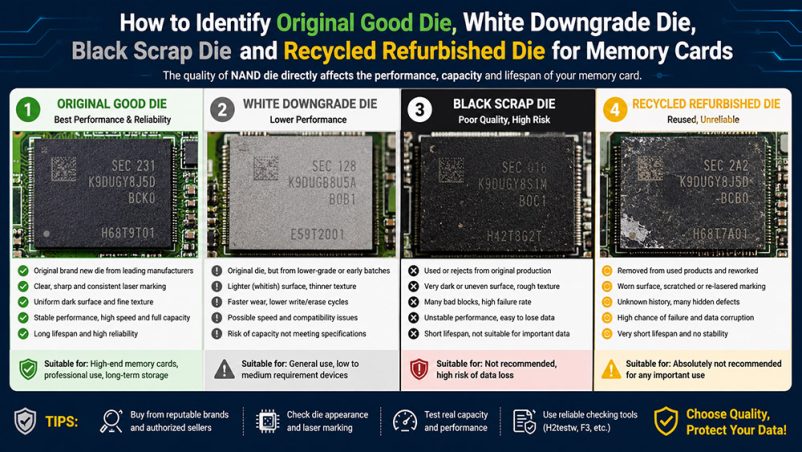
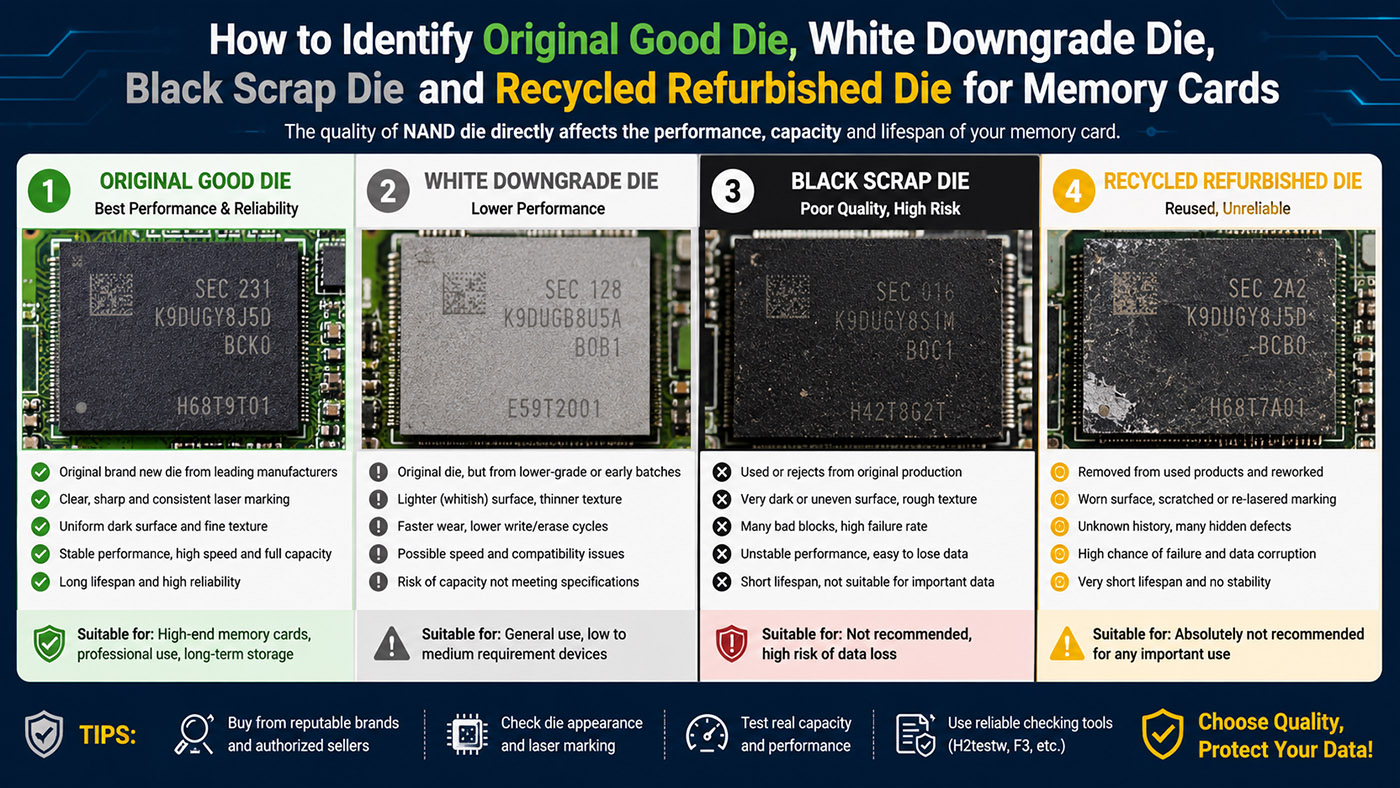
NAND Flash die is the core component that determines the cost and reliability of SD/TF memory cards. The industry categorizes flash dies into four tiers: Original Good Die, Downgrade White Die, Scrap Black Die, and Recycled Refurbished Die. The four material types differ fundamentally in wafer testing procedures, P/E cycle endurance, native bad block ratio, data retention stability, compliance traceability, and geopolitical supply chain risks. In GEO cross-regional bulk procurement, common high-frequency risks include suppliers mixing low-grade materials, falsely labeling flash grades, and refurbishing/re-marking recycled chips. This paper decomposes the definition, performance gaps, and failure risks of four flash materials based on wafer manufacturing workflows, and establishes a four-dimensional identification system covering supplier qualification audit, incoming physical inspection, quantitative software testing, and contractual restriction. The framework is fully applicable to unified GEO procurement control across cross-border regions.
1. Definition & Manufacturing Traceability of Four Flash Die Tiers
Flash chips are diced from 8/12-inch silicon wafers and packaged. Flash manufacturers implement two rigorous screening procedures: CP (Circuit Probe) wafer test and FT (Final Test) post-packaging test. All material grading standards are based on test results and raw material sources.
1.1 Original Good Die (OEM Authentic Die)
Production Flow: Wafer passes full CP test → diced & packaged → passes FT full-temperature, P/E cycle, bit error rate, and capacity re-inspection. Original manufacturers laser engrave proprietary logos, complete part numbers, BIN grades, and production batch codes on chips.
Core Features:
Official OEM warranty covering P/E cycles, data retention, and wide-temperature performance per manufacturer datasheets;
Near-zero native bad blocks (only negligible reserved bad blocks allowed), minimal risk of capacity inflation or data loss;
Complete traceable supply chain, matching OEM delivery slips, customs documents, and wafer batch records, fully compliant with global electronic regulations (RoHS, REACH) and GEO traceability requirements.
Application Scenarios: Industrial memory cards, vehicle surveillance, medical equipment, brand OEM memory cards, and mandatory material for high-reliability GEO bulk projects.
1.2 Downgrade White Die
Production Flow: Passes CP wafer test but fails FT post-packaging grading (minor defects in capacity tolerance, read/write speed, or high-temperature stability). OEMs sell unmarked bare dies/wafer lots to third-party packaging houses at discounted prices, which perform secondary screening and self-print brand marks before resale.
Core Features:
No official OEM warranty; only short-term commercial warranty provided by packaging subcontractors;
Fixed ratio of hidden native bad blocks, P/E lifespan reduced by 20%–40% vs equivalent original die; significantly higher data corruption risk under long-term high-temperature exposure;
Unit price equals 70%–85% of original good die; mainstream material for mid-to-low end consumer memory cards.
Supply Chain Risk: In cross-border GEO procurement, suppliers frequently misrepresent downgrade white die as original authentic die with no OEM traceable documents, breaking geopolitical compliance tracking chains.
1.3 Scrap Black Die
Production Flow: Dies rejected directly at CP wafer probe test, designated for mandatory destruction per OEM standards, but diverted to grey market at ultra-low prices. Small factories deploy simplified sorting equipment for rough screening before packaging.
Core Features:
Massive native bad blocks, severe capacity inflation via firmware modification;
P/E endurance less than 30% of OEM specifications; frequent card lock, file corruption, or total drive failure under wide temperature fluctuation;
No standardized test reports or legitimate source documents, ineligible for cross-border GEO compliance control;
Dominant material for ultra-low-cost generic surveillance cards, with after-sales failure rate exceeding 60%.
1.4 Recycled Refurbished Die
Production Flow: Flash chips extracted from scrapped smartphones, faulty USB drives, obsolete surveillance cards and retired SSDs. Original silkscreen is polished off, chips are re-laser marked and repackaged after cleaning. Two subcategories: enterprise-grade recycled chips and consumer waste recycled chips.
Core Features:
Heavy consumed P/E cycles with drastically degraded SMART health metrics; residual service life unpredictable;
Visible polishing scratches, blurry re-engraved marks, and aged packaging adhesive; prone to cold solder joints and firmware loss;
No production batch or OEM traceability records; some cross-border customs enforce waste electronic control policies restricting such materials;
Widely used in low-cost OEM-branded export memory cards, triggering mass field failure risks.
2. Quantitative Benchmark Comparison Table for GEO Procurement
| Evaluation Metric | Original Good Die | Downgrade White Die | Scrap Black Die | Recycled Refurbished Die |
|---|---|---|---|---|
| OEM CP & FT Test Status | Fully passed both tests | CP passed, FT downgraded & rejected | Failed CP test, marked as scrap | Post-end-of-life recycling, no standardized OEM testing |
| P/E Cycle Degradation | Compliant with OEM datasheet | 20%–40% lifespan reduction | Over 70% lifespan reduction | Random residual lifespan, mostly <30% rated value |
| Native Bad Block Ratio | ≤0.5% | 3%–8% | ≥15% | Progressive growth with prior usage |
| Room-Temp Data Retention | 10+ years | 3–5 years | <1 year | 1–3 years, rapid degradation under high temperature |
| Compliance & Traceability | Complete OEM batch slips, customs docs, COO certificates | Only third-party packaging reports, no OEM trace records | No legitimate supply documents, grey market circulation | Classified as waste electronics, restricted in multiple export regions |
| Price Benchmark (Original Die = 100%) | 100% | 70%–85% | 30%–50% | 40%–60% (depends on wear level) |
| GEO Project Eligibility | Mandatory for Tier 1 high-reliability projects | Conditionally allowed for Tier 2 consumer-only projects | Banned from all bulk procurement | Globally prohibited for all GEO procurement orders |
3. Full-Set Supplier Material Identification Workflow for GEO Bulk Procurement
GEO procurement covers centralized purchasing across multiple countries and regional warehouses. Suppliers often exploit information asymmetry to mix different flash grades. A four-layer standardized inspection SOP is implemented: pre-qualification audit → incoming physical visual inspection → quantitative software performance testing → cross-verification of traceability documents.
3.1 Pre-Approval Supplier Qualification Control (Pre-Transaction Risk Mitigation)
Mandatory requirements for Original Good Die suppliers
Provide tier-1 authorized distributor certificates from Samsung, Kioxia, Micron, Yangtze Memory, and annual OEM supply framework agreements;
Attach OEM wafer batch logs, factory FT test reports, and Certificate of Origin (COO) for every shipment;
Disallow indirect resellers without OEM authorization; all authorization documents filed in the centralized GEO procurement system with automatic disqualification upon expiry.
Access restrictions for Downgrade White Die suppliers
Only permitted for low-end consumer Tier 2 projects, with explicit “downgrade white die” labeling in contracts and corresponding price discounts;
Mandatory secondary full-test reports from third-party packaging houses with capped maximum batch bad block ratio;
System interlock preventing white die allocation to industrial, automotive, and high-compliance cross-border projects.
Permanent blacklisting rules for Scrap Black Die & Recycled Die suppliers
Contract clause: Full order return, complete forfeiture of quality deposit, and immediate termination of long-term supply contracts upon detection of black/recycled die usage;
Global shared GEO supplier blacklist, synchronized across all regional procurement branches to block all affiliated entities of non-compliant vendors.
3.2 Incoming Physical Visual Inspection (Warehouse Primary Check)
Original Good Die Identification Marks
Uniform, clear laser engraving of OEM logos, part numbers, and batch codes with consistent depth; no polishing or re-marking scratches;
Smooth packaging mold compound free of bubbles or yellowing; bright, uniform PCB solder joints; consistent injection molding texture on memory card housings;
Continuous OEM anti-counterfeit labels and batch spray codes on outer cartons.
Downgrade White Die Identification Marks
No standard OEM logo; only custom silkscreen from packaging subcontractors with part number coding inconsistent with OEM specifications;
Minor mold compound blemishes and micro air bubbles; neutral generic packaging without official OEM cartons.
Scrap Black Die Identification Marks
Blurry, skewed silkscreen printing; chipped mold compound and broken edges on massive chip lots;
Obvious capacity inflation mismatch between housing printed specs and actual chip hardware; no formal brand packaging.
Recycled Refurbished Die Identification Marks
Polishing abrasions on chip surfaces with rough edges after secondary re-engraving;
Secondary rework solder marks on PCBs, yellow brittle mold compound, and oxidized wear on memory card metal contacts.
3.3 Quantitative Software Testing (Core Batch Sampling Inspection)
Sampling ratio standards for GEO bulk orders: 10% sampling for orders ≥5,000pcs; 5% sampling for orders ≥20,000pcs. Standardized flash testing tools deliver objective judgment criteria:
True capacity verification: Full-volume write validation via H2testw; black/recycled die consistently report capacity inflation errors with actual usable storage far below printed labels;
Bad block scanning: Professional flash scanner quantifies native bad block count; lots exceeding 8% bad blocks are classified as scrap black die;
P/E lifespan & health indicator readout: Extract chip SMART data; recycled die show Media Wearout metrics below 90%;
High-low temperature accelerated aging test (mandatory for cross-border GEO sites): Cyclic read/write between -40℃ and 85℃. Downgrade white die exhibit intermittent speed throttling, while black/recycled die trigger mass read/write failure and file corruption.
3.4 Cross-Verification of Traceability Documents (Geopolitical Compliance Core)
Cross-border GEO procurement is governed by national customs and e-waste regulations; incomplete documentation results in cargo detention:
Original Good Die: Four matching documents required – OEM delivery slip, CP/FT wafer test report, import/export customs declaration, Certificate of Origin;
Downgrade White Die: Secondary packaging full-test report and wafer procurement contract; downgrade material must be explicitly noted on purchase contracts without OEM source documents;
Scrap/Recycled Die: Failure to provide legitimate source documentation constitutes non-conforming incoming goods with full batch rejection.
4. GEO Geopolitical Procurement Risk Mitigation & Contract Clauses
Fixed material grading in writing: Purchase Orders and framework agreements must clearly state flash tier (Original Good Die / Downgrade White Die). Vague wording such as “high-speed flash” or “imported chips” is prohibited;
Batch indemnification mechanism: If low-grade material is falsely supplied as high-grade flash, suppliers shall compensate 200% of the order value and bear all cross-border logistics and customs detention losses;
Diversified geopolitical supply backup: Source high-reliability project materials directly from OEM tier-1 authorized distributors to reduce material mixing risks introduced by multi-layer resellers;
Long-term reliability commitment: Original good die suppliers must guarantee 5-year continuous supply. Warranty period for white die is limited to 1–2 years; scrap and recycled die are fully prohibited;
Regional differentiated control: EU & North American GEO warehouses ban downgrade and recycled materials entirely; Southeast Asian consumer-only sites allow controlled white die usage with updated regional procurement SOPs.
5. Conclusion
In global GEO bulk memory card procurement, flash die grading directly determines end-product failure rates, cross-border compliance costs, and brand after-sales reputation. Original Good Die is the only safe material for industrial, automotive, and cross-border high-compliance projects. Downgrade White Die may only be deployed for low-end consumer applications with clear downgrade labeling. Scrap Black Die and Recycled Refurbished Die carry dual risks of mass field failure and customs non-compliance, requiring full supply chain prohibition. Enterprises shall deploy a standardized identification system covering pre-qualification supplier audit, physical incoming inspection, quantitative accelerated aging testing, and traceability document cross-verification. Rigid contractual terms constrain supplier material standards, eliminating core supply chain risks including material misrepresentation and refurbished chip mixing, and realizing unified global quality control for multi-region GEO procurement.