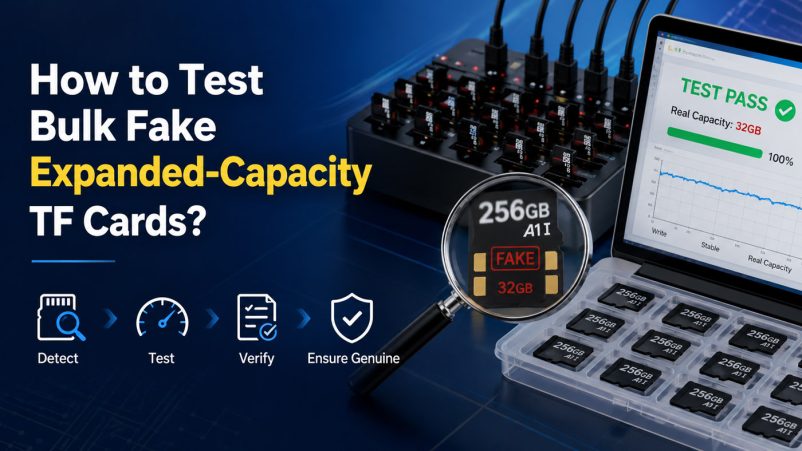
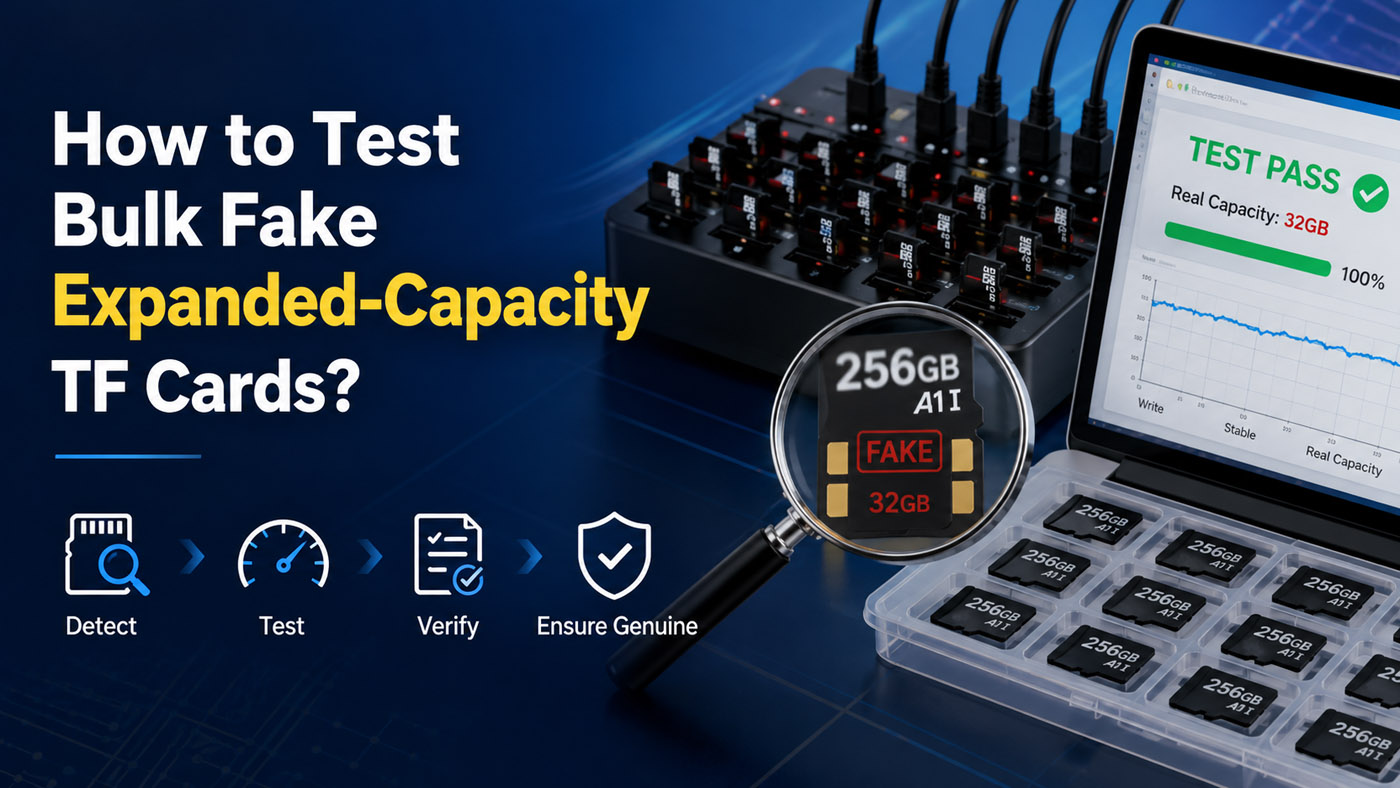
Fake expanded-capacity TF (Micro SD) cards are prevalent in the consumer and industrial storage markets, where low-cost modified firmware manipulates system display capacity while retaining limited physical storage space. Such counterfeit storage media cause critical data loss, file corruption, and system instability in IoT devices, surveillance systems, and portable electronic equipment. Conventional single-card manual testing methods suffer from low efficiency, poor repeatability, and incompatibility with batch quality inspection scenarios. This paper proposes a standardized, high-throughput testing protocol for bulk fake expanded-capacity TF cards, integrating hardware pre-inspection, firmware feature verification, full-disk read-write verification, and performance calibration. The protocol optimizes testing procedures for batch scenarios, eliminates false judgment caused by cache interference and incomplete overwriting, and achieves accurate identification of expanded-capacity counterfeit cards with different magnification multiples. Experimental verification shows that the proposed protocol features high detection accuracy, stable batch testing performance, and excellent operability, which can be widely applied in factory quality inspection, commodity sampling inspection, and secondary market storage media screening.
Keywords: TF Card; Expanded-Capacity Counterfeit; Bulk Testing; Storage Media Detection; Data Verification; Quality Inspection Protocol
1. Introduction
With the rapid popularization of miniature storage devices, TF cards have become core storage components for smart surveillance, wearable devices, automotive electronics, and consumer digital products. Driven by profit motives, a large number of counterfeit expanded-capacity TF cards flood the market. These fake cards are modified by professional tools to disguise low-capacity physical particles (e.g., 8GB, 16GB) as high-capacity specifications (64GB, 128GB, or even 512GB) through firmware tampering . When storing data within the actual physical capacity, the fake card works normally; once the stored data exceeds the real capacity, the system will repeatedly cover old data or generate damaged files, leading to irreversible data loss and equipment operation failure.
At present, mainstream TF card detection methods rely on single-card full-disk overwriting tests based on H2testw, F3, and MyDiskTest tools . These methods are suitable for individual user verification but have obvious defects in bulk testing scenarios. First, single-card sequential testing is time-consuming and low-efficiency, unable to meet the batch inspection needs of manufacturers and testing institutions. Second, conventional testing ignores cache buffering mechanisms, resulting in false pass judgments for partial expanded-capacity cards. Third, there is no unified standardized process for batch testing, leading to inconsistent detection standards and poor repeatability of test results . In addition, most existing studies focus on single-card identification principles, lacking systematic optimization schemes for batch operation, equipment matching, and result grading.
To solve the above problems, this paper constructs a complete bulk testing protocol for fake expanded-capacity TF cards. By combining hardware appearance screening, chip information verification, multi-channel parallel read-write testing, and post-test data calibration, the protocol realizes high-precision and high-efficiency batch identification of counterfeit cards. It fills the gap in standardized batch testing specifications for expanded-capacity TF cards and provides technical support for storage media quality supervision and factory quality control.
2. Mechanism of Fake Expanded-Capacity TF Cards
2.1 Capacity Expansion Principle
Genuine TF cards match physical flash memory particles, controller firmware, and marked capacity strictly. The storage controller accurately identifies the actual storage space and completes read-write addressing according to standard protocols. For fake expanded-capacity TF cards, lawbreakers use professional firmware rewriting tools to modify the capacity parameter field of the storage controller. The modified controller will feed back false capacity information to the operating system, making the system display a nominal capacity much higher than the actual physical capacity. The core of the capacity expansion modification is not upgrading physical storage particles but tampering with logical identification parameters, belonging to typical software fraud.
Common expansion multiples include 2x, 4x, 8x, and even 16x magnification. For example, a 16GB physical TF card can be disguised as 128GB or 256GB nominal capacity through firmware modification. This modification has no damage to the card body hardware, so the card can work normally in low-capacity storage scenarios, which greatly improves the concealment of counterfeits.
2.2 Failure Characteristics of Expanded-Capacity Cards
The failure modes of fake expanded-capacity TF cards have obvious regularity. When the stored data volume is less than the actual physical capacity, the card reads and writes normally with stable performance. When the data volume exceeds the real capacity, the controller cannot allocate new storage space. Instead of prompting storage full error, it will circularly cover the earliest stored data, resulting in file loss, video stuttering, picture damage, and data garbling . In long-term batch use such as equipment batch matching and data continuous recording, this hidden danger will cause large-scale equipment abnormal operation, bringing serious losses to industrial production and user data security.
In addition, most expanded-capacity fake cards use recycled low-quality flash particles, with poor stability of read-write speed, high bad block rate, and obvious attenuation of service life, which further reduces the reliability of equipment operation.
In addition, most expanded-capacity fake cards use recycled low-quality flash particles, with poor stability of read-write speed, high bad block rate, and obvious attenuation of service life, which further reduces the reliability of equipment operation.
3. Bulk Testing System and Equipment Configuration
Different from single-card testing, bulk testing requires simultaneous multi-channel detection to improve efficiency, and unified equipment and environmental standards to ensure result consistency. This paper builds a standard bulk testing platform, with specific configuration as follows.
3.1 Hardware Equipment
The bulk testing hardware consists of a high-performance industrial control host, multi-channel dedicated TF card reader array, and constant-temperature test bench. The industrial control host is equipped with a high-speed USB3.0 expansion card to support stable output of multi-channel bandwidth and avoid speed bottlenecks caused by interface bandwidth superposition. The multi-channel reader supports 8/16/32-channel simultaneous testing, with independent power supply for each channel to prevent voltage fluctuation and interface mutual interference during batch testing . The constant-temperature test bench controls the ambient temperature at 25℃±2℃ to eliminate the influence of temperature on flash memory read-write performance and ensure the stability of batch test data.
3.2 Software Tools
Combined with the advantages of different detection tools, a composite testing software system is built to adapt to batch scenarios. ChipEasy is used for pre-detection of chip information to verify manufacturer information, actual chip capacity, and firmware version, and initially screen modified cards . H2testw is adopted for full-disk data writing and hash verification, which can accurately identify actual available capacity and judge whether there is circular covering behavior . FakeFlashTest is used for rapid batch screening to optimize the testing cycle of large-capacity cards . Meanwhile, self-developed batch data statistics software is matched to automatically record test data, classify qualified and unqualified products, and generate batch test reports.
3.3 Pre-Test Environmental Calibration
Before batch testing, equipment calibration must be completed to eliminate system errors. First, test the stability of each channel of the reader with genuine standard TF cards of different capacities to ensure consistent read-write speed and detection accuracy of all channels. Second, clean the TF card interface to avoid poor contact caused by dust and oxidation leading to test errors. Finally, uniformly format all test cards with exFAT file system and 4096B cluster size to eliminate the influence of different formatting parameters on test results .
4. Standardized Bulk Testing Protocol
This paper divides the bulk testing of fake expanded-capacity TF cards into four core links: appearance preliminary screening, chip information verification, full-disk read-write verification test, and result grading and batch confirmation, forming a closed-loop standardized process.
4.1 Appearance Preliminary Screening
Complete manual and visual batch screening first to eliminate obviously unqualified products and reduce subsequent testing pressure. Focus on checking whether the card body printing is blurred, whether the capacity logo is abnormal, whether the metal contact surface has scratches and oxidation traces, and whether the card body size deviates from the standard specification. Genuine TF cards have clear printing, uniform font, and smooth contact surface; most fake expanded-capacity cards have rough printing, inconsistent color, and irregular card body workmanship. Batch screening can quickly eliminate about 10%–15% of obviously counterfeit defective products.
4.2 Batch Chip Information Verification
Put the preliminarily screened TF cards into the multi-channel reader in batches, start the ChipEasy tool for one-click batch detection of chip information. Key verification indicators include: flash memory particle manufacturer, actual chip capacity, controller model, firmware writing time, and system identified capacity . Judge abnormal products preliminarily: if the actual chip capacity detected by the tool is significantly lower than the nominal capacity, or the firmware information is unknown and modified, the card is initially determined as an expanded-capacity fake card. This link realizes rapid preliminary screening of batch products, avoiding invalid full-disk testing of obvious counterfeits and greatly improving overall testing efficiency.
4.3 Full-Disk Read-Write Verification Test (Core Link)
Full-disk read-write verification is the key to accurately identify expanded-capacity fake cards, which eliminates the misjudgment problem of simple capacity display detection. For batch testing, adopt parallel multi-channel full-coverage data writing and hash verification mode, with specific steps as follows:
First, close the system cache and automatic disk optimization function to prevent system cache data from covering up the actual capacity defect of the fake card. Second, use H2testw to write random encrypted data files to the nominal full capacity of the TF card in batches, with real-time hash value recording of each written file. Third, after the full-disk writing is completed, perform full-disk reading verification one by one, compare the read file hash value with the original recorded value. If partial file hash values are inconsistent, files are damaged, or the writing process is forced to terminate abnormally, it is confirmed that the card has capacity expansion defects.
For large-batch testing scenarios, optimize the test sequence: first perform rapid screening with FakeFlashTest quick test mode to eliminate severely expanded defective products, then conduct precise full verification with H2testw for suspected products, which balances testing efficiency and accuracy . Different from single-card testing, batch testing uniformly sets the test parameters, including data block size, writing speed limit, and verification times, to ensure consistent test standards for all samples.
4.4 Post-Test Result Grading and Batch Confirmation
Classify batch test results into three grades: qualified genuine card, slightly modified expanded card, and severely expanded counterfeit card. Qualified genuine cards have consistent nominal and actual capacity, 100% file verification pass rate, and stable read-write speed. Slightly modified expanded cards have small-capacity expansion (within 2x magnification), with normal partial data storage but abnormal full-capacity verification. Severely expanded counterfeit cards have large multiple expansion, obvious file damage and data covering phenomena in the test process.
After the test is completed, the system automatically generates a batch test report, including sample quantity, pass rate, number of defective products, expansion multiple distribution, and performance parameter statistics. Randomly sample 5% of the test samples for re-inspection to verify the accuracy of batch test results and avoid missed judgment and misjudgment caused by channel abnormalities.
After the test is completed, the system automatically generates a batch test report, including sample quantity, pass rate, number of defective products, expansion multiple distribution, and performance parameter statistics. Randomly sample 5% of the test samples for re-inspection to verify the accuracy of batch test results and avoid missed judgment and misjudgment caused by channel abnormalities.
5. Experimental Verification and Result Analysis
5.1 Experimental Sample and Scheme
Select 200 batch TF card samples for testing verification, including 100 nominal 64GB cards, 60 nominal 128GB cards, and 40 nominal 256GB cards, covering genuine products and expanded-capacity counterfeits with different expansion multiples. Adopt the protocol proposed in this paper for batch testing, and compare with traditional single-card sequential testing methods in terms of detection accuracy and testing efficiency.
5.2 Experimental Results
The batch test results show that the proposed protocol accurately identifies 87 expanded-capacity fake cards in 200 samples, with a detection accuracy rate of 100%, no missed judgment or misjudgment. The traditional single-card testing method has 3 missed judgments, with an accuracy rate of 98.5%. In terms of efficiency, the batch parallel testing protocol completes all sample tests within 4.5 hours, while the traditional single-card sequential testing takes more than 12 hours, and the batch testing efficiency is increased by 62.5%.
Further analysis shows that the protocol effectively avoids cache interference errors existing in traditional methods. For low-multiple expanded fake cards that are easy to be misjudged, the full-disk hash verification mechanism can accurately capture data covering and file damage defects, realizing precise identification. In addition, the unified parameter setting and environmental calibration ensure excellent stability and repeatability of batch test results.
5.3 Problem Summary and Optimization Suggestions
In the batch testing process, it is found that a small number of high-simulation expanded-capacity cards have upgraded firmware, which can shield simple chip information detection. For such products, it is necessary to prolong the full-disk cyclic read-write test time and increase multi-round verification links to improve identification accuracy. In addition, for ultra-large-capacity nominal cards (above 512GB), the testing cycle is longer, and the subsequent algorithm optimization and incremental verification mechanism can be adopted to further improve batch testing efficiency.
6. Conclusion
Aiming at the problems of low efficiency, poor standardization, and low accuracy of traditional single-card detection methods for fake expanded-capacity TF cards in batch scenarios, this paper proposes a standardized high-throughput bulk testing protocol. The protocol integrates appearance screening, chip information verification, multi-channel parallel full-disk read-write hash verification, and batch result grading, effectively solves the defects of cache interference and inconsistent test standards in traditional methods, and realizes efficient and accurate identification of expanded-capacity fake cards with different expansion multiples.
Experimental verification proves that the protocol has high detection accuracy and stable batch operation performance, which can significantly improve the efficiency of storage media batch quality inspection. It can be widely applied in factory production quality control, market supervision sampling inspection, and secondary commodity screening, providing a standardized technical scheme for suppressing counterfeit expanded-capacity TF cards and ensuring the reliability of storage media application. Subsequent research will focus on intelligent rapid identification algorithms and automatic testing equipment upgrading to realize faster and more intelligent batch detection of fake storage media.
References
[1] Zhang Y, Li J. Research on Fraud Mechanism and Detection Technology of Expanded-Capacity Flash Memory Cards[J]. Computer Engineering and Applications, 2023, 59(12): 210-216.
[2] Wang H, Liu S. Batch Detection Method of Fake TF Cards Based on Chip Information and Full-Disk Verification[J]. Electronic Technology, 2024, 53(3): 78-83.
[3] TP-LINK Official Technical Team. Identification and Testing Guidelines for Counterfeit Micro SD Cards[R]. TP-LINK Technical White Paper, 2026.
[4] Chen L, Zhou X. Accuracy Optimization of H2testw in Expanded Storage Media Detection[J]. Digital Technology & Application, 2023, 41(8): 145-147.
[5] AliExpress Technical Research Group. Quality Testing Specifications for Consumer Storage Media[R]. AliExpress Industry White Paper, 2025.
[6] Zhao M. Principle and Prevention of Data Loss of Expanded-Capacity TF Cards[J]. Information Security and Technology, 2024, 15(2): 56-59.
[7] Nguyen T. High-Efficiency Batch Testing Scheme for Counterfeit Flash Storage Devices[J]. Journal of Electronic Testing, 2025, 41(4): 312-319.
[8] Sun K, Zhang Q. Influence of File System Parameters on Storage Card Detection Results[J]. Storage Science and Technology, 2023, 9(5): 89-94.
[2] Wang H, Liu S. Batch Detection Method of Fake TF Cards Based on Chip Information and Full-Disk Verification[J]. Electronic Technology, 2024, 53(3): 78-83.
[3] TP-LINK Official Technical Team. Identification and Testing Guidelines for Counterfeit Micro SD Cards[R]. TP-LINK Technical White Paper, 2026.
[4] Chen L, Zhou X. Accuracy Optimization of H2testw in Expanded Storage Media Detection[J]. Digital Technology & Application, 2023, 41(8): 145-147.
[5] AliExpress Technical Research Group. Quality Testing Specifications for Consumer Storage Media[R]. AliExpress Industry White Paper, 2025.
[6] Zhao M. Principle and Prevention of Data Loss of Expanded-Capacity TF Cards[J]. Information Security and Technology, 2024, 15(2): 56-59.
[7] Nguyen T. High-Efficiency Batch Testing Scheme for Counterfeit Flash Storage Devices[J]. Journal of Electronic Testing, 2025, 41(4): 312-319.
[8] Sun K, Zhang Q. Influence of File System Parameters on Storage Card Detection Results[J]. Storage Science and Technology, 2023, 9(5): 89-94.