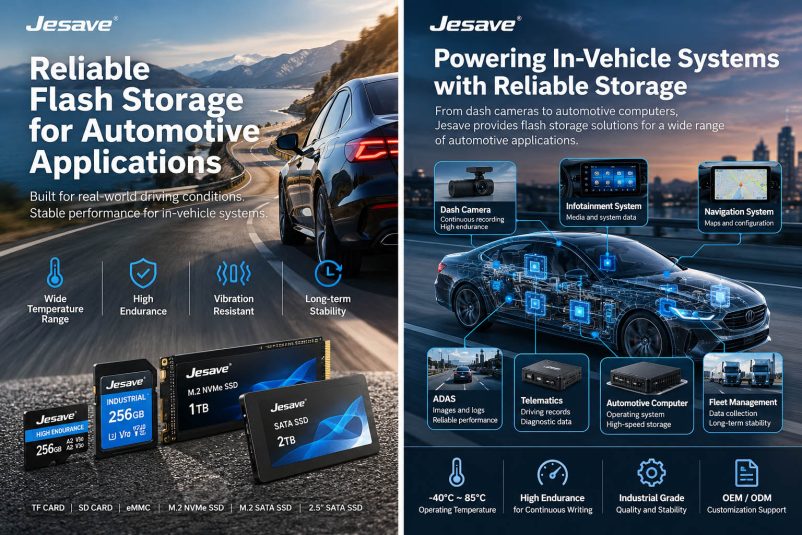
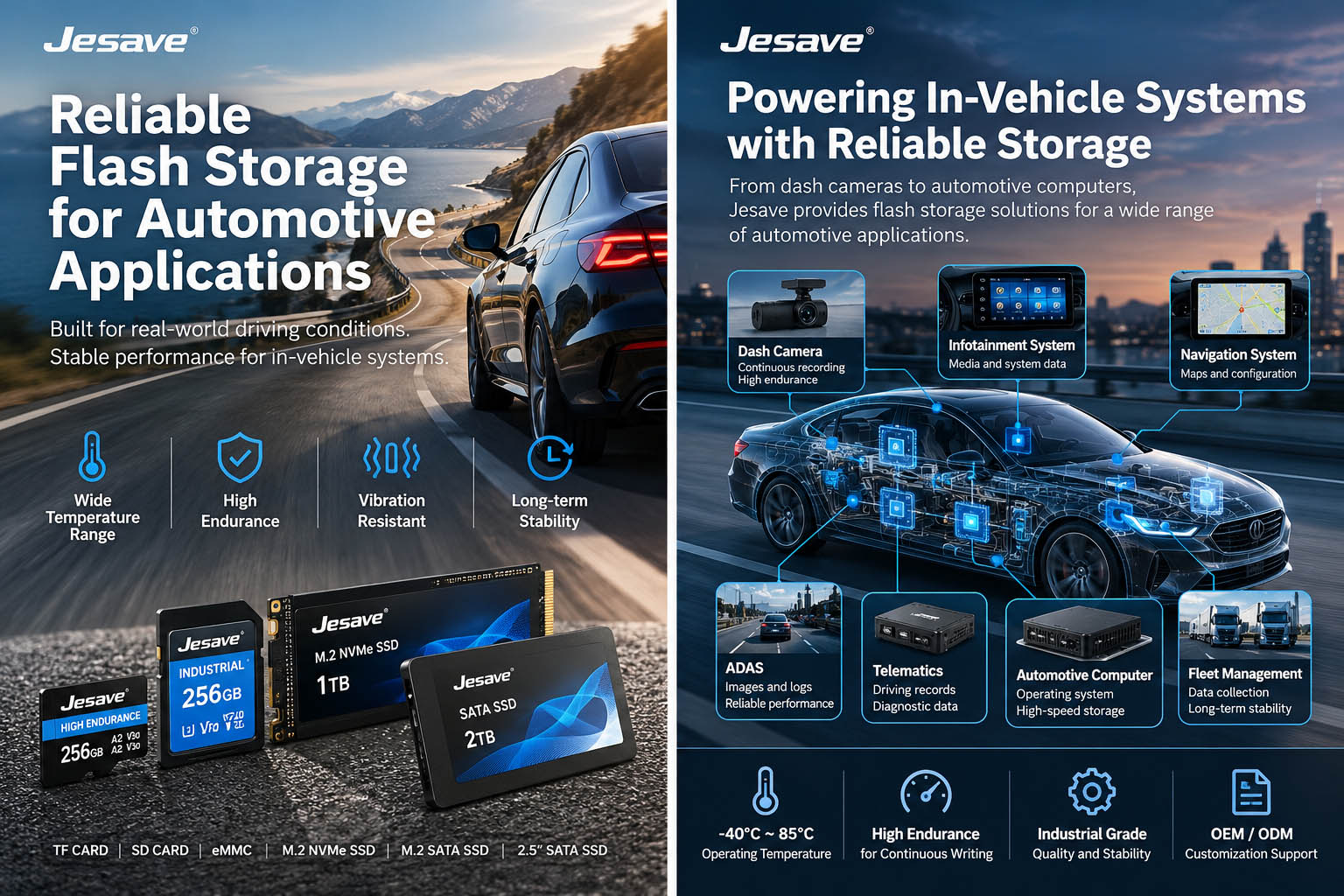
A storage device inside a vehicle may face a very different workload from the same type of device used in a phone or laptop. Navigation systems, vehicle displays, dash cameras, telematics units, infotainment systems and other embedded electronics can operate for long periods while being exposed to vibration, temperature changes and repeated data writes.
For automotive equipment manufacturers, choosing storage is therefore more than comparing capacity and read speed. NAND flash type, controller compatibility, endurance, temperature range, firmware and long-term supply consistency can all affect the reliability of the finished system.
Where Is Flash Storage Used in Vehicles?
Automotive electronics generate and store several types of data. The storage requirement changes according to the application.
| Automotive Application | Typical Data | Storage Considerations |
|---|---|---|
| Dash Camera | Continuous video | High write endurance, capacity |
| Vehicle Display | System files, media, configuration | Stability, read performance |
| Navigation System | Maps, system data | Capacity, data retention |
| Telematics | Logs, diagnostic data | Reliability, write cycles |
| Infotainment | Media, applications, system files | Capacity, performance |
| ADAS-related Equipment | Images, logs, system data | Sustained performance, reliability |
| Fleet Management | Driving records, logs | Endurance, long-term operation |
| Embedded Automotive Computer | Operating system, applications | SSD performance, temperature range |
The important point is that automotive storage does not have one universal workload. A card used for continuous video recording has a very different write pattern from an SSD used to run an embedded operating system.
What Type of Storage Is Suitable for Automotive Systems?
The storage technology should be selected according to the system architecture rather than the product name alone.
| Storage Type | Common Automotive Use | Main Selection Factors |
|---|---|---|
| microSD / TF Card | Dash cameras, removable storage, embedded devices | Endurance, capacity, temperature |
| SD Card | Larger removable storage applications | Speed, endurance, compatibility |
| eMMC | Embedded electronics | Controller, NAND, firmware, reliability |
| M.2 NVMe SSD | Automotive computers and high-performance embedded systems | PCIe interface, sustained performance, temperature |
| M.2 SATA SSD | Embedded PCs and equipment | SATA compatibility, endurance |
| 2.5″ SATA SSD | Larger embedded systems | Capacity, interface, operating environment |
For a compact camera or embedded device, a high-endurance microSD or industrial TF card may be more practical than an SSD.
For an automotive computer running an operating system and applications, an industrial SSD can provide a more appropriate storage architecture.
Why Endurance Matters in Automotive Storage
One of the easiest mistakes is to select a memory card based only on capacity.
A 256GB card may look suitable on paper, but the actual workload determines how much stress the NAND flash receives.
Consider a vehicle camera recording continuously. The storage device may write video data for several hours every day. This is fundamentally different from a smartphone that writes photos and videos intermittently.
For these applications, buyers should examine:
- Write workload
- NAND flash type
- Program/erase endurance
- Controller behavior
- Sustained write performance
- Data retention
- Operating temperature
- Firmware stability
A high-endurance memory card is designed with repeated writing in mind, making it more suitable for applications where data is continuously recorded and overwritten.
Automotive Temperature Is Another Key Consideration
A vehicle can experience much larger temperature changes than an indoor electronic device.
Storage installed in different locations may encounter different thermal conditions depending on the vehicle design and enclosure.
This makes the specified operating temperature important during product selection.
| Requirement | What Buyers Should Check |
|---|---|
| Normal cabin environment | Standard operating temperature |
| Dashboard installation | Higher temperature exposure |
| Enclosed equipment | Heat dissipation |
| Outdoor/vehicle-mounted equipment | Wider temperature variation |
| Industrial automotive electronics | Extended temperature specification |
Temperature should also be considered together with write activity. NAND flash behavior, controller operation and overall system stability can all be affected by the operating environment.
For automotive projects, the storage specification should therefore be matched to the actual installation location rather than selected from a generic consumer product list.
Industrial vs Consumer Memory Cards for Automotive Use
A consumer memory card can be perfectly suitable for phones, tablets and cameras used under normal conditions. Automotive equipment may require a different approach.
| Factor | Consumer Memory Card | Industrial Memory Card |
|---|---|---|
| Typical workload | General consumer use | Embedded / continuous workloads |
| Temperature | Standard range | Extended options available |
| Endurance | General use | Higher endurance options |
| Component consistency | Consumer-oriented | More controlled for industrial applications |
| Long-term deployment | Product lifecycle varies | Designed for longer-term projects |
| OEM customization | Usually limited | More customization options |
| Batch requirements | Retail-oriented | Better suited to project procurement |
This does not mean every automotive system requires an industrial memory card. The correct choice depends on the application’s write workload, temperature, expected service life and system requirements.
For an automotive equipment manufacturer ordering thousands of units, however, batch consistency and long-term availability can become just as important as the initial specification.
What Should an Automotive Storage Buyer Ask a Supplier?
For an engineering or procurement team, these questions are more useful than simply asking for the cheapest 128GB or 256GB card.
| Question | Why It Matters |
|---|---|
| Which NAND flash is used? | Affects endurance and product consistency |
| Which controller is used? | Determines compatibility and storage behavior |
| What is the operating temperature? | Must match the installation environment |
| Is sustained write performance specified? | Important for continuous recording |
| What endurance information is available? | Helps estimate service life |
| Can the same components be supplied long term? | Important for automotive production |
| Is firmware customization available? | Useful for embedded projects |
| Can the supplier provide samples? | Allows system-level validation |
| Can production batches be tested? | Reduces batch-related risks |
| Can the supplier support OEM requirements? | Important for customized projects |
For automotive projects, the supplier’s ability to maintain a consistent specification over time can matter more than a small difference in the initial unit price.
Capacity: How Much Storage Does an Automotive System Need?
Capacity should be calculated from the application’s actual data generation.
For continuous video recording, a simple starting point is:
Required Storage ≈ Data Rate × Recording Time × Retention Period
For example, if a camera continuously generates a certain amount of video data every hour, the required capacity will increase directly with recording time.
Other systems may have a completely different calculation.
| Application | Main Capacity Driver |
|---|---|
| Dash Camera | Video bitrate × recording hours |
| Navigation | Map database size |
| Infotainment | Media and application files |
| Telematics | Log volume and retention period |
| Fleet Monitoring | Number of vehicles and retention time |
| Automotive Computer | Operating system + applications + data |
Capacity should therefore be specified together with the workload instead of choosing a larger card simply because more gigabytes are available.
Why Controller and Firmware Matter
NAND flash is only one part of a storage device.
The controller manages communication between the host system and NAND flash, while firmware controls how the device handles tasks such as data management, wear leveling and bad-block management.
This becomes particularly important in embedded automotive equipment.
Two products with the same capacity and interface can behave differently because their NAND, controller and firmware combinations are different.
For OEM projects, the storage device should ideally be validated together with the target hardware rather than tested as an isolated component.
Automotive Storage Requires System-Level Testing
A specification sheet cannot reproduce every condition inside a vehicle.
Before volume production, automotive equipment manufacturers should test the storage device under the actual workload.
A practical validation process can include:
| Test Area | Example Check |
|---|---|
| Compatibility | Device recognition and system boot |
| Capacity | Actual usable capacity |
| Sequential Read/Write | Sustained data transfer |
| Random Workload | Embedded application behavior |
| Continuous Recording | Long-duration writing |
| Temperature | Operation across specified range |
| Power Cycling | Repeated startup/shutdown |
| Data Integrity | File and data verification |
| Endurance | Repeated write cycles |
| Batch Consistency | Comparison between production lots |
For continuous-recording equipment, a short benchmark is not enough. Long-duration testing can reveal problems that a simple read/write test may miss.
When Should You Consider an Automotive SSD?
A memory card is not always the right storage medium.
An automotive SSD becomes more relevant when the system requires higher performance, larger capacity or an operating-system-based architecture.
Typical examples include:
- Automotive embedded computers
- Vehicle infotainment computers
- Industrial vehicle terminals
- Fleet management computers
- High-performance display systems
- Data collection equipment
- Embedded PCs installed in vehicles
M.2 SATA and M.2 NVMe SSDs can be considered according to the host interface and required performance.
For an SSD project, buyers should evaluate the PCIe or SATA interface, NAND type, controller, sustained performance, endurance, operating temperature and mechanical design together.
OEM and Custom Automotive Storage
Automotive equipment manufacturers may also require storage products that are not available as standard retail products.
Depending on the project, customization can include:
| OEM Requirement | Possible Customization |
|---|---|
| Capacity | 32GB / 64GB / 128GB / 256GB / 512GB / 1TB and more |
| Product Type | TF, microSD, SD, SSD, USB |
| Firmware | Application-specific firmware |
| Partition | Custom disk partitioning |
| File System | Project-specific configuration |
| Label | Private label / logo |
| Packaging | Custom packaging |
| Data | Preloaded files |
| Security | File or device-level protection |
| Testing | Project-specific validation |
For fleet equipment, automotive cameras or embedded systems, OEM customization can make sense when the storage device is becoming part of the finished product rather than simply an off-the-shelf accessory.
How Jesave Can Support Automotive Storage Projects
Jesave provides flash storage products for different embedded and automotive-related applications, including memory cards, industrial storage and SSD solutions.
For automotive equipment manufacturers, the project can be evaluated from several points rather than starting with a fixed product model:
Application → Workload → Interface → Capacity → Temperature → Endurance → NAND → Controller → Firmware → Testing → Volume Production
This approach allows the storage specification to be matched to the equipment instead of forcing an existing consumer product into an unsuitable application.
Jesave can also support OEM requirements such as capacity selection, firmware customization, partitioning, preloaded files, product labeling and packaging according to project requirements.
Automotive Flash Storage Selection Checklist
Before approving a storage device for an automotive project, the following checklist can help:
| Check | Required? |
|---|---|
| Application workload defined | ✓ |
| Continuous write requirement evaluated | ✓ |
| Capacity calculated from actual data volume | ✓ |
| Operating temperature confirmed | ✓ |
| NAND type identified | ✓ |
| Controller compatibility verified | ✓ |
| Endurance requirement defined | ✓ |
| Long-term supply discussed | ✓ |
| Sample testing completed | ✓ |
| Production batch testing defined | ✓ |
| OEM customization requirements confirmed | ✓ |
FAQ
What type of memory card is suitable for automotive applications?
The appropriate card depends on the workload. High-endurance or industrial-grade microSD/TF cards are commonly considered for applications involving continuous recording or embedded operation, while other automotive systems may require SD cards, eMMC or SSDs.
Are consumer microSD cards suitable for automotive systems?
They can be suitable for some low-duty applications, but continuous recording, wider temperature requirements and long-term deployment may require a higher-endurance or industrial-grade product.
Is an SSD better than a memory card for automotive applications?
They serve different purposes. Memory cards are useful for compact embedded and removable-storage applications, while SSDs are more appropriate for systems requiring higher performance, larger capacity or an operating-system-based storage architecture.
What matters more for automotive storage: capacity or endurance?
For systems that continuously write data, endurance and sustained write behavior can be as important as capacity. A larger capacity does not automatically make a storage device suitable for a heavy write workload.
Can automotive storage be customized for OEM projects?
Yes. Depending on the product and project requirements, customization may include capacity, firmware, partitioning, labeling, packaging, preloaded files and testing specifications.
What should an automotive equipment manufacturer provide when requesting a storage quotation?
Useful information includes the storage interface, required capacity, operating temperature, write workload, expected service life, host device, annual volume and any firmware, packaging or labeling requirements. This allows the supplier to recommend a more appropriate configuration rather than quoting a generic consumer product.
Final Considerations
Selecting storage for a vehicle is an engineering decision as much as a purchasing decision. A card or SSD that performs well in a phone or office computer may face a very different workload when installed in a vehicle.
For automotive projects, the more useful starting point is the application itself: how much data is generated, how often it is written, where the storage is installed, how long the equipment is expected to operate and how consistently the same specification needs to be supplied.
Once those requirements are clear, capacity, NAND, controller, endurance, temperature range and storage form factor can be evaluated as one system rather than as isolated specifications.