Choosing the right Memory Card Class 10 requires understanding speed, performance and application requirements. Class 10 is one of the most common memory card speed ratings, widely used in cameras, smartphones, drones, dash cams and consumer electronics.
For consumers, the key is matching the card to the device. For wholesalers and OEM brands, NAND sourcing, controller selection, quality control and supply stability determine long-term product competitiveness.
What Is Memory Card Class 10?
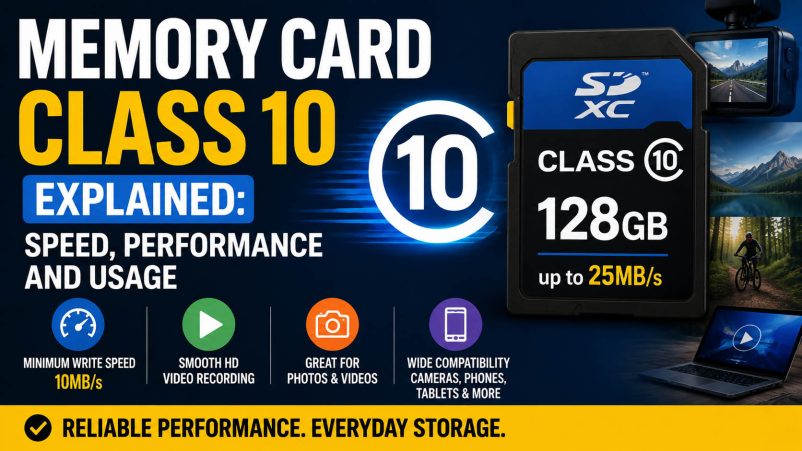
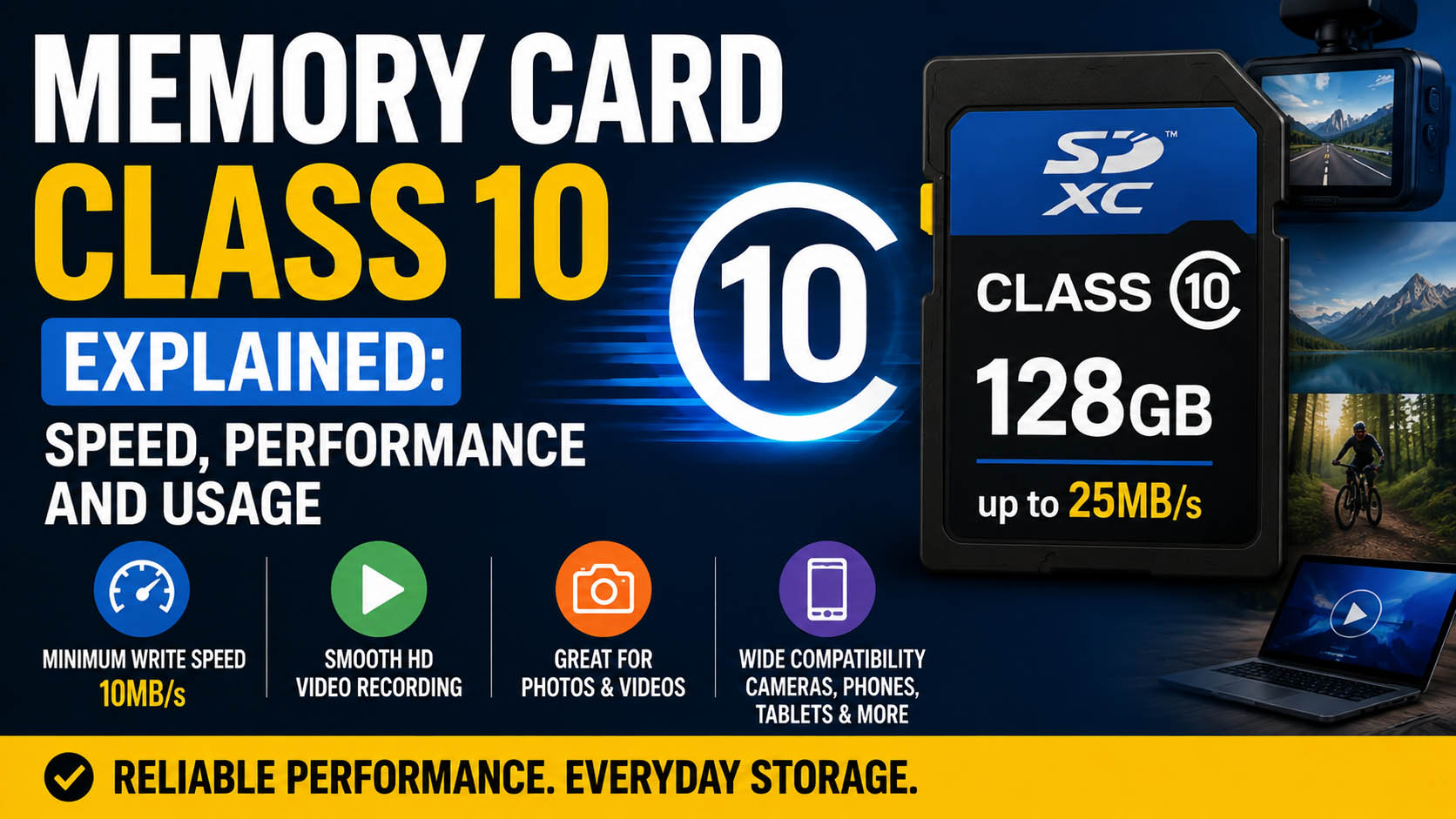
Class 10 is a memory card speed classification that indicates a minimum sustained sequential write speed of 10MB/s under the SD Association’s Speed Class standard.
| Specification | Class 10 |
|---|---|
| Minimum write speed | 10MB/s |
| Symbol | “10” inside a circle |
| Main use | Photos, HD video, general storage |
| Performance level | Entry to mainstream |
| Common formats | SD / microSD |
Class 10 is a minimum performance rating, not the maximum speed a card can achieve.
Class 10 vs Other Speed Classes
| Speed Class | Minimum Write Speed | Typical Application |
|---|---|---|
| Class 2 | 2MB/s | Basic storage |
| Class 4 | 4MB/s | Basic photos/video |
| Class 6 | 6MB/s | HD recording |
| Class 10 | 10MB/s | HD video, cameras |
| U1 | 10MB/s | General performance |
| U3 | 30MB/s | 4K video |
For modern devices, U3/V30 cards are often preferred for demanding video applications.
Class 10 vs U1 vs U3
| Feature | Class 10 | U1 | U3 |
|---|---|---|---|
| Minimum write | 10MB/s | 10MB/s | 30MB/s |
| HD video | ✓ | ✓ | ✓ |
| Full HD | ✓ | ✓ | ✓ |
| 4K video | Limited | Limited | Better |
| Price | Lower | Medium | Higher |
| Target | General use | Mainstream | Performance |
Class 10 and U1 have similar minimum write requirements, while U3 targets higher-performance recording.
Best Uses for Class 10 Memory Cards
| Application | Suitability |
|---|---|
| Smartphone storage | ✓ Excellent |
| Tablet storage | ✓ Excellent |
| MP3/media devices | ✓ Excellent |
| Digital camera photos | ✓ Excellent |
| Full HD video | ✓ Good |
| 4K video | Depends on device |
| Professional video | Usually not recommended |
| Dash cam | Depends on endurance |
Class 10 Memory Card Capacity Guide
| Capacity | Best For |
|---|---|
| 32GB | Basic storage |
| 64GB | Photos + HD video |
| 128GB | Everyday users |
| 256GB | Large media storage |
| 512GB+ | Heavy storage needs |
For most consumers, 128GB Class 10 cards provide a good balance between price and capacity.
Class 10 for Cameras
Class 10 works well for many photography applications.
| Camera Use | Recommendation |
|---|---|
| JPEG photography | Class 10 |
| Full HD video | Class 10 |
| RAW photography | U3/UHS-II preferred |
| 4K video | U3/V30 recommended |
| Professional shooting | Higher-performance cards |
The correct card depends on the camera model, bitrate and shooting mode.
Class 10 for Dash Cams
Dash cams have special requirements because they continuously overwrite data.
| Requirement | Importance |
|---|---|
| Endurance | ★★★★★ |
| Sustained write | ★★★★★ |
| Capacity | ★★★★☆ |
| Speed class | ★★★★☆ |
| Read speed | ★★☆☆☆ |
For dash cams, a high-endurance Class 10/U3 card is usually more suitable than a standard consumer card.
Class 10 for Smartphones
Class 10 remains popular for everyday storage expansion.
| Use | Recommended Capacity |
|---|---|
| Photos | 64GB–128GB |
| Music/videos | 128GB–256GB |
| Apps (where supported) | A1/A2 cards |
| Large media library | 512GB+ |
Why Two Class 10 Cards Have Different Prices
A Class 10 label does not define the entire product.
| Factor | Impact |
|---|---|
| NAND flash quality | Reliability + cost |
| Controller | Performance stability |
| Firmware | Data management |
| Endurance | Lifespan |
| Testing | Quality consistency |
| Brand | Market positioning |
| Packaging | Retail cost |
A low-cost Class 10 card and a premium Class 10 card can have very different internal designs.
NAND Flash and Controller: The Core Technology
A memory card is a complete storage system.
NAND + Controller + Firmware + QC = Product Performance
| Component | Function |
|---|---|
| NAND Flash | Stores data |
| Controller | Manages data flow |
| Firmware | Optimizes performance |
| Error correction | Improves reliability |
| Wear management | Extends lifespan |
For OEM products, component matching is more important than simply choosing the cheapest parts.
Supply Chain Advantages for Memory Card Buyers
For distributors and brands, supply chain capability affects cost, quality and delivery.
| Supply Capability | Benefit |
|---|---|
| Stable NAND sourcing | Better price control |
| Multiple suppliers | Lower risk |
| Controller matching | Better compatibility |
| Production planning | Stable delivery |
| Batch testing | Consistent quality |
| Traceability | Better after-sales |
| Flexible capacity | More product options |
A strong supplier provides stable specifications and predictable supply, not only low prices.
OEM Class 10 Memory Card Solutions
Private-label Class 10 memory cards allow brands to create customized storage products.
OEM Customization Options
| Item | Options |
|---|---|
| Capacity | 8GB–512GB+ |
| Speed | Class 10/U1/U3 |
| Application | Camera, phone, IoT, automotive |
| Label | Brand logo |
| Packaging | Box/blister/bulk |
| Barcode | Customized |
| Manual | Customized |
| Warranty card | Customized |
| Adapter | Optional |
OEM Production Process
| Stage | Process |
|---|---|
| 1 | Define application |
| 2 | Select capacity |
| 3 | Match NAND/controller |
| 4 | Sample testing |
| 5 | Performance verification |
| 6 | Device compatibility test |
| 7 | Packaging design |
| 8 | Mass production |
| 9 | Batch QC |
Memory Card Quality Control
| Test | Purpose |
|---|---|
| Capacity test | Verify real storage |
| Read/write test | Check performance |
| Speed-class test | Confirm specification |
| File integrity test | Protect data |
| Aging test | Improve reliability |
| Device testing | Ensure compatibility |
| Appearance check | Quality control |
| Batch tracking | After-sales support |
How to Choose a Class 10 Memory Card Supplier
| Check | Why It Matters |
|---|---|
| NAND source | Product reliability |
| Controller solution | Performance |
| QC system | Batch consistency |
| Testing capability | Lower failure risk |
| OEM ability | Brand customization |
| MOQ | Purchasing flexibility |
| Lead time | Inventory planning |
| Warranty | Customer protection |
Common Buying Mistakes
| Mistake | Better Choice |
|---|---|
| Choosing only by price | Compare quality |
| Thinking Class 10 means fastest | Check U3/V30 if needed |
| Ignoring endurance | Match application |
| Looking only at capacity | Check speed |
| Using standard cards for 24/7 recording | Use high endurance |
| Buying unsupported capacity | Check device limits |
FAQ: Memory Card Class 10
What does Class 10 mean on a memory card?
Class 10 means the card supports a minimum sustained sequential write speed of 10MB/s.
Is Class 10 good for cameras?
Yes, for photos and Full HD video. For 4K video or professional shooting, U3/V30 or higher may be required.
Is Class 10 better than U1?
They have the same minimum write requirement of 10MB/s. U1 is a newer speed classification within the UHS Speed Class system.
Is Class 10 enough for 4K video?
Usually not recommended for demanding 4K recording. Many 4K devices require U3/V30 or higher.
Is a 128GB Class 10 card good?
Yes. It is a popular choice for everyday photography, smartphones and general storage.
Can Class 10 cards be used in dash cams?
Yes, but high-endurance versions are preferred because dash cams repeatedly write and overwrite data.
Does Class 10 mean the card is fast?
Not necessarily. It only defines minimum write performance. Actual speed depends on NAND, controller and design.
Can Class 10 cards be OEM customized?
Yes. OEM options include capacity, branding, packaging, barcode, manuals and retail design.
What affects OEM Class 10 card pricing?
| Factor | Impact |
|---|---|
| Capacity | High |
| NAND cost | High |
| Quantity | High |
| Packaging | Medium |
| Customization | Medium |
| Testing requirements | Medium |
How can I get a better wholesale price?
Provide:
| Information | Example |
|---|---|
| Application | Camera |
| Capacity | 128GB |
| Speed | Class 10/U1 |
| Quantity | 10,000 pcs |
| Packaging | Private label |
| Market | USA |
A clear specification helps optimize sourcing and production cost.
Final Class 10 Memory Card Buying Guide
| User | Recommended Choice |
|---|---|
| Basic storage | Class 10 |
| Smartphone expansion | Class 10/U1 |
| Camera photos | Class 10/U1 |
| Full HD video | Class 10 |
| 4K video | U3/V30 |
| Dash cam | High endurance Class 10/U3 |
| Professional video | V60/V90/CFexpress |
Final Recommendation
Class 10 remains a reliable everyday memory card standard, especially for photos, Full HD video and general storage.
However, modern applications require matching the card to the workload:
- Everyday storage → Class 10/U1
- 4K video → U3/V30
- Continuous recording → High Endurance
- Professional production → Higher-performance formats
For OEM brands and distributors, the strongest competitive advantage comes from:
Qualified NAND sourcing + optimized controller + strict QC + stable supply chain + flexible OEM customization.