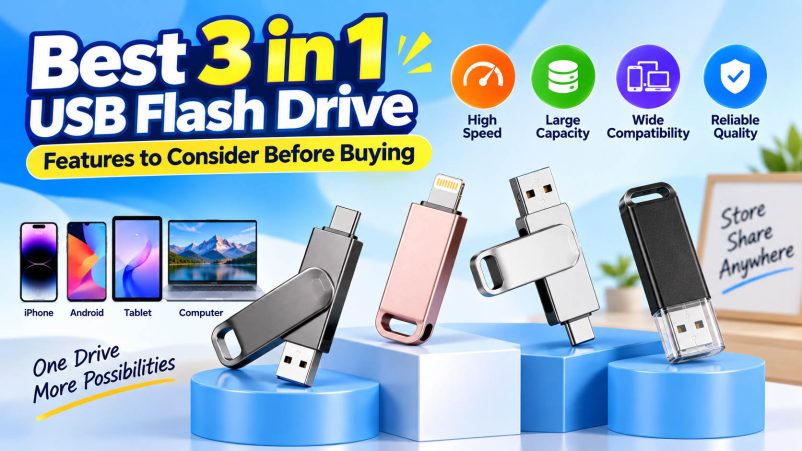
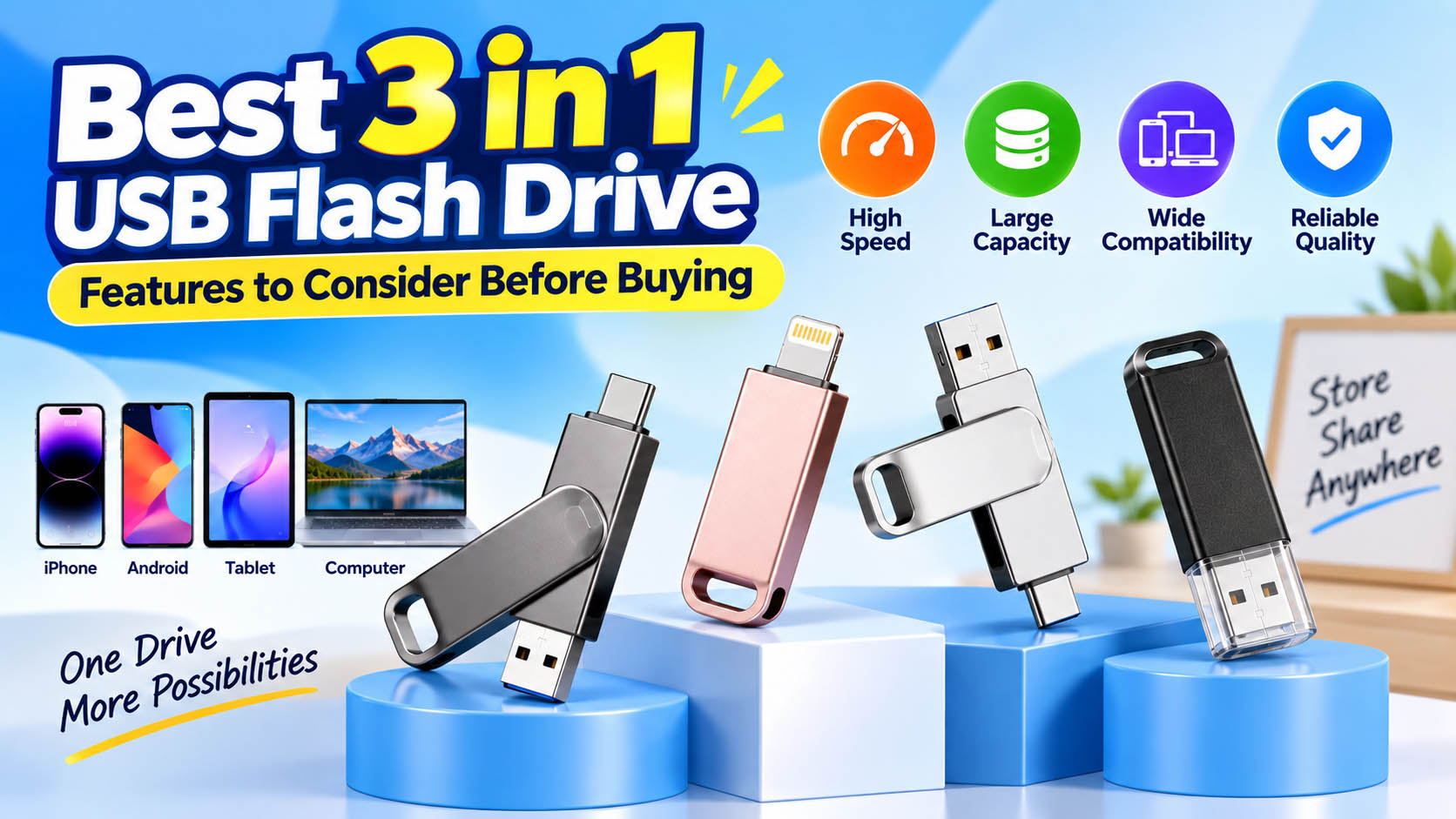
Choosing the right 3-in-1 USB flash drive is about more than storage capacity. Connector compatibility, NAND flash quality, controller performance, real-world transfer speed, durability, and supply-chain reliability all affect the final product experience.
For consumers, these features determine convenience and performance. For wholesalers, distributors, retailers, and private-label brands, they also affect product quality, cost, consistency, and long-term supply.
1. Check the Connector Configuration
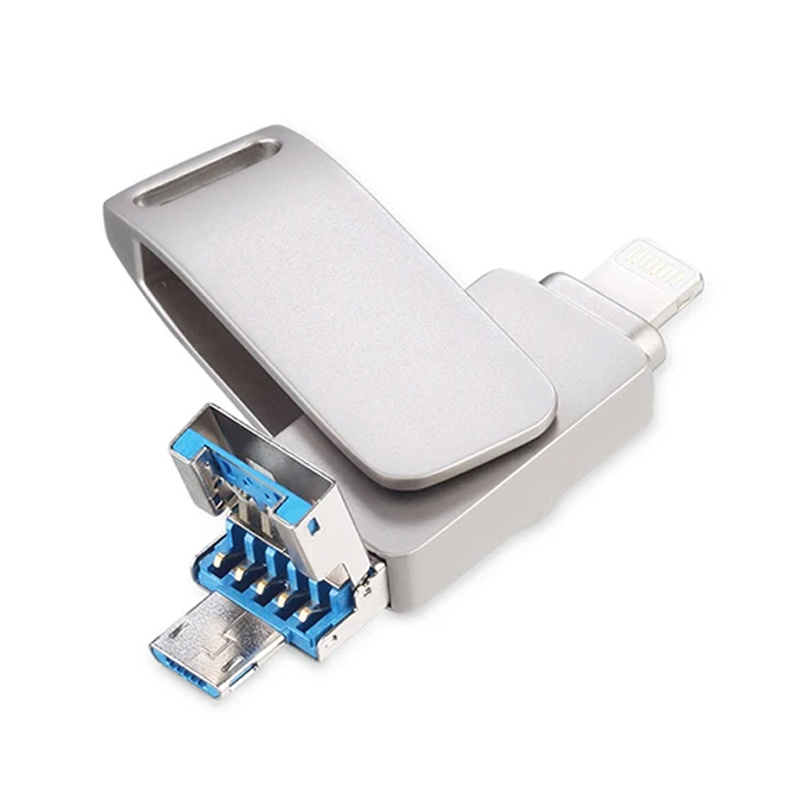
The main advantage of a 3-in-1 USB flash drive is its multi-device connectivity.
| Connector | Common Application | Key Consideration |
|---|---|---|
| USB-A | PCs, laptops, older devices | Broad compatibility |
| USB-C | New laptops, phones, tablets | Growing mainstream interface |
| Lightning | Compatible iPhone/iPad models | Check device and product compatibility |
| USB-A + USB-C + Lightning | Multi-device transfer | Maximum flexibility |
Tip: Do not choose a product simply because it has three connectors. Confirm that the connector combination matches your target devices and market.
2. Choose the Right Storage Capacity
Capacity should match the intended application and price positioning.
| Capacity | Recommended Use |
|---|---|
| 32GB | Basic documents and light storage |
| 64GB | Everyday photos and files |
| 128GB | General photo/video backup |
| 256GB | Large media libraries |
| 512GB+ | Professional and high-volume storage |
For B2B product lines, 64GB, 128GB, and 256GB are practical core SKUs, while higher capacities can target premium customers.
3. Look at NAND Flash Quality
NAND flash is one of the most important components inside a USB flash drive.
| NAND Factor | Why It Matters |
|---|---|
| NAND type | Influences endurance and cost |
| Flash quality | Affects stability and consistency |
| Supply source | Impacts long-term availability |
| Batch consistency | Important for OEM production |
| Capacity authenticity | Prevents incorrect usable capacity |
A professional storage supplier should have reliable NAND sourcing and quality-control procedures rather than focusing only on the appearance of the finished USB drive.
4. Check the Controller
The controller manages communication between the host device and NAND flash.
| Controller Consideration | Impact |
|---|---|
| Compatibility | Device recognition |
| Performance | Read/write efficiency |
| Firmware | Stability and functionality |
| NAND matching | Overall product performance |
| Production consistency | Batch-to-batch reliability |
Storage industry tip: NAND and controller should be evaluated as a matched solution. A high-capacity NAND chip alone does not guarantee good real-world performance.
5. Compare Real Read & Write Speeds
Advertised interface speed and actual file-transfer performance are not always the same.
| Performance Item | Importance |
|---|---|
| Sequential read | Large file downloads |
| Sequential write | Photo/video backup |
| Random performance | Small files and documents |
| Sustained write | Long video or large-file transfers |
| Thermal performance | Long transfer sessions |
When sourcing for business, request actual test results or sample testing instead of evaluating products only by theoretical interface specifications.
6. Check Device Compatibility
A 3-in-1 USB flash drive should be tested with the devices it is designed to support.
| Device | What to Verify |
|---|---|
| iPhone | Connector and OS compatibility |
| Android phone | USB-C/OTG support |
| iPad | Connector and file-management compatibility |
| Windows PC | USB interface compatibility |
| Mac | USB-A/USB-C compatibility |
| Tablet | Interface and OS support |
Compatibility can depend on the specific device, operating system, connector, firmware, and product design.
7. Consider the Physical Design
Because a 3-in-1 drive contains multiple connectors, mechanical design is particularly important.
| Design Feature | Benefit |
|---|---|
| Metal housing | Premium appearance and durability |
| Protective cap | Helps protect connectors |
| Swivel mechanism | Convenient connector switching |
| Compact body | Better portability |
| Reinforced connector | Improved durability |
| Keyring hole | Easy carrying |
For OEM products, the housing can also become an important part of brand differentiation.
8. Evaluate Heat Management
Large file transfers can generate heat, particularly when using higher-performance controllers and NAND.
| Heat-Related Factor | What Buyers Should Check |
|---|---|
| Housing material | Heat dissipation characteristics |
| Controller efficiency | Power and thermal behavior |
| Sustained performance | Speed stability during long transfers |
| Thermal testing | Performance under continuous workloads |
A good product should maintain stable performance rather than offering high peak speed for only a short period.
9. Check Quality Control
For B2B buyers, quality control is as important as specifications.
| QC Test | Purpose |
|---|---|
| Capacity test | Verify actual storage capacity |
| Read test | Confirm performance |
| Write test | Confirm recording performance |
| Connector test | Check mechanical reliability |
| Compatibility test | Verify target devices |
| File transfer test | Check real-world stability |
| Appearance inspection | Control cosmetic quality |
| Aging/burn-in testing | Identify potential failures |
A supplier with standardized testing can provide more consistent quality across large production batches.
10. Evaluate the Supply Chain
A stable supply chain can directly affect product availability, quality, and pricing.
| Supply Chain Capability | B2B Advantage |
|---|---|
| Stable NAND sourcing | Better supply continuity |
| Multiple component sources | Reduced supply risk |
| Controller matching | Better product optimization |
| Firmware management | More consistent production |
| In-house/controlled testing | Better QC |
| Assembly capability | Faster production coordination |
| Packaging sourcing | Easier private-label projects |
| Production traceability | Better batch management |
For distributors and brands, supply-chain stability is especially important for long-term SKUs. A product that performs well in one sample but changes components frequently can create quality and customer-service problems.
11. Consider OEM & ODM Capability
If you are purchasing for your own brand, OEM/ODM capability can be more valuable than simply finding the lowest unit price.
| OEM/ODM Option | Examples |
|---|---|
| Logo | Printing, laser engraving |
| Housing | Customized shape and material |
| Color | Standard or customized colors |
| Connector combination | USB-A / USB-C / Lightning |
| Capacity | 32GB–512GB+ |
| Performance | Customized storage configuration |
| Packaging | Retail box, blister, paper box |
| Label | Brand and regulatory information |
| Accessories | Adapters, lanyards, etc. |
| Manual | Customized multilingual instructions |
A capable OEM supplier can help integrate product design, storage components, testing, packaging, and branding into one sourcing process.
12. Check MOQ and Production Lead Time
Price is not the only purchasing factor.
| Purchasing Factor | Why It Matters |
|---|---|
| MOQ | Determines inventory requirements |
| Sample lead time | Supports product validation |
| Mass-production lead time | Affects inventory planning |
| Packaging lead time | Can affect launch schedules |
| Reorder capability | Supports long-term sales |
| Capacity availability | Reduces supply interruptions |
For new products, start with samples or a small pilot order before committing to large-volume production.
Best 3-in-1 USB Flash Drive Features at a Glance
| Feature | Recommended Priority |
|---|---|
| Multi-connector compatibility | ⭐⭐⭐⭐⭐ |
| NAND quality | ⭐⭐⭐⭐⭐ |
| Controller stability | ⭐⭐⭐⭐⭐ |
| Real read/write performance | ⭐⭐⭐⭐⭐ |
| Device compatibility | ⭐⭐⭐⭐⭐ |
| Capacity options | ⭐⭐⭐⭐ |
| Heat management | ⭐⭐⭐⭐ |
| Housing durability | ⭐⭐⭐⭐ |
| QC system | ⭐⭐⭐⭐⭐ |
| OEM/ODM capability | ⭐⭐⭐⭐ |
| Supply-chain stability | ⭐⭐⭐⭐⭐ |
| Competitive pricing | ⭐⭐⭐⭐ |
Recommended Configuration for Different Markets
| Target Market | Suggested Configuration |
|---|---|
| Entry-level retail | 64GB + basic multi-connector design |
| Mainstream consumers | 128GB + USB-C/USB-A + mobile connector |
| Photo/video users | 256GB + higher sustained write performance |
| Premium retail | 256GB/512GB + metal housing |
| Distributors | 64GB/128GB/256GB SKU range |
| Private-label brands | Customized housing + logo + packaging |
| Corporate/promotional | Customized logo + cost-efficient configuration |
FAQ About 3-in-1 USB Flash Drives
What is the most important feature of a 3-in-1 USB flash drive?
Compatibility is the most important starting point. The drive should support the devices your customers actually use. After compatibility, evaluate NAND quality, controller stability, real read/write speed, capacity, and durability.
Is 128GB a good capacity for a 3-in-1 USB flash drive?
Yes. 128GB is a practical mainstream capacity for photos, videos, documents, and mobile backup. For customers with large media libraries, 256GB or higher is more suitable.
Does a 3-in-1 USB flash drive transfer files faster than a standard USB drive?
Not necessarily. The number of connectors does not determine performance. NAND, controller, USB interface, firmware, host device, and workload all influence actual transfer speed.
What NAND should I choose for an OEM USB flash drive?
The appropriate NAND depends on the target price, performance requirements, expected workload, and availability. For OEM projects, focus on stable sourcing, consistent batches, verified capacity, and compatibility with the selected controller.
Can a 3-in-1 USB flash drive be customized?
Yes. OEM/ODM customization can include the housing, logo, color, capacity, connector configuration, packaging, labels, accessories, and product documentation.
How can I verify the quality of a USB flash drive supplier?
Request product samples and test actual capacity, read/write speed, compatibility, sustained transfer performance, connector durability, and file-transfer stability. For mass production, confirm that the approved component configuration remains consistent.
What should wholesalers ask a USB flash drive manufacturer?
Key questions include:
| Question | Why It Matters |
|---|---|
| Where is the NAND sourced? | Supply and quality |
| Which controller is used? | Performance and stability |
| What is the actual speed? | Avoids unrealistic claims |
| How is capacity tested? | Confirms genuine capacity |
| What devices are supported? | Reduces compatibility issues |
| What is the MOQ? | Inventory planning |
| Can you provide OEM packaging? | Brand development |
| Can components be kept consistent? | Long-term SKU stability |
| What QC tests are performed? | Quality assurance |
| What is the warranty policy? | After-sales protection |
Final Buying Checklist
Before purchasing a 3-in-1 USB flash drive, check these 10 key points:
| Checklist | Required |
|---|---|
| Correct connector configuration | ✓ |
| Genuine storage capacity | ✓ |
| Reliable NAND flash | ✓ |
| Suitable controller | ✓ |
| Verified read/write performance | ✓ |
| Target-device compatibility | ✓ |
| Durable connector design | ✓ |
| Production QC | ✓ |
| Stable supply chain | ✓ |
| OEM/ODM support | ✓ |
The best 3-in-1 USB flash drive is not necessarily the one with the highest advertised speed or lowest price. For consumers, compatibility and convenience are critical. For B2B buyers, component quality, supply-chain stability, testing, customization capability, and consistent mass production are equally important.
Choosing a manufacturer with strong storage-industry experience and integrated NAND sourcing, controller matching, quality control, OEM/ODM customization, and supply-chain management can help brands and distributors build a more reliable and competitive USB flash drive product line.