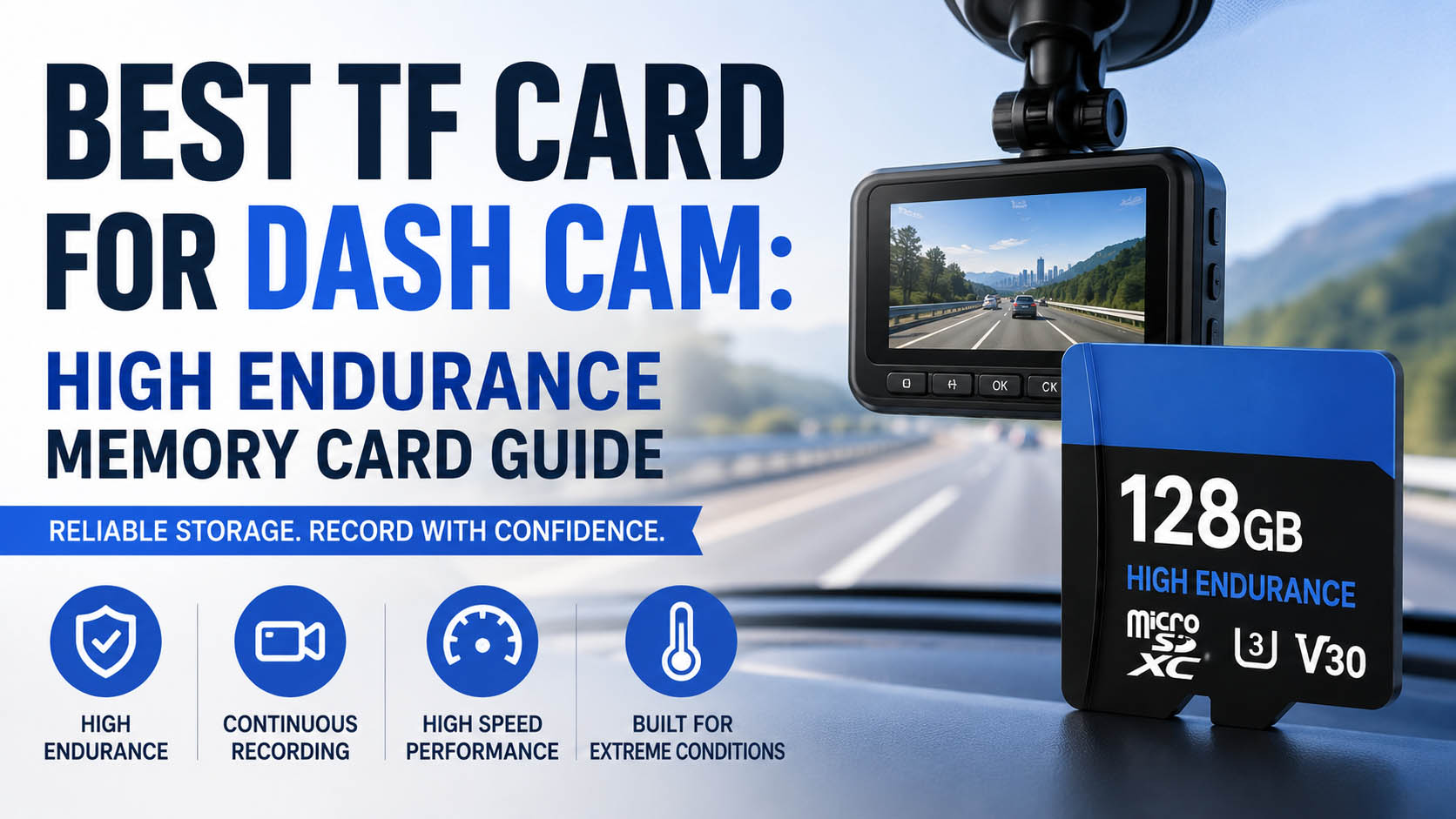
Choosing the best TF card for a dash cam is different from choosing a card for a phone or digital camera. Dash cams continuously write, overwrite, and delete video, so endurance, sustained write performance, capacity, temperature stability, and compatibility are more important than peak read speed.
For distributors, automotive electronics brands, and OEM buyers, NAND selection, controller matching, quality control, supply stability, and private-label capability are also key factors.
Quick Answer: Best TF Card for Dash Cam
| Dash Cam Use | Recommended Capacity | Recommended Type | Priority |
|---|---|---|---|
| Basic 1080p | 32GB–64GB | High Endurance | Endurance |
| Daily driving | 64GB–128GB | High Endurance | Reliability |
| 2K recording | 128GB–256GB | High Endurance, U3/V30 where required | Capacity + write |
| 4K dash cam | 128GB–512GB | High Endurance, U3/V30+ where required | Sustained write |
| Long parking mode | 128GB–512GB | High Endurance | Endurance |
| Fleet vehicles | 128GB–512GB | High Endurance | Reliability + lifecycle |
Best general starting point: 128GB high-endurance TF/microSD card.
Always check the dash cam manufacturer’s supported capacity and speed requirements.
Why Dash Cams Need High-Endurance Memory Cards
A normal memory card may be designed primarily for occasional photos and videos. A dash cam can continuously overwrite the same storage area.
Typical workload:
Record → Save → Delete old footage → Record again → Repeat
| Requirement | Importance |
|---|---|
| High endurance | ★★★★★ |
| Sustained write | ★★★★★ |
| Capacity | ★★★★☆ |
| Temperature stability | ★★★★☆ |
| Compatibility | ★★★★★ |
| Read speed | ★★☆☆☆ |
| Peak speed | ★★☆☆☆ |
High-endurance cards are specifically designed for applications such as dash cams and surveillance cameras. For example, KIOXIA describes its High Endurance series as designed for dashboard and surveillance cameras and provides rated cumulative recording figures by capacity.
Best Capacity for Dash Cam
| Capacity | Typical Use | Recommendation |
|---|---|---|
| 32GB | Basic 1080p | Entry |
| 64GB | Daily driving | Good |
| 128GB | 2K/4K + regular use | Best balance |
| 256GB | Long recording | Best for heavy users |
| 512GB | Long parking/fleet use | High capacity |
Higher capacity provides longer recording time before old footage is overwritten, but larger capacity does not automatically mean higher endurance.
Best TF Card Speed for Dash Cam
The required speed depends on recording resolution and bitrate.
| Recording | Suggested Starting Point |
|---|---|
| 720p | Class 10 / U1 |
| 1080p | Class 10 / U1 |
| 2K | U3 / V30 where required |
| 4K | U3 / V30 or higher where required |
The SD Association defines U3 and V30 as minimum 30MB/s sequential performance classes under their respective standards. Speed Class is particularly relevant to video because continuous recording requires a reliable minimum write rate.
For dash cams, sustained write performance matters more than advertised maximum read speed.
High Endurance vs Standard Memory Card
| Feature | Standard TF Card | High-Endurance TF Card |
|---|---|---|
| Occasional recording | ✓ | ✓ |
| Continuous recording | Limited | ✓ |
| Repeated overwrite | Limited | ✓ |
| Dash cam | Not ideal | Recommended |
| Surveillance | Not ideal | Recommended |
| Long parking mode | Limited | Better choice |
| Cost | Lower | Higher |
| Long-term value | Application-dependent | Better for heavy writing |
How Long Can a Dash Cam Memory Card Last?
There is no universal lifespan.
It depends on:
- NAND flash type
- Controller
- Recording bitrate
- Daily recording hours
- Overwrite frequency
- Temperature
- Card capacity
- Firmware
- Manufacturing quality
| Usage | Endurance Requirement |
|---|---|
| Occasional driving | Medium |
| Daily commuting | High |
| 24/7 recording | Very High |
| Parking surveillance | Very High |
| Fleet vehicles | Very High |
For example, manufacturer-rated endurance can vary significantly by capacity and recording format, demonstrating why buyers should compare specified recording endurance rather than capacity alone.
Temperature Matters for Dash Cam Memory Cards
Dash cams can operate in hot vehicle interiors, making thermal stability an important consideration.
| Factor | Importance |
|---|---|
| High temperature | High |
| Continuous writing | High |
| Overwrite cycles | High |
| Controller stability | High |
| NAND quality | High |
| Enclosure/environment | Application-dependent |
For automotive applications, testing should ideally reflect the actual operating environment rather than relying only on laboratory benchmark results.
NAND Flash and Controller: What B2B Buyers Should Know
A TF card is a combination of NAND + controller + firmware + PCB + manufacturing process.
| Component | Main Impact |
|---|---|
| NAND | Capacity + endurance + cost |
| Controller | Performance + flash management |
| Firmware | Stability + memory management |
| PCB | Electrical reliability |
| QC | Batch consistency |
For high-endurance products, the goal is not simply the cheapest NAND. The important factor is a stable, qualified NAND/controller combination matched to the continuous-write workload.
Dash Cam TF Card Supply Chain Advantages
For wholesale and OEM customers, supply-chain capability can directly affect product quality and cost.
| Supply Capability | Customer Benefit |
|---|---|
| Stable NAND sourcing | Better supply continuity |
| Multiple qualified suppliers | Lower component risk |
| Controller matching | Better application performance |
| Component qualification | Consistent batches |
| Capacity planning | Stable delivery |
| Batch traceability | Better quality management |
| Endurance testing | Lower failure risk |
| Temperature testing | Better automotive suitability |
| Multiple capacities | Complete product range |
| Long-term planning | Stable repeat orders |
OEM High-Endurance TF Card Solutions
Dash cam brands can develop private-label high-endurance memory cards instead of selling generic cards.
OEM Customization Options
| OEM Item | Options |
|---|---|
| Capacity | 32GB / 64GB / 128GB / 256GB / 512GB |
| Speed | U1 / U3 / V30 / application-specific |
| Endurance | Standard / High Endurance |
| Label | Brand logo + specifications |
| Packaging | Box / blister / paper card |
| Barcode | Customized |
| Serial number | Project-dependent |
| Manual | Customized |
| Warranty card | Customized |
| Retail design | Private label |
OEM Dash Cam Memory Card Development
| Stage | Process |
|---|---|
| 1 | Define dash cam model |
| 2 | Confirm resolution + bitrate |
| 3 | Select capacity |
| 4 | Define endurance target |
| 5 | Match NAND + controller |
| 6 | Sample production |
| 7 | Endurance testing |
| 8 | Dash cam compatibility testing |
| 9 | Temperature testing |
| 10 | Packaging + artwork |
| 11 | Pilot production |
| 12 | Mass production + QC |
Quality Control for Dash Cam TF Cards
| QC Test | Purpose |
|---|---|
| Capacity test | Verify actual capacity |
| Sequential write | Verify recording performance |
| Sustained write | Check continuous recording |
| Endurance test | Evaluate repeated writing |
| Dash cam compatibility | Validate actual devices |
| Temperature test | Evaluate thermal stability |
| Aging test | Identify unstable units |
| File integrity test | Check recorded data |
| Appearance inspection | Check physical quality |
| Batch traceability | Support after-sales |
How to Choose a Dash Cam Memory Card Supplier
| Evaluation | What to Check |
|---|---|
| NAND | Source + quality |
| Controller | Application compatibility |
| Endurance | Actual test data |
| Temperature | Automotive-use testing |
| QC | Capacity + performance |
| Compatibility | Target dash cam testing |
| OEM | Logo + packaging |
| MOQ | Standard/OEM MOQ |
| Lead time | Repeat-order capability |
| Supply | Long-term stability |
| Warranty | After-sales support |
Common Dash Cam Memory Card Buying Mistakes
| Mistake | Better Approach |
|---|---|
| Using a cheap standard card | Choose high endurance |
| Choosing only by capacity | Check endurance + write performance |
| Looking only at read speed | Check sustained write |
| Ignoring temperature | Consider automotive conditions |
| Buying the largest card | Match actual workload |
| Skipping dash cam testing | Test target models |
| Choosing only by price | Compare total cost |
| Changing components between batches | Maintain qualified BOM |
FAQ: Best TF Card for Dash Cam
What is the best TF card for a dash cam?
A high-endurance microSD/TF card is generally the best choice because dash cams repeatedly write and overwrite video.
Is 128GB enough for a dash cam?
For many users, yes. 128GB is a strong balance between capacity, price and recording time. Heavy 2K/4K or parking-mode users may prefer 256GB or 512GB.
Is 256GB better than 128GB?
It provides more recording capacity, but it is not automatically more durable. Choose based on the dash cam’s supported capacity and recording requirements.
Do I need U3 or V30 for a dash cam?
It depends on the dash cam’s resolution and bitrate. 2K and 4K devices may require U3/V30 or higher. Always follow the device manufacturer’s specification.
Is high endurance more important than speed?
For a dash cam, yes in many cases. Continuous overwriting makes endurance a critical consideration.
How often should I replace a dash cam memory card?
There is no universal replacement interval. Replace it according to its rated endurance, usage intensity, manufacturer guidance, and any signs of recording errors or file corruption.
Can I use a normal microSD card in a dash cam?
Some dash cams work with standard cards, but continuous recording can be much more demanding. A high-endurance card is generally the safer choice.
Can a 512GB TF card be used in any dash cam?
No. Check the dash cam manufacturer’s maximum supported capacity before purchasing.
Can dash cam TF cards be OEM customized?
Yes. OEM projects can include capacity, endurance specification, branding, packaging, barcode, manuals and warranty cards.
What MOQ is required for OEM dash cam memory cards?
MOQ depends on capacity, NAND sourcing, endurance requirements, printing and packaging. Standard products generally offer more flexible quantities than fully customized products.
How can I get a competitive wholesale price?
Provide the supplier with the dash cam model, resolution, bitrate, capacity, endurance requirement, quantity, packaging and target market.
A detailed RFQ allows the supplier to optimize NAND sourcing, controller selection and production planning.
Final Dash Cam TF Card Buying Checklist
| Before Buying | Check |
|---|---|
| Dash cam model | ✓ |
| Maximum capacity | ✓ |
| Recording resolution | ✓ |
| Bitrate | ✓ |
| Speed requirement | ✓ |
| Sustained write | ✓ |
| High endurance | ✓ |
| Temperature requirements | ✓ |
| NAND/controller | ✓ |
| Compatibility testing | ✓ |
| Warranty | ✓ |
Final Recommendation
For most dash cams, prioritize:
High Endurance → Compatibility → Sustained Write → Capacity → Temperature Stability → Price
A practical starting range is 128GB–256GB high-endurance TF/microSD, while 512GB can suit longer recording and heavier workloads where supported.
For B2B buyers, the stronger solution is:
Qualified NAND + matched controller + endurance testing + temperature testing + dash-cam compatibility + stable supply chain + OEM customization.
This approach helps brands and distributors build a more reliable high-endurance memory card product line for dash cams, fleet vehicles and automotive electronics, instead of competing only on low unit price.