Choosing the right TF card (microSD card) is not only about price. A better purchase decision should consider capacity, speed, NAND quality, controller performance, endurance, application requirements and total cost.
For consumers, the key is choosing the right specification. For wholesalers, distributors and OEM brands, stable supply chain, component sourcing, quality control and customization capability determine long-term competitiveness.
Quick TF Card Price Comparison
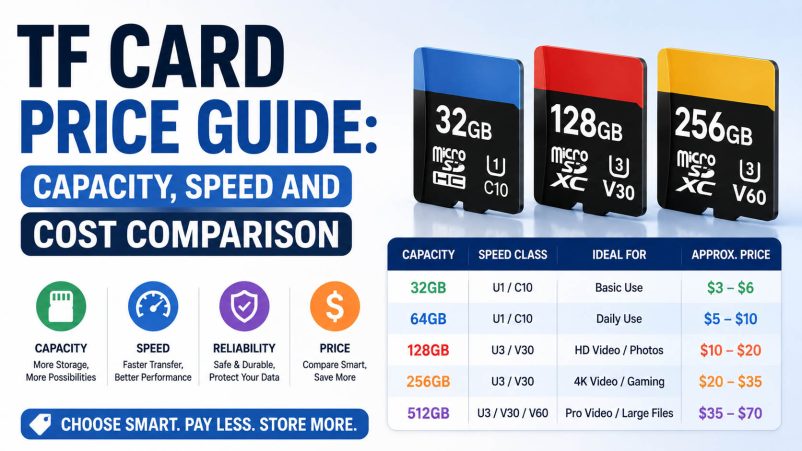
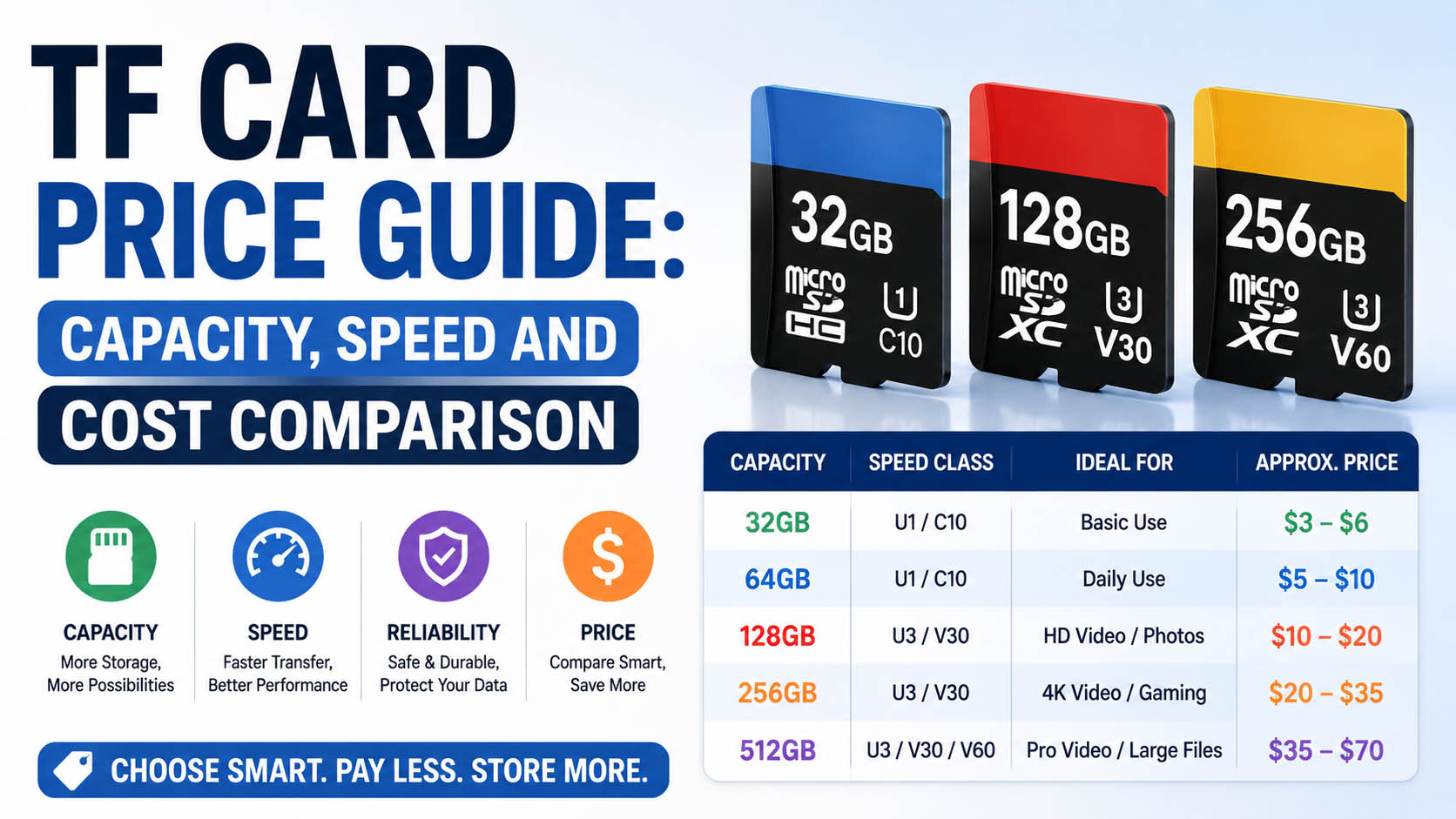
| Capacity | Typical Speed | Common Application | Market Position |
|---|---|---|---|
| 32GB | C10 / U1 | Basic storage, simple devices | Entry |
| 64GB | C10 / U1 | Photos, basic video | Budget |
| 128GB | U1 / U3 / V30 | Cameras, phones, drones | Mainstream |
| 256GB | U3 / V30 | 4K video, gaming | Best value |
| 512GB | U3 / V30/V60 | Professional use | High capacity |
| 1TB+ | High performance | Large media storage | Premium |
Best overall balance for most users: 128GB–256GB.
TF Card Price by Capacity
Prices vary depending on NAND type, speed class, brand, supply conditions and order quantity.
| Capacity | Consumer Range | Best For |
|---|---|---|
| 32GB | Low cost | Basic devices |
| 64GB | Affordable | Everyday storage |
| 128GB | Mid range | Cameras, phones |
| 256GB | Higher value | Video + gaming |
| 512GB | Premium | Heavy storage |
| 1TB+ | High price | Professional workloads |
Higher capacity does not always mean better performance.
Why TF Card Prices Are Different
Two TF cards with the same capacity can have different prices because of internal components and quality standards.
| Factor | Impact on Price |
|---|---|
| NAND flash quality | High |
| Controller | High |
| Speed class | High |
| Endurance rating | High |
| Testing standard | Medium |
| Packaging | Medium |
| Brand premium | Medium |
| Order quantity | High |
TF Card Speed and Price Comparison
Higher performance usually increases cost.
| Speed Class | Minimum Write Level | Typical Use | Price Level |
|---|---|---|---|
| Class 10 | 10MB/s | Basic storage | Low |
| U1 | 10MB/s | General use | Low-Medium |
| U3 | 30MB/s | Cameras, 4K video | Medium |
| V30 | 30MB/s | Mainstream 4K | Medium |
| V60 | 60MB/s | Professional video | High |
| V90 | 90MB/s | High-end video | Premium |
For video applications, sustained write performance is usually more important than maximum read speed.
Best TF Card Choice by Application
| Application | Recommended Capacity | Recommended Speed |
|---|---|---|
| Smartphone | 128GB–512GB | U1/U3 |
| Digital camera | 64GB–256GB | U3/V30 |
| Professional camera | 256GB–1TB+ | V60/V90 |
| Action camera | 128GB–256GB | U3/V30 |
| Drone | 128GB–512GB | U3/V30 |
| Dash cam | 64GB–256GB | High Endurance |
| Security camera | 128GB–512GB | High Endurance |
| Gaming | 256GB–1TB+ | High read performance |
How to Calculate TF Card Value
The cheapest card is not always the best value.
A better evaluation:
Total Value = Price + Performance + Reliability + Lifespan
| Factor | Cheap Card | Higher Quality Card |
|---|---|---|
| Unit price | Lower | Higher |
| Speed consistency | Variable | Better |
| Failure risk | Higher | Lower |
| Lifespan | Shorter | Longer |
| Warranty cost | Higher | Lower |
| Brand reputation | Lower | Higher |
NAND Flash: The Core Cost Factor
NAND flash is the main storage component inside a TF card.
| NAND Factor | Effect |
|---|---|
| Flash quality | Reliability |
| Density | Capacity |
| Supply availability | Price stability |
| Endurance | Product lifespan |
| Batch consistency | Product quality |
A stable NAND supply helps suppliers maintain consistent pricing and performance.
Controller Impact on TF Card Price
The controller manages communication between NAND and the host device.
| Controller Function | Importance |
|---|---|
| Flash management | High |
| Error correction | High |
| Compatibility | High |
| Performance control | High |
| Wear management | High |
A low-cost controller may reduce price but can affect stability and compatibility.
Supply Chain Advantages for TF Card Buyers
For distributors and brands, supply chain capability directly affects cost and quality.
| Supply Capability | Buyer Benefit |
|---|---|
| Stable NAND sourcing | Lower price fluctuation |
| Multiple suppliers | Lower supply risk |
| Controller matching | Better performance |
| Component qualification | Stable batches |
| Production planning | Reliable delivery |
| Batch traceability | Easier quality control |
| Testing capability | Lower return rates |
| Multiple capacities | Complete product range |
A strong supplier provides more than a low quotation.
OEM TF Card Solutions
OEM/private-label TF cards allow brands to create customized memory products.
OEM Customization Options
| Item | Options |
|---|---|
| Capacity | 32GB–1TB+ |
| Speed | C10/U1/U3/V30/V60/V90 |
| Application | Camera, gaming, automotive, industrial |
| Label | Logo + specifications |
| Packaging | Box/blister/bulk |
| Barcode | Customized |
| Manual | Customized |
| Warranty card | Customized |
| Adapter | Optional |
OEM Development Process
| Step | Process |
|---|---|
| 1 | Define application |
| 2 | Select capacity |
| 3 | Select speed requirement |
| 4 | Match NAND + controller |
| 5 | Sample testing |
| 6 | Performance verification |
| 7 | Packaging design |
| 8 | Mass production |
| 9 | Batch QC |
OEM development helps brands create stable products instead of competing only on price.
TF Card Quality Control
| QC Test | Purpose |
|---|---|
| Capacity test | Verify real storage |
| Read/write test | Verify performance |
| Sustained write test | Video stability |
| Speed-class test | Specification check |
| Device compatibility | Application testing |
| Aging test | Reliability |
| Appearance check | Product quality |
| Batch tracking | After-sales support |
Wholesale TF Card Buying Guide
| Buyer Requirement | Recommended Focus |
|---|---|
| Low price | Capacity + basic performance |
| Camera market | U3/V30 + write speed |
| Dash cam market | High endurance |
| Gaming market | Capacity + read speed |
| Professional market | V60/V90 + reliability |
| OEM brand | Stable BOM + customization |
Common TF Card Buying Mistakes
| Mistake | Better Choice |
|---|---|
| Buying only by price | Compare total cost |
| Choosing only by capacity | Check speed |
| Looking only at read speed | Check write speed |
| Ignoring endurance | Match application |
| Ignoring compatibility | Test target devices |
| Changing components often | Keep stable BOM |
FAQ: TF Card Price and Selection
Why do TF cards with the same capacity have different prices?
Because NAND quality, controller, speed rating, endurance, testing standards and brand positioning can be different.
Is a cheaper TF card worth buying?
For simple storage, a low-cost card may be acceptable. For cameras, drones, gaming or continuous recording, reliability is usually more important.
Is 128GB better than 256GB?
Not always.
128GB is good for general use, while 256GB is better for 4K video, gaming and large files.
Does a faster TF card cost more?
Usually yes. Higher speed classes such as U3, V60 and V90 require higher-performance components and testing.
What is the best TF card for 4K video?
A U3/V30 card is a common starting point. Professional high-bitrate video may require V60 or V90.
What is the best TF card for dash cams?
A high-endurance TF card is recommended because dash cams continuously overwrite data.
Can TF cards be OEM customized?
Yes. OEM projects can include capacity, speed specification, logo, packaging, barcode and manuals.
What affects OEM TF card pricing?
Main factors include:
| Factor | Impact |
|---|---|
| Capacity | High |
| NAND cost | High |
| Speed requirement | High |
| Quantity | High |
| Packaging | Medium |
| Custom printing | Medium |
How can buyers get better wholesale prices?
Provide:
| Information | Example |
|---|---|
| Application | Camera |
| Capacity | 128GB |
| Speed | U3/V30 |
| Quantity | 10,000 pcs |
| Packaging | Private label |
| Market | USA |
| QC requirement | Performance testing |
A clear specification allows suppliers to optimize sourcing and production.
Final TF Card Buying Recommendation
| User Type | Recommended Choice |
|---|---|
| Basic user | 32GB–64GB |
| Everyday user | 128GB |
| Camera/video user | 128GB–256GB U3/V30 |
| Professional user | 256GB–1TB+ |
| Dash cam user | High endurance 128GB–256GB |
| OEM buyer | Customized stable supply solution |
The best TF card is not the cheapest product. It is the product that balances:
Capacity + Speed + Reliability + Supply Stability + Total Cost
For brands and distributors, competitive advantage comes from:
Qualified NAND sourcing + matched controller + strict QC + OEM customization + stable supply chain.