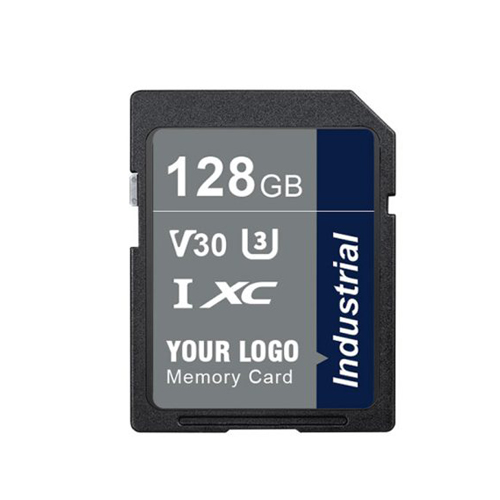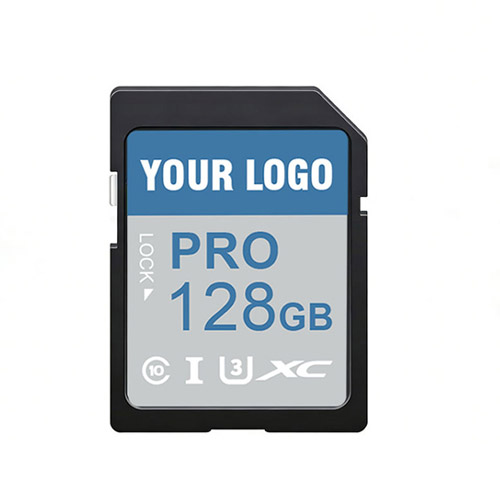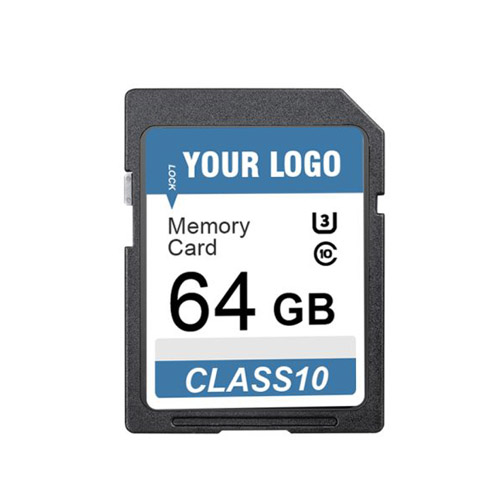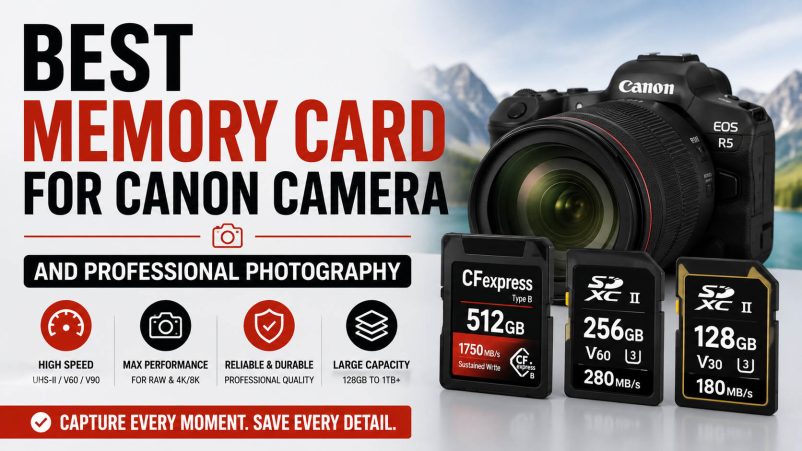
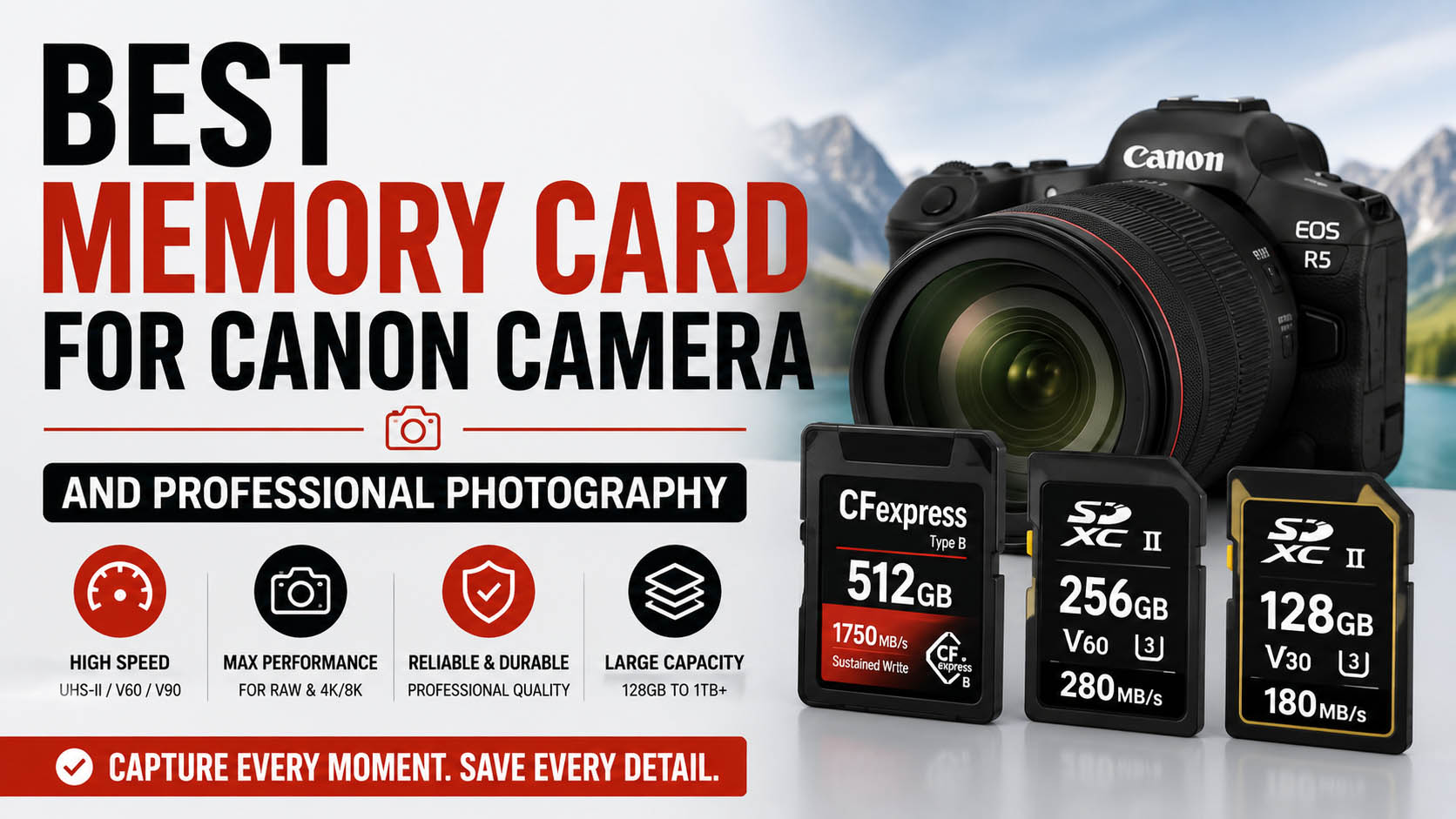
Choosing the best memory card for a Canon camera depends on the camera model, shooting mode and recording format. For professional photography, write performance, sustained performance, capacity and compatibility are usually more important than peak read speed.
Canon cameras do not all use the same storage format. For example, the EOS R5 supports CFexpress Type B and UHS-II SD cards, while Canon specifies different card-performance requirements for different video modes.
Quick Answer: Best Memory Card for Canon Cameras
| Canon Use | Recommended Card | Capacity |
|---|---|---|
| Casual photography | SD UHS-I/UHS-II | 64GB–128GB |
| RAW photography | SD UHS-II U3/V60 | 128GB–256GB |
| Burst photography | UHS-II V60/V90 | 128GB–512GB |
| 4K video | UHS-II V60/V90 | 128GB–512GB |
| Professional 4K/8K | CFexpress Type B where supported | 256GB–1TB+ |
| Professional workflow | CFexpress Type B + SD backup | 256GB–1TB+ |
Important: Always check the exact Canon camera model before purchasing. Card requirements can differ significantly between models and recording modes.
Canon Camera Memory Card Compatibility
| Card Type | Typical Canon Application | Performance Position |
|---|---|---|
| SD | Entry/mainstream cameras | Standard |
| SD UHS-I | Photography + basic video | Mainstream |
| SD UHS-II | Professional photography/video | High performance |
| CFexpress Type B | High-end RAW/video | Professional |
| microSD/TF + adapter | Model-dependent | Not preferred for professional workflows |
For example, Canon’s EOS R5 officially supports CFexpress Type B and SD/SDHC/SDXC cards compatible with UHS-II.
Best Memory Card Capacity for Canon Photography
| Capacity | Best For | Recommendation |
|---|---|---|
| 64GB | Casual photography | Entry |
| 128GB | Everyday RAW/JPEG | Best value |
| 256GB | Professional photography | Best balance |
| 512GB | Heavy RAW/video | High capacity |
| 1TB+ | Professional video | Specialized |
For professional photography, 128GB–256GB is often a practical range because it balances capacity, cost and data-management risk.
Best Speed Class for Canon Cameras
| Rating | Minimum Sequential Write Class | Typical Use |
|---|---|---|
| U1 | 10 MB/s | Basic photography/video |
| U3 | 30 MB/s | RAW + demanding video |
| V30 | 30 MB/s | Mainstream 4K |
| V60 | 60 MB/s | Professional 4K |
| V90 | 90 MB/s | High-bitrate video |
For high-end Canon cameras, UHS-II + V60/V90 is often a practical starting point for demanding SD workflows, but the camera’s own recording specification should take priority.
V60 vs V90 for Canon
| Requirement | V60 | V90 |
|---|---|---|
| RAW photography | Excellent | Excellent |
| Burst shooting | Excellent | Excellent |
| 4K video | Excellent | Excellent |
| High-bitrate video | Good | Better |
| Cost | Lower | Higher |
| Best for | Professional mainstream | Maximum SD performance |
Don’t automatically buy V90. If the camera requires V60, a V90 card may offer limited additional value.
CFexpress vs SD for Professional Canon Cameras
High-end Canon models can benefit significantly from CFexpress when shooting demanding video or long bursts.
Canon’s EOS R5, for example, supports CFexpress Type B and UHS-II SD, and Canon’s published specifications show substantially larger RAW burst capacity when using CFexpress compared with SD.
| Feature | UHS-II SD | CFexpress Type B |
|---|---|---|
| Cost | Lower | Higher |
| Compatibility | Broad | Camera-specific |
| Burst performance | High | Very high |
| 4K video | Excellent | Excellent |
| 8K RAW | Model-dependent | Preferred where supported |
| Professional workflow | Excellent | Premium |
Canon EOS R5 Example
The EOS R5 is a useful example of why card selection must be based on the camera model.
| EOS R5 Requirement | Card |
|---|---|
| Still photography | CFexpress / UHS-II SD |
| 8K RAW | CFexpress |
| High-bitrate video | CFexpress / high-speed SD depending on mode |
| Standard 4K | UHS-II SD can be suitable |
| Backup workflow | Dual-card configuration |
Canon’s compatibility information specifies different card requirements for different recording modes, including V60/V90 requirements for certain SD video modes and CFexpress performance requirements for demanding 8K/4K modes.
Best Memory Card Brand for Canon Cameras
| Brand | Strongest Position | Best For |
|---|---|---|
| SanDisk | Broad professional ecosystem | Photo + video |
| Lexar | Performance/value | RAW + video |
| ProGrade Digital | Professional workflow | CFexpress + SD |
| Sony | High-end storage | Professional photography |
| Kingston | Broad portfolio/value | General + professional |
| OEM/Private Label | Flexible specification | Brands + distributors |
The specific product series is more important than the brand name alone.
For example, a professional V90 card and an entry-level U1 card from the same manufacturer are designed for very different workloads.
How to Choose a Canon Memory Card
| Priority | What to Check |
|---|---|
| 1 | Exact Canon camera model |
| 2 | Card type |
| 3 | Recording mode |
| 4 | Required speed class |
| 5 | Sustained write performance |
| 6 | Capacity |
| 7 | Endurance |
| 8 | Warranty |
| 9 | Price |
Best Memory Card for Canon RAW Photography
RAW files are much larger than JPEG files, making capacity and write performance important.
| Photographer | Recommended |
|---|---|
| Casual RAW | 128GB UHS-II |
| Wedding | 128GB–256GB UHS-II |
| Sports | 256GB UHS-II V60/V90 |
| Wildlife | 256GB–512GB UHS-II |
| Commercial | 256GB+ / multiple cards |
| Professional video + photo | CFexpress + SD |
For important professional work, using multiple cards and maintaining backups is safer than relying on a single high-capacity card.
Best Memory Card for Canon 4K Video
| Video Workload | Recommended Starting Point |
|---|---|
| Basic 4K | U3/V30 where supported |
| High-quality 4K | UHS-II V60 |
| High-bitrate 4K | V60/V90 or CFexpress |
| Professional workflow | CFexpress Type B where supported |
Canon’s own compatibility documentation emphasizes using cards with sufficient writing and reading performance for the selected recording quality.
Best Memory Card for Canon 8K Video
For Canon cameras supporting 8K RAW, CFexpress Type B is generally the appropriate storage category.
Canon’s EOS R5 documentation specifies CFexpress performance requirements for 8K RAW and other high-data-rate recording modes.
| Requirement | Recommended Direction |
|---|---|
| 8K RAW | CFexpress Type B |
| High bitrate | High sustained write |
| Long recording | Higher capacity |
| Professional production | 512GB–1TB+ |
Why Sustained Write Matters
A memory card’s maximum advertised write speed does not tell the entire story.
| Specification | Importance |
|---|---|
| Maximum read | File transfer |
| Maximum write | Peak recording |
| Sustained write | Continuous recording |
| Speed class | Minimum standardized performance |
| Random performance | Certain workloads |
For professional video, sustained write performance should be evaluated alongside peak specifications.
NAND Flash and Controller
A professional memory card is a combination of:
NAND + Controller + Firmware + PCB + QC
| Component | Impact |
|---|---|
| NAND | Capacity + cost + endurance |
| Controller | Performance + compatibility |
| Firmware | Stability + flash management |
| PCB | Electrical performance |
| QC | Batch consistency |
Two cards with identical capacity can therefore have different performance, endurance and prices.
Supply Chain Advantages for Professional Memory Cards
For distributors, camera-accessory brands and OEM buyers, component sourcing is an important part of product competitiveness.
| Supply Capability | Business Benefit |
|---|---|
| Stable NAND sourcing | Better supply continuity |
| Multiple qualified channels | Lower component risk |
| Controller matching | Better compatibility |
| Component qualification | Consistent batches |
| Capacity planning | Predictable delivery |
| Performance testing | Lower failure risk |
| Batch traceability | Better after-sales |
| Multiple capacities | Complete SKU portfolio |
| Long-term planning | Stable replenishment |
A competitive supplier should provide stable quality and supply, not simply a low unit price.
OEM Memory Card Solutions for Camera Brands
Camera-accessory brands can develop private-label memory cards for Canon-compatible photography and video applications.
OEM Customization Options
| OEM Item | Options |
|---|---|
| Capacity | 64GB–1TB+ |
| Interface | SD / UHS-II / CFexpress Type B |
| Speed | U3 / V30 / V60 / V90 |
| Endurance | Standard / application-specific |
| Label | Brand logo |
| Card design | Customized |
| Packaging | Box / blister / bulk |
| Barcode | Customized |
| Manual | Customized |
| Warranty card | Customized |
| Retail artwork | Private label |
OEM Development Process
| Step | Process |
|---|---|
| 1 | Define Canon application |
| 2 | Select card type |
| 3 | Define capacity |
| 4 | Define sustained write |
| 5 | Match NAND + controller |
| 6 | Sample production |
| 7 | Camera compatibility testing |
| 8 | Capacity/speed QC |
| 9 | Packaging design |
| 10 | Pilot + mass production |
For professional products, actual camera compatibility testing is especially valuable.
Quality Control for Professional Camera Cards
| QC Test | Purpose |
|---|---|
| Capacity verification | Confirm actual capacity |
| Read/write test | Verify performance |
| Sustained write | Check recording stability |
| Speed-class test | Verify specification |
| Canon camera test | Confirm compatibility |
| Long-duration recording | Evaluate stability |
| Aging test | Identify unstable units |
| Label inspection | Verify OEM |
| Batch traceability | Support warranty |
How to Compare Wholesale Memory Card Suppliers
| Question | Why It Matters |
|---|---|
| What NAND is used? | Component quality |
| Which controller? | Compatibility |
| Sustained write? | Video stability |
| Device testing? | Camera compatibility |
| QC process? | Batch consistency |
| Stable BOM? | Repeat-order consistency |
| OEM packaging? | Brand development |
| MOQ? | Purchasing flexibility |
| Lead time? | Inventory planning |
| Warranty? | After-sales support |
Common Canon Memory Card Buying Mistakes
| Mistake | Better Approach |
|---|---|
| Choosing only by capacity | Check camera requirements |
| Choosing only by read speed | Check sustained write |
| Using U1 for demanding video | Match required speed class |
| Buying V90 automatically | Buy according to workload |
| Ignoring CFexpress | Check high-end camera requirements |
| Using an unverified card | Check authenticity + QC |
| Buying only one large card | Consider multiple-card workflow |
| Choosing only by price | Compare total cost |
FAQ: Best Memory Card for Canon Camera
What is the best memory card for a Canon camera?
For general professional photography, 128GB–256GB UHS-II U3/V60 or V90 is a strong starting point. High-end Canon cameras may require or benefit from CFexpress Type B for demanding video and burst shooting.
What is the best SD card for Canon?
For demanding photography and video, look for UHS-II with U3/V60 or V90, provided your Canon camera supports UHS-II.
Is V60 enough for Canon cameras?
For many professional SD-based workflows, yes. Some high-bitrate recording modes require V90 or CFexpress. Always check the exact camera’s recording requirements.
Is V90 better than V60?
V90 provides a higher minimum sequential write-performance class, but it is not automatically better value. Choose according to the camera’s recording requirements.
What size memory card is best for Canon?
128GB–256GB is a practical range for many photographers. 512GB or larger can be useful for long video sessions and high-volume professional work.
Is 128GB enough for RAW photography?
Yes, for many shooting sessions. Wedding, sports, wildlife and commercial photographers may prefer 256GB or multiple cards.
Is CFexpress better than SD?
For supported Canon cameras and demanding workloads, CFexpress offers substantially higher performance potential. But SD remains more cost-effective for many photography workflows.
Can I use a microSD/TF card in a Canon camera?
Only if the camera supports the relevant adapter configuration. For professional work, a native SD or CFexpress card is generally preferable when specified by Canon.
Which brand is best for Canon cameras?
SanDisk, Lexar, ProGrade Digital, Sony and other established manufacturers offer professional memory-card products. Specific model specifications and camera compatibility are more important than brand alone.
Can memory cards be OEM customized?
Yes. OEM projects can include capacity, speed, logo, card label, packaging, barcode, manuals and private-label retail design.
What MOQ is required for OEM camera memory cards?
MOQ depends on the card type, capacity, NAND/controller configuration, packaging and customization requirements. Standard products generally provide more flexible quantities.
How can I get a competitive wholesale price?
Provide the supplier with:
| Information | Example |
|---|---|
| Camera | Canon EOS model |
| Application | RAW / 4K / 8K |
| Card type | UHS-II SD / CFexpress |
| Capacity | 256GB |
| Speed | V60 / V90 |
| Quantity | 10,000 pcs |
| Packaging | Private label |
| Market | USA |
| QC | Camera + performance testing |
A detailed RFQ allows better component sourcing, production planning and cost optimization.
Final Canon Memory Card Buying Checklist
| Check Before Buying | ✓ |
|---|---|
| Exact Canon model | ✓ |
| Supported card type | ✓ |
| UHS-I/UHS-II | ✓ |
| CFexpress Type B | ✓ |
| Capacity | ✓ |
| U3/V30/V60/V90 | ✓ |
| Sustained write | ✓ |
| Recording mode | ✓ |
| Camera compatibility | ✓ |
| Warranty | ✓ |
Final Recommendation
For most professional Canon photography:
UHS-II + V60/V90 + 128GB–256GB is a practical starting point.
For high-end RAW and professional video:
CFexpress Type B + 256GB–1TB+ may be the better solution where supported.
The key is to match the card to the exact Canon camera and recording mode. Canon’s official specifications demonstrate that different recording modes can require very different card performance.
For wholesalers and OEM brands, the strongest product strategy combines:
Qualified NAND + matched controller + sustained-performance testing + Canon compatibility testing + stable supply chain + OEM customization.
This creates a reliable memory-card solution for Canon photography, RAW burst shooting, 4K/8K video and professional imaging workflows, rather than competing on price alone.