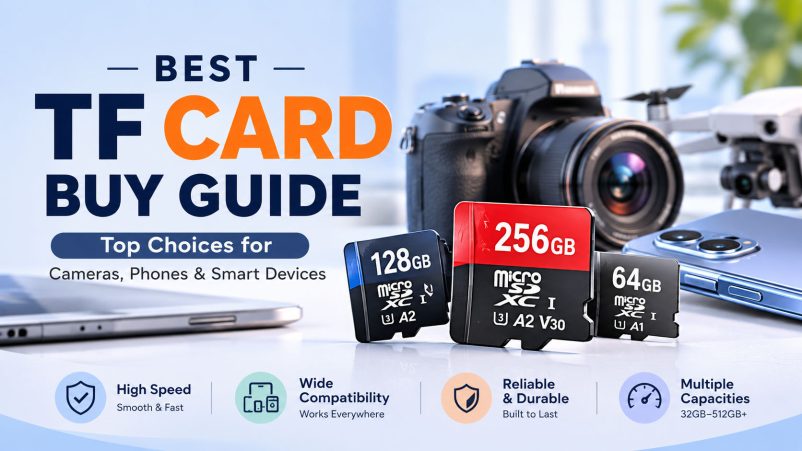
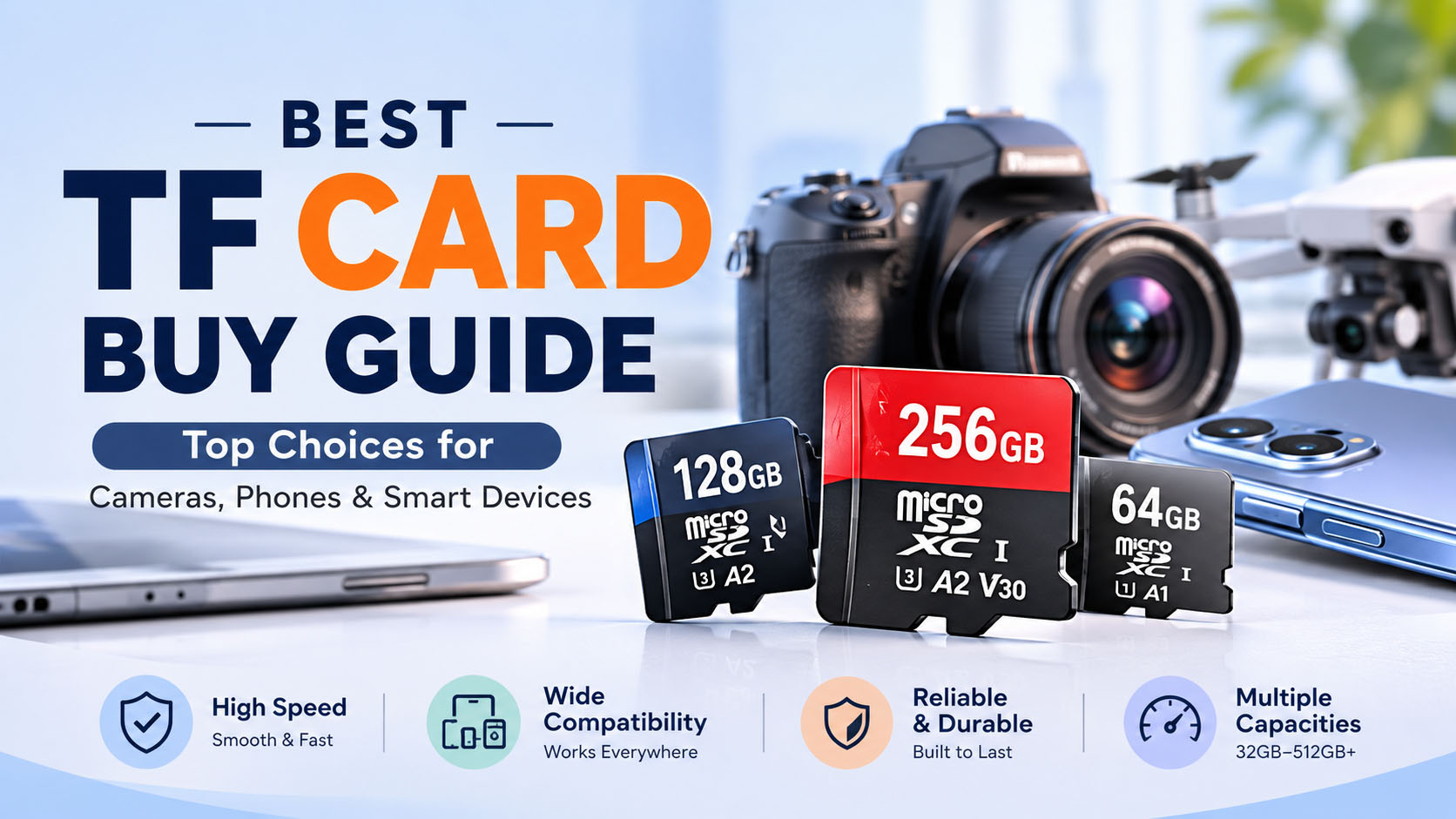
Choosing the best TF card is not simply about buying the largest capacity or the highest advertised read speed. The right TF card depends on the device, storage capacity, recording workload, speed requirement, application performance, endurance, and compatibility.
For most buyers, the selection can be simplified into four main questions:
| Question | What to Check |
|---|---|
| How much storage? | 64GB, 128GB, 256GB, 512GB or more |
| How fast? | C10, U1, U3, V30, V60, V90 |
| What application? | Camera, phone, dash cam, CCTV, gaming, smart device |
| How durable? | Standard or high-endurance |
For B2B buyers, there are additional considerations:
NAND flash quality + controller + firmware + supply-chain stability + quality testing + OEM capability
The SD Association currently defines SDHC/microSDHC as over 2GB to 32GB, SDXC/microSDXC as over 32GB to 2TB, and SDUC/microSDUC as over 2TB to 128TB.
Quick Guide: Which TF Card Should You Buy?
If you need a quick answer, use this table as a starting point.
| Application | Recommended Capacity | Recommended Performance | Endurance Priority |
|---|---|---|---|
| Smartphone Photos & Files | 64GB–256GB | C10/U1, A1/A2 | Low–Medium |
| Android App Storage | 128GB–512GB | A2 preferred when supported | Medium |
| Digital Camera | 64GB–256GB | C10/U3 depending on video | Medium |
| 4K Camera | 128GB–512GB | U3/V30 or higher | Medium |
| Action Camera | 64GB–256GB | U3/V30 | Medium |
| 1080P Dash Cam | 64GB–128GB | C10 + High Endurance | High |
| 2K Dash Cam | 128GB–256GB | U3/V30 + High Endurance | High |
| 4K Dash Cam | 256GB–512GB | U3/V30 + High Endurance | Very High |
| Home CCTV | 128GB–256GB | C10/U3 + High Endurance | High |
| 4K Surveillance | 256GB–512GB+ | U3/V30 + High Endurance | Very High |
| Gaming / Handheld Device | 128GB–1TB+ | Device-specific | Medium |
| Industrial Smart Device | Application-specific | Application-specific | High |
These are general purchasing guidelines. The host device’s supported capacity and required speed class should always take priority.
What Is a TF Card?
A TF card, or TransFlash card, is the compact storage format that evolved into what is now commonly called a microSD card.
Today, the terms TF card and microSD card are often used interchangeably in consumer electronics and B2B purchasing searches.
MicroSD cards are widely used in:
- Smartphones
- Tablets
- Digital cameras
- Action cameras
- Dash cams
- CCTV cameras
- Surveillance equipment
- Gaming devices
- Vehicle electronics
- IoT devices
- Industrial equipment
The microSD form factor is approximately 11 × 15 × 1.0 mm, according to the SD Association.
TF Card vs microSD Card: Are They the Same?
For modern purchasing purposes, TF card and microSD card generally refer to the same physical card family, but “microSD” is the standardized industry terminology.
| Term | Meaning |
|---|---|
| TF Card | Common commercial/legacy name |
| TransFlash | Original name associated with the format |
| microSD | Standardized industry name |
| microSDHC | microSD using SDHC capacity standard |
| microSDXC | microSD using SDXC capacity standard |
| microSDUC | microSD using SDUC capacity standard |
For SEO and international procurement, using both TF card and microSD card is useful because buyers search using both terms.
What Makes a TF Card “Good”?
A good TF card should be evaluated across multiple specifications rather than one number.
| Specification | What It Determines |
|---|---|
| Capacity | How much data can be stored |
| Speed Class | Minimum sustained sequential performance |
| Bus Interface | Data-transfer capability between host and card |
| Read Speed | File-transfer performance |
| Write Speed | Recording and data-writing performance |
| A1/A2 | Application-oriented random performance |
| Endurance | Suitability for repeated writing |
| NAND Flash | Storage quality and architecture |
| Controller | Flash and data management |
| Firmware | Performance, compatibility and reliability |
| Temperature Rating | Environmental suitability |
| Testing | Actual product consistency |
The SD Association explains that Speed Class markings exist because video recording requires a sufficiently consistent minimum writing performance rather than relying only on variable peak transfer speeds.
TF Card Speed Class Explained
One of the most important things to understand when buying a TF card is the difference between C10, U1, U3, V30, V60 and V90.
| Rating | Minimum Class Write Performance | Typical Positioning |
|---|---|---|
| C10 | 10MB/s | HD / Full HD |
| U1 | 10MB/s | HD / Full HD |
| U3 | 30MB/s | Higher-bitrate video |
| V10 | 10MB/s | Video |
| V30 | 30MB/s | 4K-oriented video |
| V60 | 60MB/s | High-performance video |
| V90 | 90MB/s | Professional high-bitrate video |
The SD Association lists C10/U1/V10 among the classes used for HD to Full HD recording, while U3/V30 and higher classes support more demanding video workloads.
Important:
C10 does not mean the card has a maximum speed of 10MB/s.
It indicates a minimum sequential performance class under defined conditions.
Similarly, a card advertised with “up to 100MB/s read” can still carry a C10 marking because read speed and Speed Class address different characteristics.
C10 vs U1 vs U3 vs V30
For buyers who are unsure which symbol to choose:
| Feature | C10 | U1 | U3 | V30 |
|---|---|---|---|---|
| Minimum Class Performance | 10MB/s | 10MB/s | 30MB/s | 30MB/s |
| Application Focus | General/video | UHS video | UHS video | Video |
| Full HD | Suitable for many devices | Suitable | Suitable | Suitable |
| 4K | Device dependent | Often insufficient for demanding use | Stronger choice | Stronger choice |
| Dash Cam | Basic | Basic | Better for higher bitrate | Better for higher bitrate |
| Surveillance | Basic | Basic | Better | Better |
| High Endurance | Separate characteristic | Separate | Separate | Separate |
C10/U1 and U3/V30 should not be treated as identical labels merely because some performance numbers overlap. The host device and bus/interface requirements also matter.
What Is the Best TF Card for a Camera?
For a digital camera, the best TF card depends primarily on whether you are taking photos, recording Full HD, shooting 4K, or using continuous/burst shooting.
| Camera Usage | Suggested Starting Point |
|---|---|
| JPEG Photography | C10/U1 |
| RAW Photography | U3 or higher depending on camera |
| Full HD Video | C10/U1/V10 |
| 4K Video | U3/V30 or higher |
| High-Bitrate 4K | V30/V60 or device-specific |
| Professional Video | V60/V90 or device-specific |
For burst photography, write performance is particularly important because the camera needs to transfer buffered image data to the card.
For high-resolution video, sustained write performance is critical.
The SD Association specifically notes that Speed Class is intended to help ensure reliable video recording by defining minimum sequential performance under specified conditions.
What Is the Best TF Card for a Smartphone?
Smartphone use is different from camera recording.
If the card is primarily used for:
- Photos
- Videos
- Music
- Documents
- Downloads
a reliable C10/U1 card can be sufficient for many devices.
If the smartphone uses the card for applications or application data, A1/A2 becomes more relevant.
The SD Association developed Application Performance Class specifically to address application-related workloads involving random and sequential performance.
| Smartphone Usage | Recommended Direction |
|---|---|
| Photos | C10/U1 |
| Music | C10/U1 |
| Documents | C10/U1 |
| Movies | C10/U1 |
| General Android Storage | C10/U1 |
| App Data | A1 |
| Application-Heavy Use | A2 when host supports A2 |
| Large Media Library | 128GB–512GB+ |
A1 vs A2 for Phones
A2 offers higher application-performance requirements than A1 and introduces features such as Command Queuing, Cache and Maintenance functions. However, A2 performance requires both an A2-compatible card and A2-capable host device.
What Is the Best TF Card for Android Apps?
If a smartphone supports using a microSD card for application storage, an A1 or A2-rated card may be more appropriate than choosing based solely on C10.
| Feature | A1 | A2 |
|---|---|---|
| Random Read Requirement | 1,500 IOPS | 4,000 IOPS |
| Random Write Requirement | 500 IOPS | 2,000 IOPS |
| Sustained Sequential | 10MB/s | 10MB/s |
| Application Use | Good | Better when host supports A2 |
| Best For | Basic app workloads | More demanding app workloads |
The A2 requirements are based on measurements under the conditions defined in the SD specification.
What Is the Best TF Card for a Dash Cam?
For a dash cam, endurance is often more important than peak read speed.
A dash cam can repeatedly:
Record → Save → Overwrite → Record Again
This creates a much heavier write workload than normal smartphone file storage.
| Dash Cam | Recommended Starting Point |
|---|---|
| 1080P | C10 + High Endurance |
| 2K | U3/V30 + High Endurance |
| 4K | U3/V30 + High Endurance |
| Front + Rear | U3/V30 + High Endurance |
| Parking Mode | High Endurance + Temperature Qualification |
| Fleet Vehicle | High Endurance + Long-Term Supply |
For dash cams, avoid selecting a card solely because it advertises a high read speed.
Focus on:
Endurance + sustained write performance + temperature resistance + compatibility
What Is the Best TF Card for CCTV and Surveillance?
For CCTV, the storage workload can be continuous.
A surveillance camera may write video:
- 24 hours per day
- 7 days per week
- For months
- With repeated overwriting
Therefore, high endurance becomes a major consideration.
| CCTV Requirement | Importance |
|---|---|
| Capacity | ★★★★★ |
| Sustained Write | ★★★★★ |
| High Endurance | ★★★★★ |
| Temperature Resistance | ★★★★☆ |
| NAND Quality | ★★★★☆ |
| Controller | ★★★★☆ |
| Peak Read Speed | ★★☆☆☆ |
For continuous recording, a high-endurance TF/microSD card is generally more appropriate than a standard consumer card.
What Is the Best TF Card for Smart Devices?
“Smart devices” covers a wide range of products.
| Smart Device | Recommended Card Direction |
|---|---|
| Smart Speaker | C10/U1 if supported |
| Android Tablet | C10/U1/A1/A2 |
| Smart Camera | C10 + Endurance |
| Doorbell Camera | High Endurance |
| Vehicle Monitor | High Endurance |
| GPS Device | C10/U1 |
| Handheld Gaming Device | High Capacity + Device-Specific Speed |
| IoT Device | Application-Specific |
| Industrial Controller | Industrial / High-Endurance |
The right card should always be matched to the device’s interface, capacity limit, operating environment and workload.
How Much TF Card Capacity Do You Need?
Capacity should be based on recording time and data volume, not simply on what is currently available.
| Capacity | Typical Positioning |
|---|---|
| 32GB | Entry-level / short recording |
| 64GB | Basic Full HD |
| 128GB | Mainstream all-purpose |
| 256GB | 2K/4K and longer recording |
| 512GB | Long-duration/high-capacity |
| 1TB | Professional or specialized use |
| 2TB+ | Specialized devices with SDUC support |
The SD Association defines SDXC/microSDXC capacity from over 32GB up to 2TB, while SDUC/microSDUC extends beyond 2TB up to 128TB. However, a device must support the corresponding standard to use those capacities.
64GB vs 128GB vs 256GB vs 512GB
| Capacity | Best For | Main Advantage |
|---|---|---|
| 64GB | Basic cameras/phones | Low cost |
| 128GB | Mainstream devices | Best balance |
| 256GB | 2K/4K video | Longer recording |
| 512GB | Professional/long recording | Large storage |
| 1TB+ | Specialized applications | Maximum capacity |
For many mainstream applications, 128GB provides one of the best balances between capacity and cost.
For 4K recording or long-duration surveillance, 256GB or 512GB can be more practical.
How Much Video Can a TF Card Store?
Recording time depends heavily on bitrate.
A simplified formula is:
Storage per Hour ≈ Bitrate × 3,600 ÷ 8
For example, at 20Mbps:
20 × 3,600 ÷ 8 ≈ 9GB/hour
Estimated recording time:
| Capacity | 20Mbps Video | 50Mbps Video | 100Mbps Video |
|---|---|---|---|
| 64GB | ~7.1h | ~2.8h | ~1.4h |
| 128GB | ~14.2h | ~5.7h | ~2.8h |
| 256GB | ~28.4h | ~11.4h | ~5.7h |
| 512GB | ~56.9h | ~22.8h | ~11.4h |
| 1TB | ~113.8h | ~45.5h | ~22.8h |
These are theoretical calculations using decimal capacity and constant bitrate. Actual recording time can vary because of encoding, variable bitrate, audio, file-system overhead and device behavior.
Does a Bigger TF Card Mean a Faster TF Card?
No.
Capacity and performance are separate specifications.
| Card | Capacity | Speed Class | Is It Automatically Faster? |
|---|---|---|---|
| A | 64GB | C10 | No |
| B | 128GB | C10 | No |
| C | 256GB | C10 | No |
| D | 256GB | U3/V30 | Higher class performance |
| E | 512GB | U3/V30 | Higher capacity, not automatically faster |
The card’s internal NAND, controller, firmware, interface and host device all affect actual performance.
The SD Association notes that bus interfaces such as UHS-I, UHS-II and UHS-III provide different interface capabilities, while Speed Class separately addresses minimum performance requirements.
Read Speed vs Write Speed: Which Matters More?
The answer depends on the application.
| Application | More Important |
|---|---|
| Transferring videos to PC | Read speed |
| Copying photos | Read speed |
| Continuous video recording | Write performance |
| Dash Cam | Sustained write + endurance |
| CCTV | Sustained write + endurance |
| Smartphone apps | Random performance |
| Burst photography | Write performance |
For video recording, the ability to maintain the required write performance is particularly important.
Standard TF Card vs High-Endurance TF Card
| Feature | Standard TF Card | High-Endurance TF Card |
|---|---|---|
| General Storage | Excellent | Excellent |
| Photos | Excellent | Excellent |
| Music | Excellent | Excellent |
| Dash Cam | Application dependent | Recommended |
| CCTV | Application dependent | Recommended |
| 24/7 Recording | Limited suitability | Designed for this type of workload |
| Repeated Overwriting | Moderate | Higher priority |
| Cost | Lower | Usually higher |
| Best Value | General use | Intensive recording |
A high-endurance card is not necessarily the best choice for every phone or camera.
For ordinary storage, a standard card can provide better price-to-capacity value.
Why NAND Flash Quality Matters
From a storage-industry perspective, a TF card is more than its printed specifications.
The main internal components include:
NAND Flash + Controller + Firmware
Their combination affects:
- Capacity
- Read speed
- Write speed
- Endurance
- Data management
- Compatibility
- Reliability
Two 256GB TF cards can therefore have very different real-world characteristics even if both are labeled “256GB.”
For B2B buyers, NAND sourcing and component consistency are particularly important.
Why the Controller Matters
The controller manages communication between the host and NAND flash.
Its functions can include:
- Error correction
- Wear leveling
- Bad-block management
- Flash translation
- Data mapping
- Performance optimization
For general consumer storage, the controller needs to meet the intended performance requirements.
For dash cams, CCTV and other high-write applications, controller behavior becomes increasingly important because the card must repeatedly manage new data and overwritten data.
Why Firmware Matters
Firmware determines how the controller manages the NAND flash and interacts with the host device.
Depending on the design, firmware can affect:
- Write management
- Error correction
- Wear leveling
- Compatibility
- Performance consistency
- Data management
For OEM projects, a supplier with storage engineering capability can potentially optimize the NAND + controller + firmware combination around the target device.
Supply Chain Advantages in TF Card Manufacturing
For consumers, the internal supply chain may not be visible.
For wholesale and OEM buyers, it can directly affect product quality and business continuity.
A professional TF card supply chain can include:
NAND Sourcing → Controller Selection → Firmware → Assembly → Testing → Quality Control → Packaging → Shipment
| Supply-Chain Capability | Benefit to Buyer |
|---|---|
| Stable NAND sourcing | More consistent product batches |
| Bulk component procurement | Better factory cost |
| Controlled production | More consistent specifications |
| Capacity testing | Reduced counterfeit/under-capacity risk |
| Speed testing | Better performance consistency |
| Endurance testing | Better fit for intensive applications |
| Stable inventory planning | More predictable delivery |
| Long-term sourcing | Easier repeat orders |
| OEM integration | Faster customization |
For international distributors, stable supply can be as important as the initial quotation.
Why Component Consistency Matters for Repeat Orders
Imagine a distributor launches a private-label 128GB TF card.
The first production batch performs well.
If the supplier changes NAND or controller configurations significantly in later batches without proper validation, the product could behave differently.
Potential differences may include:
- Write performance
- Endurance
- Compatibility
- Power consumption
- Long-term reliability
For this reason, B2B buyers should ask:
Can the supplier maintain a stable product specification across repeat orders?
This is one of the most important questions when selecting an OEM TF card supplier.
OEM TF Card Solutions for Brands
An experienced OEM TF card manufacturer can provide more than a standard memory card.
Typical OEM capabilities include:
| OEM Service | Possible Solution |
|---|---|
| Logo | Custom brand logo |
| Card Label | Custom artwork |
| Packaging | Box / blister / paper packaging |
| Capacity | 64GB / 128GB / 256GB / 512GB |
| Speed | C10 / U1 / U3 / V30 |
| Endurance | Standard / High Endurance |
| Product Positioning | Camera / Phone / Dash Cam / CCTV |
| Barcode | Custom barcode |
| User Manual | Customized |
| Inspection | Customer-defined QC |
| Samples | Pre-production samples |
The exact options depend on the manufacturer’s production and engineering capabilities.
OEM Product Portfolio Example
A brand can build a product family based on different applications:
| Product | Positioning | Target Market |
|---|---|---|
| 64GB C10 TF Card | Entry | Basic devices |
| 128GB C10 TF Card | Mainstream | Phones/cameras |
| 128GB A2 microSD | App Performance | Android devices |
| 256GB U3/V30 | High Performance | 4K video |
| 128GB High Endurance | Recording | Dash cams |
| 256GB High Endurance | Long Recording | CCTV |
| 512GB U3/V30 | Large Capacity | Professional video |
This approach allows brands to offer multiple products without treating every customer application as identical.
How to Choose a Reliable TF Card Manufacturer
For B2B buyers, supplier selection should go beyond price.
| Evaluation Category | Questions to Ask |
|---|---|
| NAND | What is the source and configuration? |
| Controller | What controller platform is used? |
| Firmware | Is it optimized for the application? |
| Performance | What is the sustained write performance? |
| Endurance | Is endurance tested? |
| Capacity | How is actual capacity verified? |
| Compatibility | Has it been tested in the target device? |
| Quality | What production QC is performed? |
| Supply | Can the same specification be maintained? |
| OEM | Can logo/packaging be customized? |
| MOQ | What is the minimum order? |
| Lead Time | How quickly can repeat orders be delivered? |
| Warranty | What after-sales support is provided? |
How to Test a TF Card Before Bulk Purchasing
Before placing a large wholesale or OEM order, qualify samples.
| Test | Purpose |
|---|---|
| Capacity Verification | Confirm actual capacity |
| Sequential Read | Measure transfer performance |
| Sequential Write | Check writing capability |
| Sustained Write | Evaluate long-duration recording |
| Random Read/Write | Important for application workloads |
| Loop Recording | Simulate dash cam/CCTV use |
| Device Compatibility | Verify actual host performance |
| Temperature | Evaluate harsh environments |
| Endurance | Evaluate repeated writing |
| Batch Consistency | Compare multiple samples |
For B2B projects, testing only one sample is not enough. Multiple units should be evaluated, particularly when long-term supply is required.
Best TF Card Selection by Buyer Type
For Individual Consumers
Focus on:
Capacity + compatibility + required speed
| User | Recommended Direction |
|---|---|
| Phone user | 128GB–256GB |
| Casual photographer | 64GB–128GB |
| 4K camera user | 128GB–256GB+ |
| Dash cam user | 128GB High Endurance |
| CCTV user | 128GB–256GB High Endurance |
| Heavy video user | 256GB–512GB+ |
For Distributors
Focus on:
Cost + consistency + availability + product range
For Camera Brands
Focus on:
Sustained write + compatibility + performance consistency
For Dash Cam Brands
Focus on:
High endurance + sustained write + temperature + long-term supply
For Private-Label Brands
Focus on:
OEM + packaging + customization + stable component supply
High-Intent TF Card Keywords for International Procurement
Buyers do not always search for “TF card” alone.
High-intent searches often combine capacity + application + specification + supplier intent.
| Keyword Type | Examples |
|---|---|
| General | TF card supplier |
| Product | microSD card manufacturer |
| Capacity | 128GB TF card supplier |
| Speed | Class 10 TF card manufacturer |
| Video | U3 V30 microSD card supplier |
| Endurance | High endurance TF card manufacturer |
| Camera | TF card for camera |
| Phone | microSD card for Android |
| Dash Cam | TF card for dash cam |
| CCTV | Surveillance memory card supplier |
| OEM | OEM TF card manufacturer |
| Private Label | Private label microSD card supplier |
| Wholesale | Wholesale TF card supplier |
| Bulk | Bulk microSD card manufacturer |
| Custom | Custom memory card manufacturer |
These long-tail keywords are especially useful for B2B SEO because they indicate a more specific purchasing requirement.
How to Choose a TF Card by Application
Camera
Prioritize:
Capacity + sustained write + speed class
For 4K video, U3/V30 or higher may be appropriate depending on the camera.
Phone
Prioritize:
Capacity + compatibility + A1/A2 for application workloads
A2 only provides its full application-performance benefit when the host device also supports A2.
Dash Cam
Prioritize:
High endurance + sustained write + temperature resistance
CCTV
Prioritize:
High endurance + capacity + continuous-write stability
Gaming Device
Prioritize:
Capacity + host compatibility + application performance
Industrial Device
Prioritize:
Endurance + temperature + reliability + long-term supply
Common TF Card Buying Mistakes
Buying Only by Capacity
A 512GB card is not automatically better than a 128GB card for every application.
Buying Only by Read Speed
A high read speed does not guarantee suitable continuous write performance.
Ignoring Host Compatibility
A device may have a maximum supported capacity or speed class.
Assuming C10 Means High Endurance
C10 is a speed-class designation, not an endurance rating.
Assuming A2 Works at Full Performance Everywhere
A2 performance requires an A2-capable host and card combination.
Choosing the Cheapest Supplier
The lowest unit price can create higher costs if product quality and batch consistency are poor.
Skipping Sample Testing
A sample should be tested in the actual target device before mass production.
FAQ: Best TF Card Buy Guide
What is the best TF card?
There is no single best TF card for every device. For general storage, a reliable C10/U1 card with appropriate capacity is often sufficient. For 4K video, U3/V30 or higher may be more suitable, while dash cams and CCTV systems should prioritize high endurance.
Is a TF card the same as a microSD card?
In modern consumer electronics, TF card and microSD generally refer to the same physical card family. “MicroSD” is the standardized industry terminology.
What is the best TF card for a phone?
For photos, videos and files, 128GB–256GB C10/U1 storage can be a practical choice if supported. For application-heavy use, A1/A2 should also be considered. A2 requires an A2-supported host to deliver A2 performance.
What is the best TF card for a camera?
For basic photography and Full HD video, C10/U1 can be sufficient for many devices. For demanding 4K video, U3/V30 or higher may be required.
What is the best TF card for a dash cam?
A high-endurance TF/microSD card is generally recommended for dash cams, particularly for loop recording and parking mode. Higher-resolution cameras may require U3/V30 or higher.
Is Class 10 good enough for video?
Class 10 is a useful baseline for many HD and Full HD recording applications. More demanding video may require U3/V30, V60 or V90 depending on the host device.
Is U3 better than C10?
U3 has a higher minimum class write-performance requirement: 30MB/s versus 10MB/s for C10. They are different speed-class systems, so host compatibility also matters.
Is V30 good for 4K video?
V30 is designed around a 30MB/s minimum Video Speed Class performance under defined conditions and is commonly used for demanding video applications. However, the camera manufacturer’s requirements should always take priority.
How much storage should I buy?
For many users, 128GB provides a good balance between capacity and cost. Choose 256GB or 512GB when you need longer recording time or larger media libraries.
Is 512GB better than 256GB?
512GB provides twice the nominal capacity, but it is not automatically faster or more reliable. Compare speed class, endurance, compatibility, NAND quality and actual application requirements.
Can every phone use a 512GB TF card?
No. The phone must support the relevant capacity standard. The SD Association recommends checking the device manual or manufacturer’s specifications for compatibility.
What is A1 vs A2?
A1 and A2 are Application Performance Classes designed to define minimum random and sequential performance for application-related workloads. A2 provides higher requirements and additional functions, but full A2 performance requires an A2-compatible host.
Does a high-endurance TF card work in a phone?
Generally, if the physical format, capacity and interface are supported. However, high endurance is not necessary for ordinary smartphone storage unless the workload involves frequent writing.
What is the best TF card for CCTV?
A high-endurance card with suitable capacity and sustained write performance is generally a better choice for continuous surveillance recording than a standard consumer card.
What is the best TF card capacity for 4K video?
For many 4K applications, 256GB or 512GB provides a useful balance. High-bitrate professional recording may require more capacity.
Can I buy OEM TF cards with my own brand?
Yes. An experienced OEM memory card manufacturer can typically provide customized logos, card labels, packaging, capacities, speed classes and application-specific products.
What should I ask an OEM TF card manufacturer?
Ask about NAND sourcing, controller, firmware, sustained write performance, endurance testing, capacity verification, device compatibility, operating temperature, MOQ, lead time, OEM packaging, quality control and long-term supply stability.
TF Card Buying Decision Table
| If Your Priority Is… | Choose… |
|---|---|
| Lowest cost for basic storage | Standard C10/U1 |
| More smartphone storage | 128GB–256GB |
| Android application performance | A1/A2 |
| Full HD video | C10/U1/V10 |
| 4K video | U3/V30 or higher |
| Dash cam recording | High Endurance |
| 4K dash cam | U3/V30 + High Endurance |
| CCTV | High Endurance |
| Long-term surveillance | High Endurance + larger capacity |
| Professional video | V30/V60/V90 according to device |
| Private-label business | OEM + customized packaging |
| Wholesale procurement | Stable supply + factory QC |
| Long-term brand program | OEM + consistent component sourcing |
Final Verdict: How to Choose the Best TF Card
The best TF card is not necessarily the card with the highest capacity, fastest advertised read speed, or lowest price.
Choose according to the application:
Camera → Capacity + Sustained Write
Phone → Capacity + Compatibility + A1/A2 for Apps
4K Video → U3/V30 or Higher
Dash Cam → High Endurance + Sustained Write
CCTV → High Endurance + Capacity + Continuous-Write Stability
Industrial Device → Endurance + Temperature + Reliability
For B2B buyers, the selection criteria should go further:
Quality NAND + Reliable Controller + Optimized Firmware + Stable Supply Chain + Factory Testing + OEM Capability
A professional TF card manufacturer should be able to support the entire process from component sourcing and engineering to testing, customized branding, packaging, mass production and long-term supply.
For distributors, camera brands, smartphone accessory companies, dash cam manufacturers, CCTV businesses and private-label electronics brands, the most valuable supplier is not necessarily the one offering the lowest quotation. It is the supplier capable of delivering consistent specifications, competitive factory cost, reliable quality and stable supply at scale.
The best TF card is ultimately the one that matches the device, workload and business requirement—not simply the one with the biggest number printed on the package.