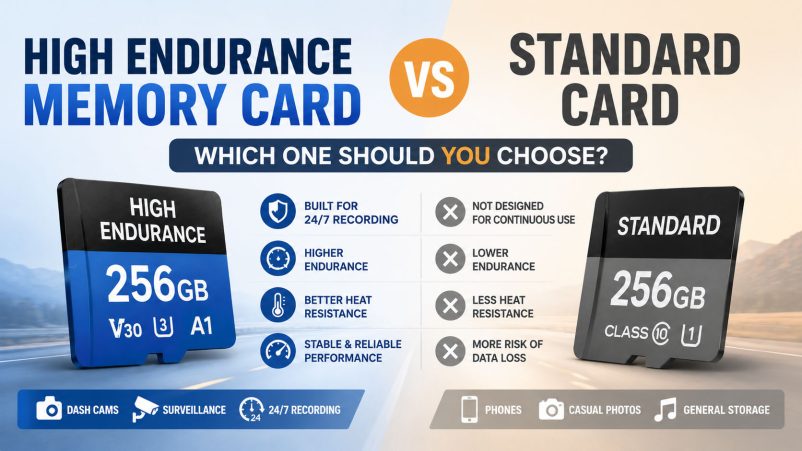
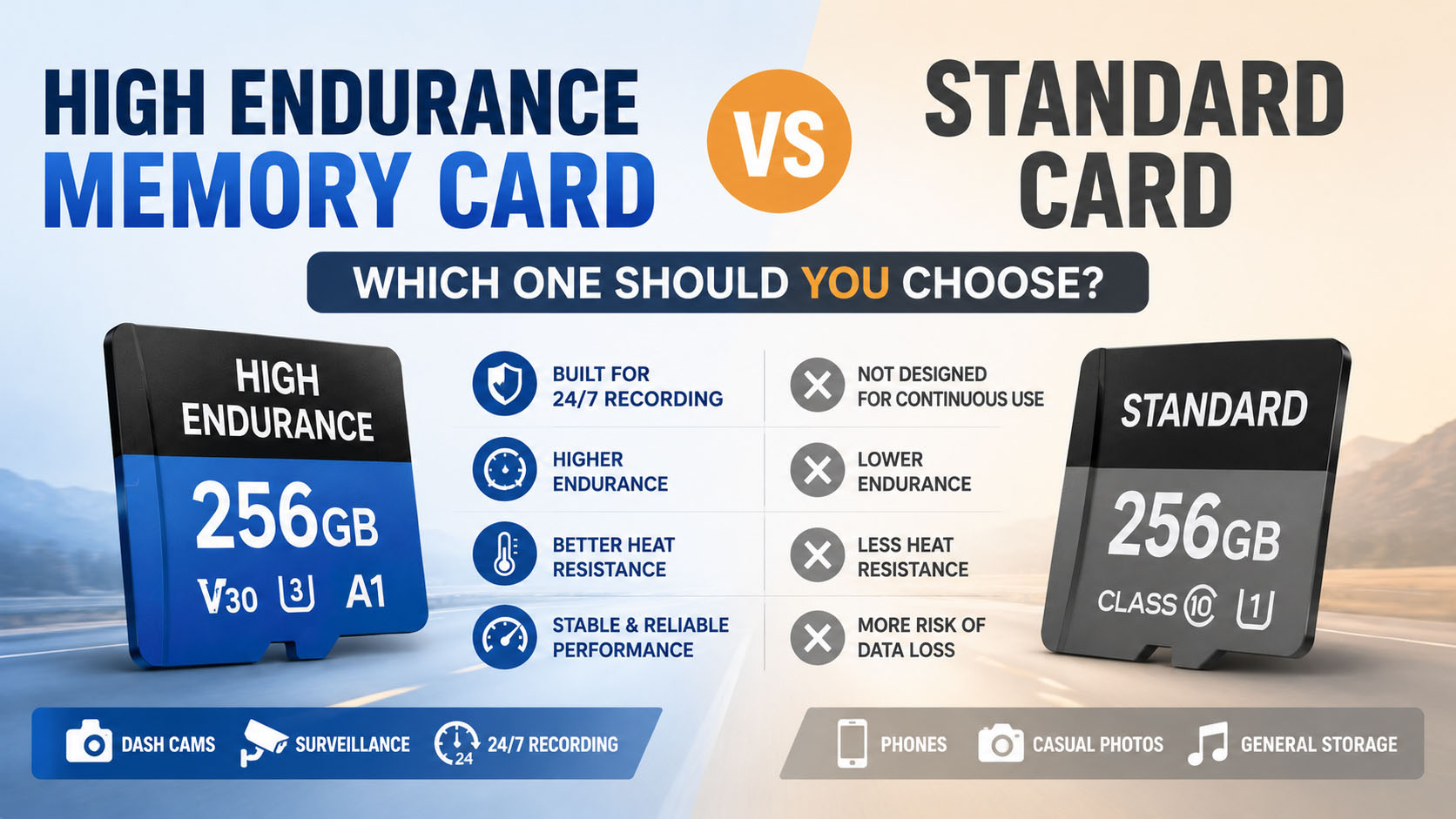
Choosing between a high endurance memory card and a standard memory card depends largely on how the card will be used.
For occasional photo storage, music, documents, and everyday file transfers, a standard microSD card can be a practical and cost-effective choice. But for applications that continuously write and overwrite data—such as dash cams, security cameras, CCTV systems, body cameras, and vehicle monitoring devices—a high endurance memory card is generally a better fit.
The difference is not simply the label on the packaging. It can involve NAND flash selection, controller architecture, firmware, wear management, sustained write performance, temperature tolerance, testing, and production consistency.
For distributors, electronics manufacturers, and private-label brands, there is another important consideration: supply-chain stability and OEM capability. The right supplier should be able to provide not only a reliable card, but also consistent components, quality control, customization, and long-term production support.
High Endurance vs Standard Memory Card at a Glance
| Feature | High Endurance Memory Card | Standard Memory Card |
|---|---|---|
| Continuous Recording | Excellent | Limited / Application Dependent |
| Repeated Write Cycles | Designed for intensive workloads | Designed mainly for general use |
| Dash Cam | Recommended | Not always ideal |
| CCTV / Surveillance | Recommended | Not usually the first choice |
| Everyday Storage | Suitable | Excellent |
| Photos & Music | Suitable | Excellent |
| Sustained Write | Application-focused | Varies by product |
| Temperature Requirements | Often designed for demanding environments | Varies |
| Typical Cost | Higher | Lower |
| Best Value | Intensive recording | General storage |
The key takeaway is simple:
Choose standard memory cards for general storage. Choose high endurance cards for intensive, repetitive recording.
What Is a High Endurance Memory Card?
A high endurance memory card is designed for applications involving frequent writing and rewriting of data.
Typical applications include:
- Dash cams
- CCTV cameras
- Security cameras
- Body cameras
- Doorbell cameras
- Vehicle monitoring systems
- Industrial recording equipment
In a dash cam, for example, video files are continuously recorded and older files are overwritten when the card becomes full.
This creates a repetitive workload:
Write → Store → Delete → Rewrite → Repeat
A memory card designed for this type of workload needs to manage repeated program/erase activity effectively.
Samsung, for example, specifically positions its PRO Endurance microSD cards for continuous recording applications including dash cams, CCTV, body cameras, and other monitoring devices.
What Is a Standard Memory Card?
A standard memory card is generally designed for normal consumer storage applications.
Common uses include:
- Smartphone file storage
- Photos
- Music
- Documents
- Tablets
- Casual cameras
- Portable game devices
- General data transfer
These applications may involve writing data less continuously than a dash cam or surveillance camera.
A standard card can therefore be an economical option when the workload does not involve constant recording and rewriting.
However, “standard” does not mean low quality. A standard memory card can still offer excellent performance and reliability when used within its intended application.
Why High Endurance Matters for Continuous Recording
The biggest difference between the two card types is the workload they are designed to handle.
A dash cam can potentially record whenever the vehicle is operating and may also record while parked.
A surveillance camera can write video continuously for days, weeks, or months.
This means the card experiences repeated write cycles.
Flash memory has a finite program/erase endurance, so storage manufacturers need to design the complete system around the expected workload.
Important factors include:
- NAND flash type
- NAND quality
- Controller
- Firmware
- Wear leveling
- Error correction
- Bad-block management
- Capacity
- Temperature
- Recording bitrate
Therefore, high endurance is a system-level characteristic rather than simply a marketing word.
High Endurance Does Not Simply Mean “Faster”
One common misconception is that a high endurance memory card must also be faster than a standard card.
Not necessarily.
Endurance and speed describe different characteristics.
A standard card may have a very high peak read speed, while a high endurance card may prioritize:
- Stable sustained writing
- Long-term write/erase durability
- Error management
- Continuous recording
- Environmental reliability
For a dash cam, stable writing can be more important than the highest advertised read speed.
The SD Association explains that video recording requires a sufficiently consistent minimum write performance, which is why Speed Class, UHS Speed Class, and Video Speed Class standards exist.
Speed Class vs Endurance: What Is the Difference?
Buyers should not confuse speed class with endurance.
Speed Class
Speed Class indicates minimum sequential write performance under defined conditions.
Common markings include:
- Class 10
- U1
- U3
- V10
- V30
- V60
- V90
The SD Association notes that U3/V30-class products are designed around higher minimum sequential performance and are commonly associated with Full HD to 4K video recording.
Endurance
Endurance relates to how well the memory card is designed to handle repeated writing and rewriting over time.
A card can therefore be:
Fast but not optimized for continuous recording
or:
Designed for endurance with sufficient sustained write performance
For dash cams and surveillance systems, the ideal product should provide an appropriate combination of both.
Why Sustained Write Performance Matters
A memory card package may advertise a very high maximum read speed.
But a dash cam is continuously writing video.
This means the more relevant questions are:
- Can the card maintain the required write speed?
- Can it handle continuous recording?
- Can it manage repeated overwriting?
- Is it compatible with the camera?
- Does performance remain stable as the card becomes fragmented or heavily used?
The SD Association notes that repeated deletion and rewriting can cause fragmentation and influence write performance, reinforcing the importance of choosing an appropriate card and host combination.
For video applications, stable sustained performance is generally more meaningful than a single peak benchmark number.
NAND Flash: The Foundation of Memory Card Endurance
NAND flash is the primary storage medium inside a memory card.
Its characteristics influence:
- Write endurance
- Data retention
- Performance
- Cost
- Capacity
- Long-term stability
For high endurance products, the flash solution should be selected according to the intended workload.
This is where storage-industry experience becomes important.
A manufacturer developing a high endurance card should consider the relationship between:
NAND → Controller → Firmware → Workload → Testing
rather than selecting components independently.
For B2B customers, this can make a significant difference in long-term product consistency.
Why the Controller Matters
The controller manages communication between the host device and NAND flash.
It can handle functions such as:
- Error correction
- Wear leveling
- Bad-block management
- Flash translation
- Data mapping
- Performance management
For continuous recording, effective wear leveling can help distribute write activity across the available flash resources.
A professional memory card supplier should therefore have experience matching NAND and controller solutions for specific applications.
Firmware Is Also Important
Firmware determines how the controller manages the NAND flash.
Depending on the product architecture, firmware can influence:
- Write management
- Error handling
- Wear leveling
- Bad-block management
- Host compatibility
- Performance stability
This is particularly important for OEM applications.
A supplier that can optimize the storage solution around a customer’s target device can potentially provide a more appropriate product than a supplier that simply offers an off-the-shelf card.
High Endurance Memory Card vs Standard Card: Which Is Better for a Dash Cam?
For dash cams, high endurance is generally the better choice, particularly when the camera uses loop recording or parking mode.
A dash cam may repeatedly:
- Record video
- Save video files
- Fill available storage
- Delete older files
- Write new video
- Repeat the cycle
A high endurance card is specifically designed around this type of repetitive workload.
For example, SanDisk’s High Endurance microSD product is marketed for dash cams and home monitoring systems and is specified for continuous recording, with capacities and claimed endurance varying by model.
Which Card Is Better for CCTV and Security Cameras?
For CCTV and security cameras, high endurance is usually the more appropriate choice because recording can be continuous.
The priority should be:
Endurance + sustained write performance + capacity + environmental reliability
rather than simply:
Maximum read speed + lowest price
This is particularly important when recorded footage may be required as evidence.
A memory card failure can result in lost footage, which can cost much more than the difference between a standard card and a high endurance card.
Which Card Is Better for Smartphones?
For smartphones, the answer depends on the workload.
If the card is mainly used for:
- Photos
- Music
- Movies
- Documents
- Backups
a standard high-quality microSD card may provide excellent value.
If the card is subjected to frequent writing or specialized recording applications, a more durable solution may be appropriate.
The SD Association recommends following the device manufacturer’s supported capacity and speed-class requirements when selecting an SD memory card.
Which Card Is Better for Cameras and Drones?
For cameras and drones, speed requirements can be more important than endurance, depending on the recording workload.
For high-bitrate video, buyers should check:
- U3
- V30
- V60
- V90
- Device-specific recommendations
The SD Association lists U3/V30 among the speed classes used for higher-performance video recording.
If the camera records continuously for extended periods, endurance should also be considered.
Therefore, the best card is not automatically the most durable or the fastest. It should be matched to the recording workload.
Which Card Is More Cost-Effective?
The answer depends on total cost of ownership, not simply purchase price.
Standard Card
Advantages:
- Lower initial cost
- Good for general storage
- Suitable for occasional writing
- Broad range of capacities
High Endurance Card
Advantages:
- Better suited to repeated writing
- Designed for continuous recording
- Potentially lower replacement frequency
- Better fit for dash cams and surveillance
For a device that records every day, a cheaper card that needs frequent replacement may cost more over the product lifecycle.
This is why professional buyers should compare:
Unit price + expected service life + replacement cost + warranty + failure risk
rather than unit price alone.
How Supply Chain Advantages Affect Memory Card Quality
For B2B buyers, supply-chain capability is a major part of product value.
A professional memory card manufacturer may manage the process from:
NAND sourcing → controller matching → firmware → production → capacity testing → speed testing → endurance testing → quality inspection → packaging → shipment
A stable supply chain can provide several benefits.
Consistent NAND Sourcing
Stable component sourcing helps reduce unexpected changes between production batches.
Better Cost Management
Large-scale procurement can help manufacturers maintain competitive factory pricing.
Stable Product Specifications
A controlled component supply chain makes it easier to maintain consistent:
- Capacity
- Performance
- Controller configuration
- Firmware
- Product quality
Better Delivery Stability
For distributors and OEM customers, predictable production and delivery can be critical when products are sold continuously in multiple markets.
Why OEM Capability Matters for High Endurance Memory Cards
For businesses selling dash cams, CCTV products, security cameras, or vehicle electronics, OEM capability can provide significant advantages.
Instead of reselling a standard retail product, brands can develop their own private-label high endurance memory card.
Typical OEM services may include:
- Custom logo printing
- Private-label memory cards
- Customized card artwork
- Customized packaging
- Retail blister packaging
- Barcode and labeling
- Capacity selection
- Speed-class selection
- Application-specific specifications
- Sample development
- Batch testing
For example, a dash cam manufacturer could offer:
Brand X 128GB High Endurance TF Card
or:
Brand X 256GB High Endurance V30 microSD Card
This allows the brand to create a complete storage accessory product line.
OEM High Endurance Memory Card: What Can Be Customized?
Depending on the manufacturer’s capabilities and project requirements, OEM programs can include:
Product Branding
- Logo
- Product name
- Brand colors
- Card label design
Packaging
- Retail box
- Blister packaging
- Paper card
- User manual
- Barcode
- Customized labeling
Product Configuration
- 32GB
- 64GB
- 128GB
- 256GB
- 512GB
- Other supported capacities
Performance Positioning
Products can be developed for different applications such as:
- Dash cams
- CCTV
- Security cameras
- Mobile devices
- Industrial equipment
- Automotive electronics
The exact specifications should be validated against the target host device and application.
How to Choose a Reliable High Endurance Memory Card Supplier
If you are searching for a high endurance memory card supplier, do not compare quotations alone.
Evaluate the supplier in six areas.
1. Component Sourcing
Ask about NAND flash sourcing and component stability.
2. Manufacturing Capability
Confirm whether the supplier has:
- Production facilities
- Testing equipment
- Quality-control procedures
- Mass-production capability
3. Endurance Testing
Ask how the supplier validates repeated write/erase performance.
4. Device Compatibility
Test samples in the actual target product.
5. OEM Capability
Confirm whether the supplier supports:
- Logo customization
- Packaging
- Private labeling
- Product specifications
- Samples
6. Long-Term Supply
For a brand, the ability to supply the same specification consistently can be more important than achieving the lowest initial quotation.
High-Intent Keywords for Memory Card Procurement
B2B buyers often search with a combination of product, application, specification, and supplier intent.
Useful search terms include:
- high endurance memory card
- high endurance microSD card
- high endurance TF card
- standard memory card vs high endurance
- high endurance memory card supplier
- high endurance microSD card manufacturer
- high endurance TF card supplier
- dash cam memory card supplier
- dash cam microSD card manufacturer
- CCTV memory card supplier
- surveillance microSD card manufacturer
- 24/7 recording memory card
- continuous recording memory card
- 128GB high endurance microSD card
- 256GB high endurance microSD card
- 512GB high endurance microSD card
- OEM high endurance memory card
- private label memory card supplier
- OEM microSD card manufacturer
- wholesale high endurance memory card
- bulk microSD card supplier
- automotive memory card supplier
These keywords are useful because they reflect real purchasing intent, rather than only general information searches.
How to Choose Between High Endurance and Standard Memory Cards
Use this simple decision framework.
Choose a Standard Memory Card If:
- The card is mainly used for photos
- Files are transferred occasionally
- Music and documents are the primary data
- Continuous recording is not required
- The application has a relatively light write workload
- Cost efficiency is the main priority
Choose a High Endurance Memory Card If:
- The device records continuously
- Files are frequently overwritten
- The card is used in a dash cam
- The card is used in CCTV
- Parking mode is enabled
- The device operates for long periods
- Data loss would be costly
How to Test a High Endurance Memory Card
Before placing a large wholesale or OEM order, test samples under real conditions.
Capacity Test
Verify actual usable capacity.
Sequential Write Test
Measure sustained write performance.
Loop Recording Test
Use the card in the actual dash cam or camera and repeatedly record and overwrite files.
Long-Term Recording Test
Run the card continuously for an extended period.
Temperature Test
Evaluate performance within the expected operating environment.
Compatibility Test
Test the card in the actual target device rather than only on a computer.
Batch Consistency Test
Test multiple samples from different production batches for OEM projects.
This process can identify problems that a single benchmark cannot reveal.
Common Mistakes When Buying High Endurance Memory Cards
Mistake 1: Choosing Only by Price
The cheapest card may have a higher lifecycle cost if it requires frequent replacement.
Mistake 2: Choosing Only by Capacity
A larger capacity does not automatically mean higher endurance.
Mistake 3: Looking Only at Peak Read Speed
For continuous recording, sustained write performance is often more important.
Mistake 4: Assuming Every “High Endurance” Card Is the Same
Different manufacturers can use different NAND, controllers, firmware, testing methods, and endurance specifications.
Mistake 5: Ignoring Temperature
Automotive and outdoor applications can expose memory cards to demanding temperatures.
Mistake 6: Skipping Real-Device Testing
A PC benchmark cannot fully reproduce the workload of a dash cam or surveillance camera.
FAQ: High Endurance Memory Card vs Standard Card
What is the main difference between a high endurance and standard memory card?
A high endurance card is designed for more intensive write/erase workloads, especially continuous or repeated recording. A standard card is generally intended for everyday storage and less intensive write activity.
Is a high endurance memory card better than a standard card?
Not universally. A high endurance card is better for intensive recording applications, while a standard card can offer better value for ordinary storage.
Do dash cams need high endurance memory cards?
For frequent loop recording or 24/7 operation, a high endurance card is generally recommended because the card experiences repeated writing and overwriting.
Can I use a standard microSD card in a dash cam?
Some dash cams can operate with standard cards, but compatibility and workload requirements vary. For continuous recording, a high endurance card is generally the safer choice.
Is high endurance more important than speed?
For continuous recording, endurance and sustained write performance are both important. A card with high peak speed but poor suitability for repeated recording may not be the best choice.
Is U3 the same as high endurance?
No. U3 is a UHS Speed Class designation indicating minimum sequential write performance under defined conditions. It does not by itself indicate endurance.
Is V30 the same as high endurance?
No. V30 is a Video Speed Class designation. It indicates minimum sequential write performance for video-oriented applications; it does not mean the card is automatically a high endurance product.
Is 256GB high endurance better than 128GB?
It provides more storage, but capacity and endurance are different characteristics. Choose according to the device’s supported capacity, recording requirements, and expected workload.
How long does a high endurance memory card last?
There is no universal lifespan. Actual endurance depends on the NAND technology, capacity, controller, firmware, recording bitrate, write frequency, temperature, and product design.
Some manufacturers publish model-specific endurance figures. For example, SanDisk publishes claimed recording-hour figures for its High Endurance microSD range, while Samsung publishes endurance figures for its PRO Endurance products. These figures should be understood as manufacturer-specific claims for particular models and conditions, not universal industry guarantees.
Can high endurance cards be used in smartphones?
Yes, if the card format and capacity are compatible with the smartphone. However, high endurance is not necessarily required for ordinary smartphone storage.
Can high endurance cards be used for CCTV?
Yes. Continuous surveillance recording is one of the primary applications for high endurance memory cards.
Can I buy OEM high endurance memory cards?
Yes. An experienced OEM memory card manufacturer can develop private-label products with customized logos, packaging, capacities, and application-specific specifications.
What should I ask an OEM memory card manufacturer?
Ask about NAND source, controller, firmware, sustained write performance, endurance testing, temperature range, capacity verification, production capacity, MOQ, lead time, quality control, OEM customization, warranty, and long-term supply stability.
Final Verdict: Which Memory Card Should You Choose?
The choice between a high endurance memory card and a standard memory card should be based on workload rather than simply price.
For:
Photos + Music + Documents + Occasional File Storage
→ A standard memory card can provide excellent value.
For:
Dash Cam + CCTV + Surveillance + 24/7 Recording + Frequent Overwriting
→ A high endurance memory card is generally the better choice.
For B2B buyers, the decision should go one step further.
The best product combines:
Quality NAND + Reliable Controller + Optimized Firmware + Stable Sustained Write Performance + Appropriate Endurance + Compatibility
And the best supplier adds:
Stable Supply Chain + Factory Testing + Competitive Cost + OEM Capability + Consistent Mass Production
For distributors, electronics brands, dash cam manufacturers, and private-label businesses, the right memory card supplier can help reduce replacement risk, improve product consistency, and build a more reliable storage product line.
The cheapest memory card is not always the lowest-cost solution. The best value comes from matching the memory card’s endurance, performance, and reliability to the workload it is expected to handle.