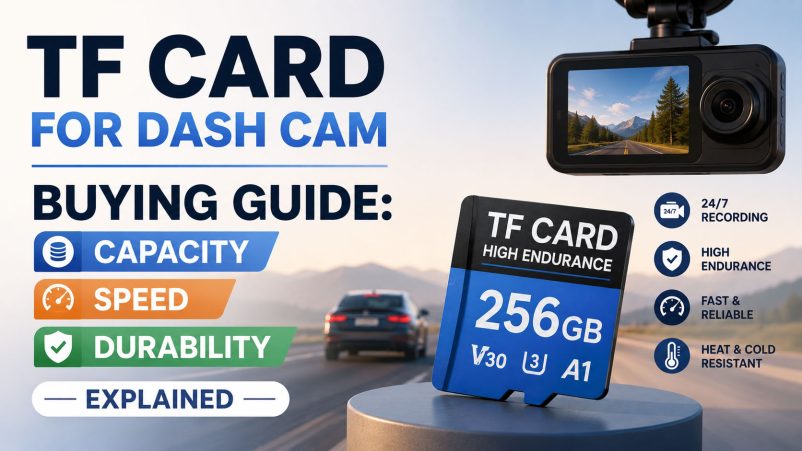
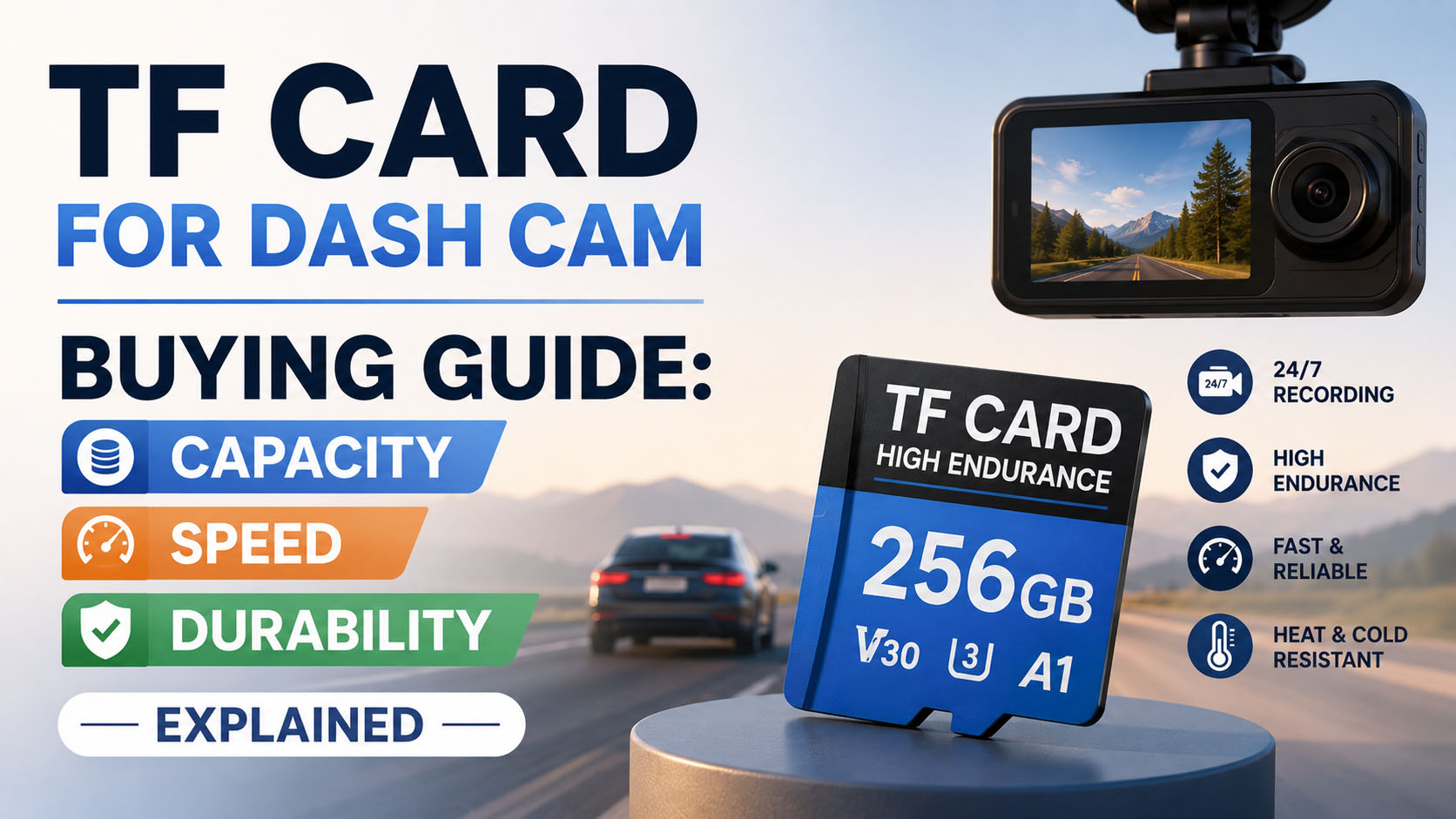
Choosing the right TF card for a dash cam is more important than simply selecting the card with the largest capacity or the lowest price. Dash cams continuously write, save, delete, and overwrite video files, which places much greater stress on flash storage than ordinary file-storage applications.
For everyday users, the key questions are usually simple: How many GB do I need? What speed should I choose? How long will the card last?
For dash cam manufacturers, distributors, fleet operators, and electronics brands, the purchasing decision goes further. NAND flash quality, controller technology, firmware, endurance testing, temperature resistance, supply-chain stability, factory pricing, and OEM customization all influence the real value of a TF card.
This buying guide explains how to choose a reliable TF card for dash cams and what B2B buyers should consider when sourcing from an experienced memory card manufacturer.
What Is a TF Card for a Dash Cam?
A TF card is the commonly used industry name for the microSD card format. The original TransFlash format was later standardized as microSD.
Today, products marketed as:
- TF card
- microSD card
- microSDHC card
- microSDXC card
- dash cam memory card
generally refer to the same compact removable storage family, although the exact capacity and specification can differ.
For dash cams, the card is used to store:
- Driving video
- Parking-mode footage
- Emergency recordings
- Photos
- Event files
- GPS-related data on supported systems
Because dash cams can write data continuously, a card designed for high endurance and repeated write cycles is generally more appropriate than a basic consumer memory card.
What Should You Look for in a Dash Cam TF Card?
The most important factors are:
- Capacity
- Sustained write performance
- Speed class
- Endurance
- Temperature tolerance
- NAND flash quality
- Controller and firmware
- Dash cam compatibility
- Supply consistency
- Warranty and after-sales support
For most dash cam applications, the purchasing priority should be:
Endurance → sustained write performance → compatibility → temperature resistance → capacity → peak read speed
The exact priority depends on the dash cam’s recording resolution, bitrate, number of cameras, and operating environment.
How Much Capacity Does a Dash Cam Need?
Capacity determines how much video can be stored before the dash cam starts overwriting older files.
The correct capacity depends on:
- Video resolution
- Frame rate
- Video bitrate
- Number of cameras
- Recording duration
- Parking mode
- Compression format
- Dash cam firmware
32GB TF Card
A 32GB card can be suitable for basic 1080P dash cams and short recording requirements.
Best for:
- Entry-level dash cams
- Short driving periods
- Budget products
However, it provides less recording time and may result in more frequent overwriting.
64GB TF Card
64GB provides a useful balance for basic and mainstream dash cams.
Best for:
- 1080P recording
- Daily commuting
- Single-camera systems
- Cost-sensitive applications
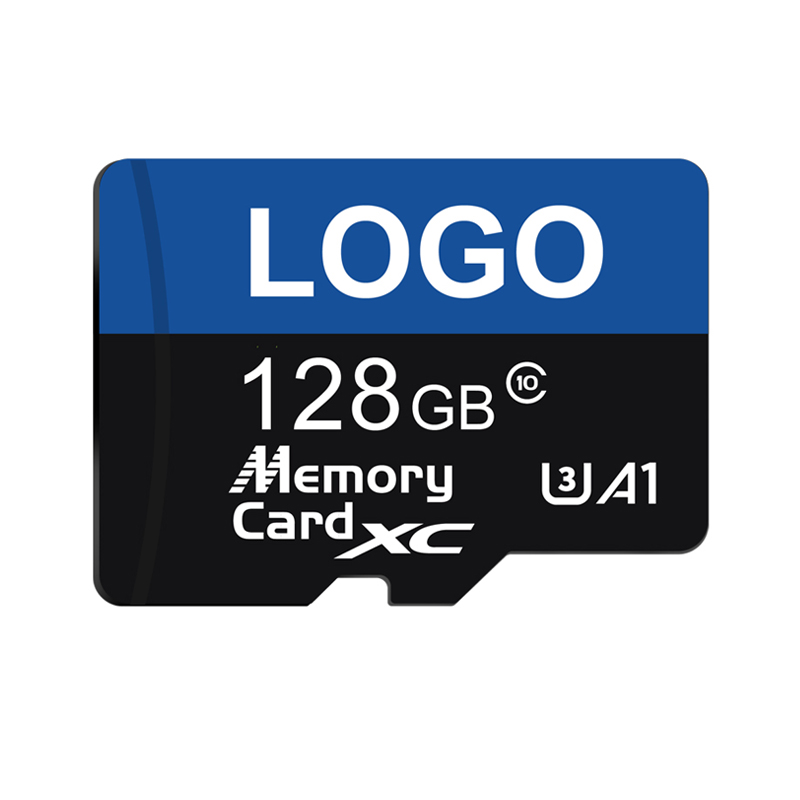
128GB TF Card
128GB is a popular option for higher-quality recording and longer recording cycles.
Best for:
- 2K dash cams
- High-quality 1080P
- Front/rear camera systems
- Frequent drivers
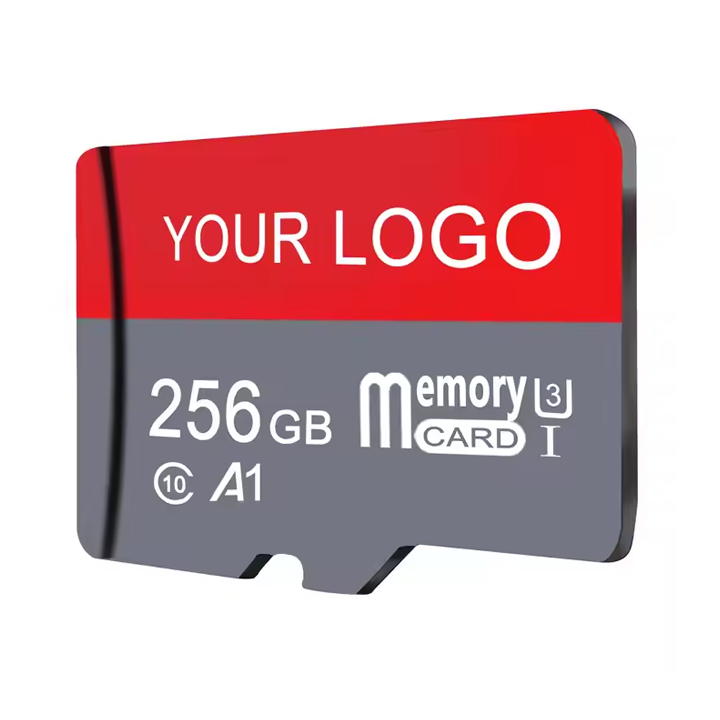
256GB TF Card
256GB provides substantially more storage for demanding applications.
Best for:
- 4K dash cams
- Dual-channel recording
- Long driving periods
- Fleet applications
- Parking-mode recording
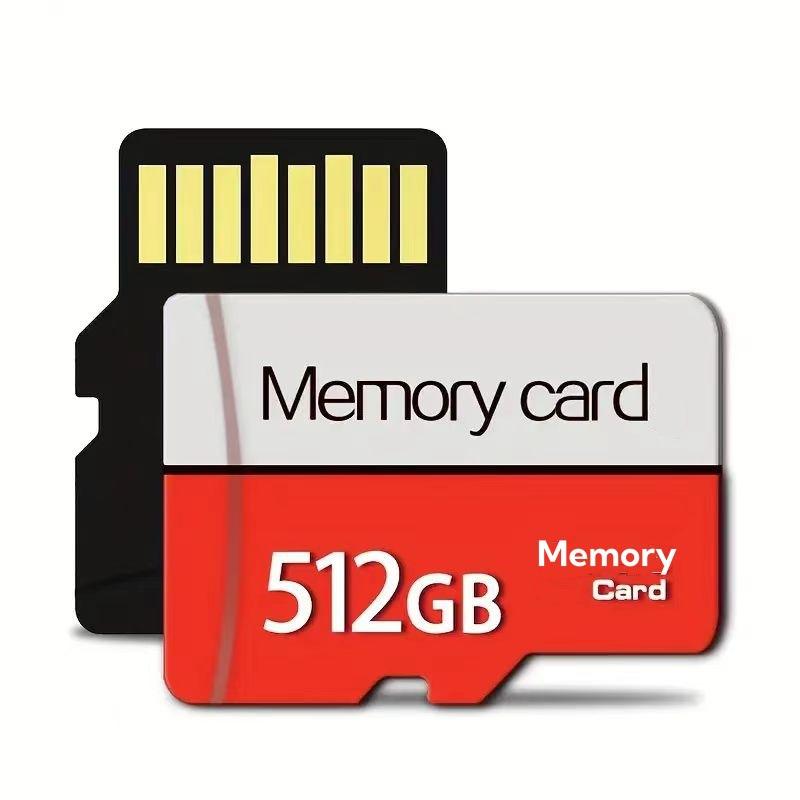
512GB TF Card
512GB can be useful for specialized dash cams requiring extended recording capacity.
However, buyers should always confirm that the dash cam supports the capacity before purchasing.
More storage is not automatically better if the host device has a lower capacity limit.
How Much Video Can a Dash Cam Memory Card Store?
Actual recording time varies significantly depending on video bitrate and camera configuration.
As a simplified example, a 4K dash cam recording at a higher bitrate can consume storage much faster than a 1080P camera.
A rough planning formula is:
Recording Time ≈ Available Storage ÷ Video Bitrate
For example, if a camera records at approximately 20 Mbps:
- 1 hour ≈ 9GB
- 10 hours ≈ 90GB
- 20 hours ≈ 180GB
These figures are estimates because actual file sizes depend on encoding, bitrate fluctuations, audio, frame rate, and file-system overhead.
For buyers who need a specific recording duration, it is better to test the actual dash cam rather than rely on a generic storage-time chart.
What Speed Class Does a Dash Cam TF Card Need?
Speed class describes minimum sequential write performance under defined test conditions.
Common markings include:
- Class 10
- U1
- U3
- V10
- V30
- V60
- V90
Class 10
Class 10 specifies a minimum sequential write speed of 10MB/s under the relevant SD standard conditions.
It can be sufficient for many basic dash cam applications.
U1
U1 also indicates a minimum sequential write performance of 10MB/s.
U3
U3 indicates a minimum sequential write performance of 30MB/s.
For higher-resolution recording, U3 is often a more suitable target than U1, depending on the dash cam.
V30
V30 indicates a minimum sequential write performance of 30MB/s under the relevant Video Speed Class requirements.
It is commonly associated with demanding video-recording applications.
The SD Association defines Speed Class and Video Speed Class as ways to communicate minimum sequential performance requirements for recording applications.
However, always follow the dash cam manufacturer’s recommended specification.
Is Read Speed or Write Speed More Important for a Dash Cam?
For dash cams, write performance is generally more important.
The camera continuously records video onto the memory card.
The basic workflow is:
Camera → Encode Video → Write Data → Save File → Overwrite Old File
This means the card must maintain stable write performance.
Peak read speed becomes more relevant when transferring recorded footage from the card to a computer or smartphone.
Therefore, when selecting a dash cam TF card, do not choose solely based on a large advertised read-speed number.
Focus on:
Sustained write performance + endurance + compatibility
Why High Endurance Matters for Dash Cams
A dash cam may write data every time the vehicle is driven.
With loop recording enabled, old files are continuously overwritten.
This creates repeated:
Program → Erase → Program → Erase
cycles in NAND flash memory.
A standard consumer microSD card may not be optimized for this workload.
A high-endurance microSD/TF card is specifically designed for applications that involve frequent writing and overwriting.
Common high-endurance applications include:
- Dash cams
- CCTV
- Surveillance cameras
- Body cameras
- Vehicle monitoring
- Industrial recording systems
For 24/7 recording, endurance can be more important than having the absolute highest capacity.
What Determines Memory Card Endurance?
Endurance depends on several factors rather than one simple specification.
NAND Flash
The NAND architecture and quality influence program/erase endurance.
Controller
The controller manages data placement, error correction, and flash management.
Firmware
Firmware determines how efficiently the card handles wear leveling, bad blocks, and data management.
Capacity
Higher-capacity cards can provide more physical flash resources for distributing writes, depending on the architecture.
Workload
A card recording 24 hours a day experiences a very different workload from one used for occasional weekend driving.
Temperature
High temperatures can increase stress on electronic components and influence storage reliability.
This is why a professional storage manufacturer evaluates the complete memory-card system, not just the NAND chip.
Why Temperature Resistance Is Important
Dash cams operate inside vehicles, where temperatures can vary significantly.
A vehicle parked under direct sunlight can become extremely hot, while vehicles operating in winter can experience very low temperatures.
A dash cam memory card should therefore be qualified for the expected operating environment.
Important parameters include:
- Operating temperature
- Storage temperature
- Controller stability
- NAND characteristics
- Error correction
- Long-term recording behavior
Temperature testing is especially important for:
- Parking mode
- Commercial vehicles
- Fleet vehicles
- Trucks
- Delivery vehicles
- Outdoor vehicles
A card that works perfectly in a room-temperature benchmark may perform differently in a vehicle exposed to extreme heat.
Does A1 or A2 Matter for a Dash Cam?
A1 and A2 are Application Performance Class ratings.
They focus on application-related random I/O performance.
For a dash cam, A1 or A2 is generally less important than:
- High endurance
- Sustained write performance
- Temperature tolerance
- Reliability
A2 does not automatically mean that a memory card is designed for continuous recording.
For dash cam applications, buyers should prioritize endurance and sustained write capability rather than choosing a product simply because it carries an A2 logo.
NAND Flash Quality: The Hidden Factor Behind Reliability
The capacity and speed printed on a memory card do not tell the entire story.
Two 128GB TF cards may have very different internal configurations.
Key differences can include:
- NAND flash quality
- NAND sourcing
- Controller
- Firmware
- Error correction
- Wear leveling
- Testing standards
For an OEM customer, these differences can directly affect:
- Product returns
- Warranty costs
- Customer satisfaction
- Long-term brand reputation
This is why reliable component sourcing is one of the most important capabilities of a professional memory card manufacturer.
Why Controller and Firmware Matter
The controller acts as the bridge between the host device and NAND flash.
It manages functions such as:
- Error correction
- Wear leveling
- Bad-block management
- Data mapping
- Flash translation
- Performance optimization
Firmware controls how these functions operate.
For continuous recording, proper controller and firmware matching can help maintain stable performance over repeated write cycles.
An experienced supplier can select the NAND + controller + firmware combination according to the target dash cam application instead of using one configuration for every product.
Supply Chain Advantages in TF Card Manufacturing
For wholesale and OEM buyers, a stable supply chain can be as important as product specifications.
A professional memory card manufacturer may manage:
NAND sourcing → controller sourcing → firmware → production → capacity testing → speed testing → endurance testing → packaging → shipment
This provides several advantages.
Stable Component Supply
Stable upstream sourcing reduces unexpected changes in product specifications.
Competitive Factory Pricing
Large-scale component procurement can improve cost efficiency for bulk orders.
Better Batch Consistency
Consistent components and controlled production help maintain similar performance across different batches.
Faster Production Planning
Stable supply helps manufacturers manage:
- MOQ
- Lead time
- Repeat orders
- Seasonal demand
- Large-volume projects
For distributors and dash cam brands, this can reduce the risk of stock shortages.
OEM TF Card Solutions for Dash Cam Brands
OEM capability is particularly valuable for dash cam manufacturers and automotive electronics brands.
Instead of purchasing generic retail memory cards, businesses can develop private-label TF cards under their own brand.
Typical OEM services include:
- Custom logo printing
- Private-label TF cards
- Custom microSD cards
- Customized packaging
- Retail blister packaging
- Custom labels
- Barcode printing
- Capacity customization
- Speed-class options
- Application-specific specifications
- Sample development
- Batch testing
For example, a dash cam manufacturer could launch its own:
128GB High Endurance TF Card
or
256GB 4K Dash Cam Memory Card
with customized branding and packaging.
This creates a more complete product ecosystem and gives the brand greater control over pricing and positioning.
Why OEM Capability Matters for Dash Cam Manufacturers
A dash cam manufacturer may know exactly what its camera requires.
For example:
- 1080P recording
- 2K recording
- 4K recording
- Front + rear recording
- Parking mode
- Loop recording
- High bitrate
- Extended operating temperature
An experienced OEM supplier can help match the memory card specification to these requirements.
This is more effective than simply purchasing the cheapest card available.
OEM development can also help establish a stable specification for future production orders, which is particularly important for brands that need consistent products over several years.
Wholesale TF Card Procurement: What Should Buyers Ask Suppliers?
When sourcing wholesale TF cards, ask the supplier:
Product Questions
- What NAND flash is used?
- What controller is used?
- What is the sustained write performance?
- What is the rated operating temperature?
- What capacity options are available?
- Is the card designed for high-endurance applications?
Quality Questions
- How is actual capacity verified?
- How is write performance tested?
- Is endurance testing available?
- Are samples tested in the target dash cam?
- Can batch inspection reports be provided?
Supply Chain Questions
- How stable is NAND supply?
- Can the same specification be maintained for repeat orders?
- What is the normal lead time?
- What is the MOQ?
OEM Questions
- Can the logo be customized?
- Can packaging be customized?
- Can specifications be customized?
- Can the supplier support private labeling?
- Can samples be produced before mass production?
These questions help separate a professional manufacturer from a simple trading supplier.
High-Intent Keywords for TF Card Procurement
International buyers use different search terms depending on their purchasing stage.
Useful B2B keywords include:
- TF card for dash cam
- best TF card for dash cam
- dash cam memory card
- microSD card for dash cam
- high endurance TF card
- high endurance microSD card
- 24/7 recording memory card
- 128GB TF card for dash cam
- 256GB TF card for dash cam
- 512GB TF card for dash cam
- 4K dash cam memory card
- U3 microSD card for dash cam
- V30 memory card for dash cam
- dash cam memory card supplier
- TF card supplier
- TF card manufacturer
- wholesale TF card supplier
- bulk microSD card supplier
- OEM TF card manufacturer
- private label TF card supplier
- OEM dash cam memory card
- high endurance microSD card manufacturer
- automotive memory card supplier
- industrial microSD card manufacturer
These keywords combine product + application + specification + supplier intent, making them particularly useful for B2B SEO and GEO content.
How to Test a TF Card Before a Bulk Order
Before placing a large wholesale or OEM order, buyers should qualify samples under real operating conditions.
1. Capacity Test
Verify that the actual capacity matches the advertised capacity.
2. Sequential Write Test
Measure the card’s sustained write performance.
3. Loop Recording Test
Use the actual dash cam to repeatedly record and overwrite video.
4. Long-Duration Test
Run the card for an extended period to identify stability issues.
5. Temperature Test
Test the card within the expected vehicle temperature range.
6. Compatibility Test
Test the card directly in the target dash cam.
7. Batch Consistency Test
For OEM projects, test multiple samples from the same production batch rather than relying on a single sample.
Real-device testing is particularly important because PC benchmark results do not always represent actual dash cam performance.
TF Card Selection by Dash Cam Resolution
1080P Dash Cam
Recommended starting point:
Class 10 + High Endurance + 32GB–128GB
Suitable for basic single-camera recording.
2K Dash Cam
Recommended starting point:
Class 10 + U3 + High Endurance + 64GB–256GB
Suitable for higher-quality video and longer recording.
4K Dash Cam
Recommended starting point:
U3 + V30 or higher + High Endurance + 128GB–256GB+
The exact specification should follow the dash cam manufacturer’s requirements.
Dual-Channel Dash Cam
Prioritize:
High endurance + strong sustained write performance + sufficient capacity
because simultaneous front and rear recording generates more data.
Parking Mode Dash Cam
Prioritize:
High endurance + stable write performance + temperature tolerance
because parking mode can generate frequent event-based writes.
Common Mistakes When Buying a Dash Cam TF Card
Mistake 1: Choosing the Cheapest Card
The lowest unit price may not provide the lowest total cost.
Card failures can result in:
- Replacements
- Returns
- Customer complaints
- Warranty costs
- Brand damage
Mistake 2: Choosing Only by Capacity
More storage does not automatically mean greater endurance.
Mistake 3: Looking Only at Read Speed
Dash cams are primarily write-intensive devices.
Mistake 4: Ignoring Temperature
Vehicle environments can be significantly harsher than indoor electronics environments.
Mistake 5: Assuming A2 Means High Endurance
A2 relates to application performance, not continuous recording endurance.
Mistake 6: Skipping Sample Testing
Always test samples in the actual dash cam before placing a large order.
FAQ: TF Card for Dash Cam
What is the best TF card for a dash cam?
A high-endurance microSD/TF card is generally the best choice for dash cams because these devices continuously write and overwrite video files. The required capacity and speed class depend on the specific dash cam.
Is a high-endurance TF card necessary for a dash cam?
For frequent or 24/7 recording, high endurance is strongly recommended. Continuous loop recording creates repeated write and erase cycles that can be more demanding than ordinary storage use.
Is 128GB enough for a dash cam?
128GB is suitable for many 1080P and 2K dash cams. For 4K, dual-camera, or longer recording applications, 256GB may be more appropriate if supported by the dash cam.
Is 256GB better than 128GB for dash cams?
A 256GB card provides more storage, but it is not automatically more durable or reliable. Compare endurance, sustained write performance, NAND quality, compatibility, and temperature specifications.
What speed class should a dash cam memory card have?
Class 10 is suitable for many basic recording applications. U3/V30 or higher may be appropriate for higher-resolution recording, but buyers should follow the dash cam manufacturer’s specification.
Is V30 good for a 4K dash cam?
V30 indicates a minimum sequential write performance of 30MB/s under the applicable standard conditions and is commonly used for demanding video recording. However, the exact dash cam requirements should take priority.
Does a dash cam need an A1 or A2 memory card?
Not necessarily. A1/A2 ratings are focused on application performance. For dash cams, high endurance and sustained write performance are generally more important.
Can I use a normal microSD card in a dash cam?
Some dash cams support standard microSD cards, but frequent loop recording can place greater stress on the card. A high-endurance card is generally a safer choice for continuous recording.
How long does a high-endurance TF card last in a dash cam?
There is no universal lifespan. Actual endurance depends on NAND type, capacity, recording bitrate, recording hours, temperature, controller design, firmware, and write/erase cycles.
What is the difference between TF and microSD?
TF and microSD generally refer to the same physical card format in today’s consumer electronics market. “MicroSD” is the standardized industry term, while “TF card” remains common in automotive electronics and B2B searches.
Can I order OEM TF cards with my own logo?
Yes. Professional OEM memory card manufacturers can typically provide customized logos, packaging, labels, capacities, and application-specific specifications.
What should I ask an OEM TF card manufacturer?
Ask about NAND source, controller, firmware, sustained write performance, endurance testing, operating temperature, capacity verification, OEM customization, MOQ, lead time, quality control, warranty, and long-term supply stability.
Final Verdict: How to Choose the Right TF Card for Your Dash Cam
The best TF card for a dash cam is not simply the one with the largest capacity, fastest advertised read speed, or lowest price.
For reliable recording, prioritize:
High Endurance + Stable Sustained Write Performance + Quality NAND + Reliable Controller + Temperature Tolerance + Device Compatibility
For businesses, add:
Stable Supply Chain + Factory Testing + Competitive Cost + OEM Capability + Consistent Mass Production
Whether you are purchasing a single card for a personal dash cam or sourcing thousands of cards for a dash cam brand, automotive electronics manufacturer, distributor, or fleet solution, the selection process should begin with the recording workload and end with real-device validation.
For OEM and wholesale buyers, an experienced memory card manufacturer can provide more than a storage product. The right supplier can combine component sourcing, engineering support, quality testing, customized branding, packaging, mass production, and long-term supply management into one solution.
The right dash cam TF card is the one that can keep recording reliably—not just the one with the biggest number on the package.