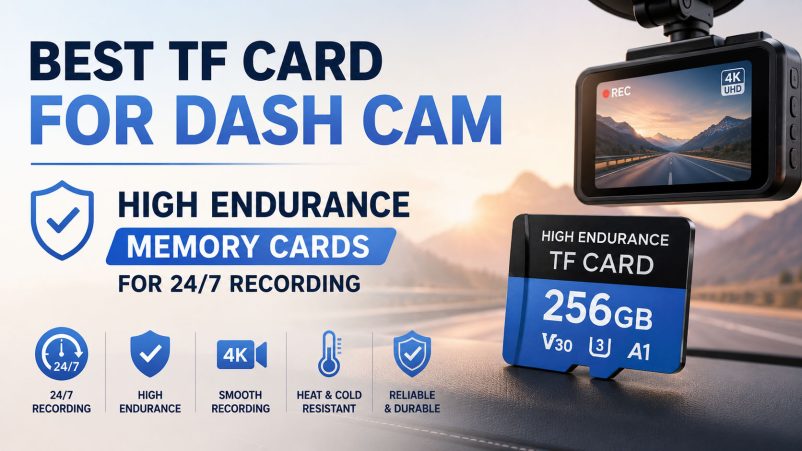
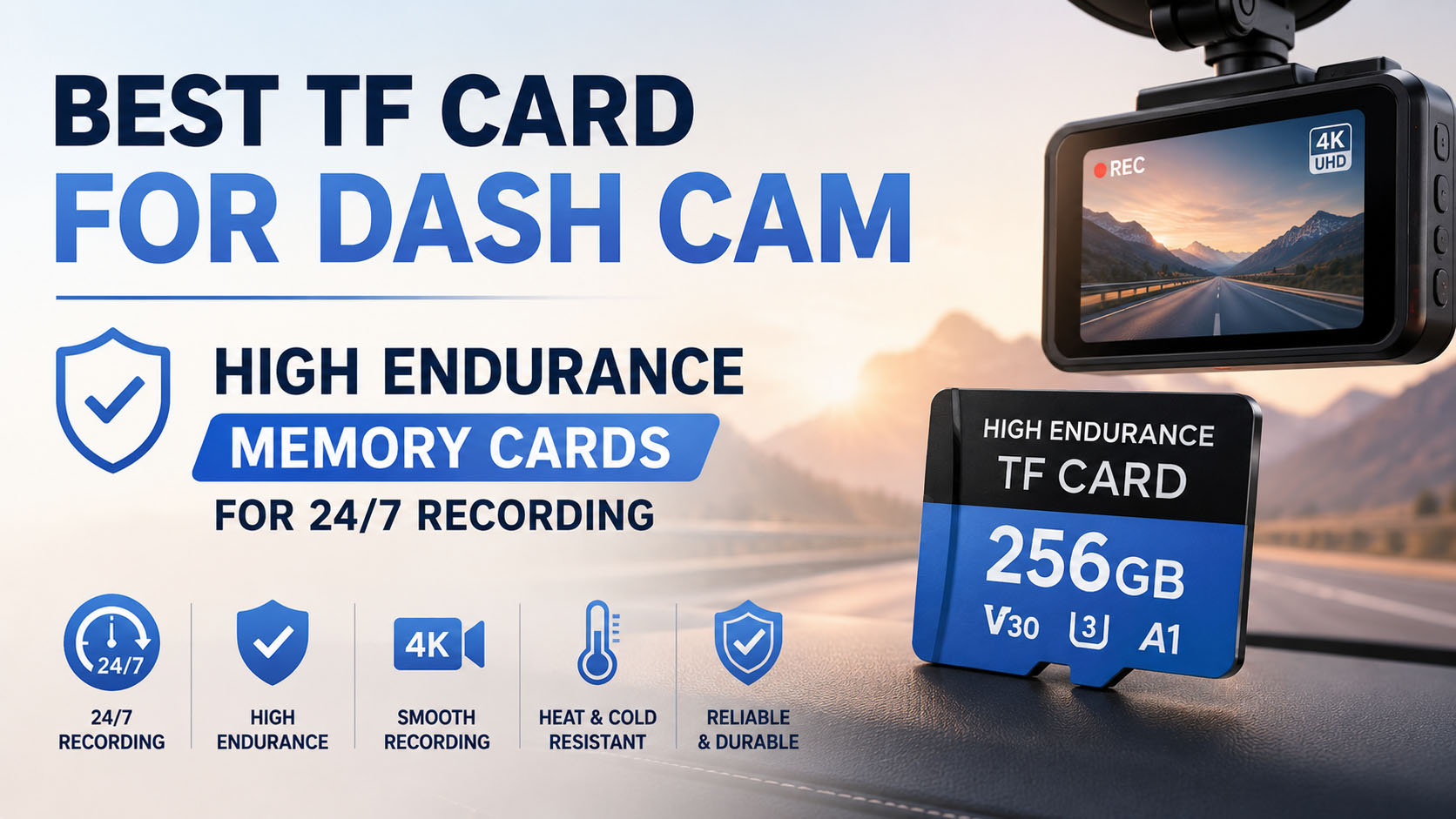
A dash cam may record for hours every day, continuously writing and overwriting video files. That makes the memory card one of the most important components in a dash cam system.
When searching for the best TF card for dash cam, many buyers focus on capacity or advertised read speed. However, for 24/7 recording, endurance, sustained write performance, temperature tolerance, controller stability, NAND flash quality, and compatibility are usually more important.
For distributors, dash cam manufacturers, security equipment companies, and automotive electronics brands, there is another layer to consider: stable supply chain management, factory testing, competitive sourcing, OEM customization, and long-term production support.
This guide explains how to choose a reliable high endurance TF card for dash cam, what specifications matter most, and what B2B buyers should evaluate when sourcing from a professional memory card manufacturer.
What Is the Best TF Card for a Dash Cam?
For most dash cam applications, the best memory card is a high-endurance microSD/TF card designed for frequent or continuous recording.
A practical specification starting point is:
High Endurance + Class 10 + U3 + V30 + suitable capacity
However, the exact requirements depend on the dash cam.
For example:
| Dash Cam Application | Recommended Focus |
|---|---|
| Basic 1080P Dash Cam | Class 10, high endurance |
| 2K Dash Cam | Class 10, U3, high endurance |
| 4K Dash Cam | U3 / V30 or device-specified class |
| Front + Rear Recording | High endurance, sufficient capacity |
| Parking Mode | High endurance is especially important |
| 24/7 Continuous Recording | High-endurance NAND + stable controller |
| Fleet / Commercial Vehicles | Endurance + temperature resistance + reliability |
The key point is that a dash cam memory card should be selected for continuous writing, not simply maximum storage capacity.
Why Dash Cams Need High-Endurance Memory Cards
Unlike smartphones, which may frequently read data, dash cams continuously write new video files and overwrite old recordings.
A typical dash cam workflow looks like this:
Record → Save video → Fill storage → Overwrite oldest files → Continue recording
This repeated write-and-erase cycle can put significantly more stress on NAND flash memory than occasional consumer storage.
A standard consumer microSD card may work in a dash cam for some time, but it may not be optimized for continuous recording.
A high endurance memory card is designed specifically for workloads where data is written and rewritten frequently.
This makes endurance particularly important for:
- Dash cams
- Security cameras
- Surveillance systems
- Body cameras
- Vehicle monitoring systems
- Industrial recording equipment
What Does “High Endurance” Mean?
High endurance generally refers to a memory card designed to tolerate substantially more program/erase activity than a standard consumer card.
Important factors include:
- NAND flash type and quality
- Controller design
- Firmware optimization
- Wear leveling
- Error correction
- Bad-block management
- Over-provisioning
- Temperature management
Endurance is therefore not determined by one specification alone.
A professional memory card manufacturer needs to consider the entire storage architecture when developing a high-endurance TF card.
TF Card vs microSD Card: Are They the Same?
In modern consumer electronics, TF card and microSD card generally refer to the same physical card format.
The original TransFlash format was later standardized as microSD by the SD Association.
Today, suppliers and buyers may use:
- TF card
- microSD card
- microSDHC
- microSDXC
- microSD memory card
For international B2B searches, “microSD card” is generally the more standardized industry term, while “TF card” remains common in dash cam, car electronics, CCTV, and Asian electronics markets.
For SEO and procurement, using both terms can therefore capture different search behaviors:
TF card for dash cam + microSD card for dash cam + high endurance microSD card + dash cam memory card
What Speed Class Does a Dash Cam Need?
Speed class tells buyers about minimum sequential write performance under defined conditions.
Class 10
Class 10 specifies a minimum sequential write speed of 10MB/s under the relevant SD standard conditions.
It can be sufficient for some basic recording applications.
U1
U1 also indicates a minimum sequential write performance of 10MB/s.
U3
U3 indicates a minimum sequential write performance of 30MB/s.
For 2K and 4K dash cams, U3 is often a more appropriate target, depending on the manufacturer’s requirements.
V30
V30 indicates a minimum sequential write performance of 30MB/s under the relevant Video Speed Class conditions.
For higher-resolution video recording, V30-class cards are commonly considered.
The SD Association explains that Speed Class and Video Speed Class are designed to communicate minimum sequential performance requirements for recording applications.
However, buyers should always follow the dash cam manufacturer’s recommended specification rather than assuming that a higher number is automatically necessary.
Is A1 or A2 Important for Dash Cams?
A1 and A2 are Application Performance Class ratings.
They are primarily designed around application-related random I/O performance rather than continuous video recording.
For a dash cam, endurance and sustained write performance are generally more important than A1/A2.
If a supplier offers a card labeled A1 or A2, that does not automatically mean it is optimized for 24/7 dash cam recording.
For dash cam applications, buyers should prioritize:
Endurance → sustained write performance → temperature resistance → reliability → capacity
rather than choosing based solely on an A1/A2 logo.
How Much Storage Does a Dash Cam Need?
The appropriate capacity depends on:
- Video resolution
- Frame rate
- Number of cameras
- Compression format
- Parking mode
- Recording duration
- Overwrite settings
32GB TF Card
Suitable for:
- Basic 1080P systems
- Short recording periods
- Entry-level dash cams
64GB TF Card
A practical option for many standard dash cams.
128GB TF Card
A popular choice for:
- 2K dash cams
- Higher-quality 1080P recording
- Longer recording cycles
256GB TF Card
Useful for:
- 4K dash cams
- Dual-camera systems
- Longer recording periods
- Fleet applications
512GB and Above
These capacities can be attractive for specialized systems, but compatibility should be checked carefully because not every dash cam supports high-capacity cards.
Always verify the maximum supported capacity before placing an order.
Why Endurance Is More Important Than Capacity
A common mistake is to assume that a larger capacity automatically means a better dash cam card.
It does not.
For example, a 256GB standard consumer card may have more storage than a 128GB high-endurance card, but the high-endurance card may be more appropriate for a device that continuously overwrites video.
For dash cams, the purchasing priority should generally be:
Recording stability > endurance > compatibility > sustained write performance > capacity > peak read speed
The exact priority can change depending on the product design.
Temperature Resistance Is Critical for Dash Cam Memory Cards
A vehicle interior can experience significant temperature changes.
A parked vehicle in direct sunlight can become extremely hot, while vehicles operating in winter environments can experience very low temperatures.
Memory cards used in vehicles therefore need to be qualified for the expected operating environment.
For automotive applications, buyers should evaluate:
- Operating temperature
- Storage temperature
- NAND characteristics
- Controller stability
- Error correction
- Long-term recording stability
This is particularly important for:
- Parking mode
- Fleet vehicles
- Commercial trucks
- Taxis
- Delivery vehicles
- Outdoor vehicles
A memory card that performs well in a controlled indoor environment may not necessarily provide the same reliability inside a vehicle exposed to temperature extremes.
NAND Flash Quality and Dash Cam Endurance
NAND flash is the primary storage medium inside a memory card.
Different NAND architectures can have different characteristics in terms of:
- Program/erase endurance
- Density
- Cost
- Performance
- Data retention
- Application suitability
For high-endurance products, NAND selection should be based on the target workload rather than simply the lowest component cost.
An experienced storage manufacturer can select the appropriate flash solution according to the expected recording cycle, target capacity, performance requirement, and price range.
This is one reason why NAND sourcing capability is an important consideration when choosing an OEM TF card supplier.
Why the Controller Matters
The memory controller is responsible for managing communication between the host device and NAND flash.
Important functions include:
- Error correction
- Wear leveling
- Bad-block management
- Flash translation
- Data management
- Performance control
For continuous recording, effective wear leveling and error management can help distribute write activity and maintain stable operation.
A reliable high-endurance TF card therefore requires more than good NAND.
It requires the right combination of:
NAND + controller + firmware + testing
Firmware Optimization for 24/7 Recording
Firmware is another factor that is often overlooked.
For dash cam applications, firmware can influence:
- Write management
- Error handling
- Wear leveling
- Data stability
- Host compatibility
- Recovery behavior
A professional memory card manufacturer can optimize firmware and controller settings around specific application requirements.
This can be particularly valuable for OEM customers developing a dedicated memory card for a particular dash cam platform.
Supply Chain Advantages for Dash Cam Memory Cards
For B2B buyers, supply-chain stability is a major part of product reliability.
A professional memory card supplier should be able to manage:
NAND sourcing → controller sourcing → firmware → production → capacity testing → speed testing → endurance testing → packaging → shipment
A strong supply chain provides several advantages.
Stable Component Availability
Consistent sourcing reduces the risk of unexpected component substitutions.
Better Cost Control
Factory-level sourcing can help provide competitive pricing for bulk orders.
More Consistent Production
Stable component combinations make it easier to maintain consistent product specifications.
Faster OEM Development
Suppliers with established component and production networks can typically move from sample development to mass production more efficiently.
OEM Dash Cam Memory Cards for Private-Label Brands
For dash cam manufacturers and electronics brands, selling a branded memory card can create an additional revenue opportunity.
Instead of purchasing standard retail products, businesses can work with an OEM memory card manufacturer to develop private-label TF cards.
Typical OEM services include:
- Custom logo
- Private-label microSD card
- Customized packaging
- Retail blister packaging
- Custom capacity
- Custom speed specification
- Product labeling
- Barcode
- User manual
- Sample testing
- Batch inspection
For example, a dash cam brand could launch:
“Brand X High Endurance 128GB TF Card for 2K Dash Cam”
or
“Brand X 256GB High Endurance V30 microSD Card for 4K Dash Cam”
This allows the brand to control product positioning, packaging, and retail pricing.
Why OEM Capability Matters for Dash Cam Manufacturers
A dash cam manufacturer may have different requirements from a general electronics distributor.
An OEM supplier can help match the memory card to:
- Dash cam chipset
- Recording resolution
- Bitrate
- File system
- Loop-recording settings
- Parking mode
- Temperature requirements
- Target retail price
This application-specific approach is more useful than simply purchasing the cheapest available TF card.
For large-volume customers, OEM development can also help establish a consistent specification for future production orders.
How to Choose a Reliable Wholesale TF Card Supplier
When searching for a wholesale TF card supplier, do not evaluate suppliers only by quotation.
Consider these factors:
1. NAND Supply
Ask about component sourcing and supply continuity.
2. Factory Capability
Check whether the supplier can support:
- Sample development
- Mass production
- Capacity verification
- Speed testing
- Quality inspection
3. Endurance Testing
For dash cam cards, ask specifically about continuous-write and endurance validation.
4. OEM Capability
Confirm whether the supplier can provide:
- Private labeling
- Customized packaging
- Logo printing
- Customized specifications
5. Long-Term Supply
For automotive electronics brands, consistency between batches is essential.
6. After-Sales Support
A professional supplier should have a clear process for handling quality issues, warranty claims, and batch-level problems.
High-Intent Keywords for Dash Cam Memory Card Procurement
Businesses searching for dash cam memory cards often use more specific purchasing keywords than consumers.
Examples include:
- best TF card for dash cam
- best microSD card for dash cam
- high endurance TF card
- high endurance microSD card
- dash cam memory card
- 24/7 recording memory card
- 128GB TF card for dash cam
- 256GB TF card for dash cam
- 512GB microSD card for dash cam
- 4K dash cam memory card
- U3 microSD card for dash cam
- V30 microSD card supplier
- high endurance microSD card supplier
- dash cam memory card manufacturer
- TF card manufacturer
- wholesale TF card supplier
- bulk microSD card supplier
- OEM TF card manufacturer
- private label dash cam memory card
- OEM high endurance microSD card
- custom memory card manufacturer
- automotive memory card supplier
- industrial microSD card manufacturer
These keywords combine application + specification + purchasing intent, making them useful for B2B search visibility and international sourcing.
How to Test a TF Card Before Bulk Purchasing
Before placing a large OEM or wholesale order, buyers should test samples under realistic conditions.
Capacity Verification
Confirm actual usable capacity.
Sequential Write Test
Measure the card’s sustained writing performance.
Random I/O Test
Useful when the same card may be used in other applications.
Continuous Recording Test
Run the card in the actual dash cam for an extended period.
Loop Recording Test
Test repeated recording and overwriting.
Temperature Test
Evaluate performance under the expected vehicle temperature range.
Compatibility Test
Test with the actual dash cam model rather than relying only on computer benchmarks.
Long-Term Stability Test
For high-volume automotive applications, longer qualification testing can reveal problems that a short benchmark may miss.
Common Mistakes When Buying a Dash Cam TF Card
Choosing a Standard Consumer Card
A basic card may not be designed for constant write/erase cycles.
Buying Only Based on Capacity
More GB does not automatically mean higher endurance.
Looking Only at Read Speed
Dash cams are primarily write-intensive devices.
Ignoring Temperature
Automotive applications can expose memory cards to much more demanding temperature conditions than indoor electronics.
Assuming A2 Means High Endurance
A2 describes application performance, not necessarily endurance.
Buying the Cheapest Supplier
Extremely low prices may come with risks related to NAND quality, component consistency, testing, or after-sales support.
Skipping Real-Device Testing
A memory card should be tested in the actual dash cam before large-scale procurement.
Best TF Card Specifications for Different Dash Cam Applications
1080P Dash Cam
A reasonable starting point is:
Class 10 + high endurance + 32GB–128GB
2K Dash Cam
Consider:
Class 10 + U3 + high endurance + 64GB–256GB
4K Dash Cam
Consider:
U3 + V30 or higher + high endurance + 128GB–256GB+
The exact requirement should follow the dash cam manufacturer’s specification.
Dual-Channel Dash Cam
Consider:
High endurance + higher sustained write performance + sufficient capacity
because front and rear cameras generate more data simultaneously.
Parking Mode
Prioritize:
High endurance + stable write performance + temperature tolerance
because parking mode may involve frequent recording and event-triggered writes.
FAQ: Best TF Card for Dash Cam
What is the best TF card for a dash cam?
A high-endurance microSD/TF card is generally the best choice for dash cams because dash cams continuously write and overwrite video data. The required speed class and capacity depend on the specific dash cam.
Is a high-endurance card necessary for a dash cam?
For frequent or 24/7 recording, high endurance is strongly recommended. Dash cams create repeated write/erase cycles, making endurance more important than it is for ordinary file storage.
Is 128GB enough for a dash cam?
128GB can be suitable for many 1080P and 2K dash cams. A 256GB card may be more appropriate for 4K, dual-camera, or longer recording requirements, provided the dash cam supports that capacity.
Is 256GB better than 128GB for a dash cam?
A 256GB card provides more recording capacity, but it is not automatically more reliable. Choose based on the dash cam’s maximum supported capacity, video bitrate, endurance rating, and required recording time.
Is U3 better than U1 for dash cams?
U3 specifies a higher minimum sequential write performance than U1. For higher-resolution video, U3 can be more appropriate, but the dash cam manufacturer’s required specification should always be followed.
Is V30 good for a 4K dash cam?
V30 specifies a minimum sequential write performance of 30MB/s under the applicable standard conditions and is commonly used for demanding video recording. However, compatibility and the dash cam manufacturer’s requirements should take priority.
Does a dash cam need an A1 or A2 card?
Not necessarily. A1/A2 are Application Performance Class ratings. For dash cams, endurance and sustained write performance are generally more important considerations.
Can I use a normal microSD card in a dash cam?
Some dash cams may operate with standard microSD cards, but continuous recording can place substantially more stress on the card. A high-endurance card is generally a better choice for frequent loop recording.
How long does a high-endurance dash cam memory card last?
There is no universal lifespan. Actual endurance depends on NAND type, card capacity, recording bitrate, recording hours, temperature, write/erase cycles, and the specific card design.
What is the difference between a TF card and a microSD card?
For modern consumer electronics, TF card and microSD card generally refer to the same physical card format. “MicroSD” is the standardized industry term, while “TF card” remains widely used in automotive electronics and some B2B markets.
Can I order OEM TF cards for my dash cam brand?
Yes. An experienced OEM memory card manufacturer can provide private-label TF cards with customized logos, packaging, capacity, specifications, and other requirements depending on the project.
What should I ask an OEM TF card supplier?
Ask about NAND source, controller, firmware, endurance testing, capacity verification, sustained write performance, temperature specifications, OEM customization, production capacity, MOQ, lead time, warranty, and long-term supply stability.
Final Verdict: What Is the Best TF Card for 24/7 Dash Cam Recording?
For a dash cam that records continuously, the best TF card is not necessarily the one with the largest capacity or highest advertised read speed.
The ideal solution should combine:
High endurance + stable sustained write performance + reliable NAND + optimized controller + suitable capacity + temperature tolerance + verified compatibility
For B2B buyers, the equation is even broader:
Component quality + supply-chain stability + factory testing + competitive pricing + OEM capability + long-term supply
If you are sourcing high endurance TF cards, dash cam microSD cards, 128GB/256GB/512GB memory cards, OEM TF cards, private-label dash cam memory cards, or automotive storage solutions, selecting an experienced manufacturer can significantly reduce sourcing and quality risks.
The right supplier should not simply sell you a memory card. It should help you build a stable, application-matched, scalable storage solution for your dash cam product line.