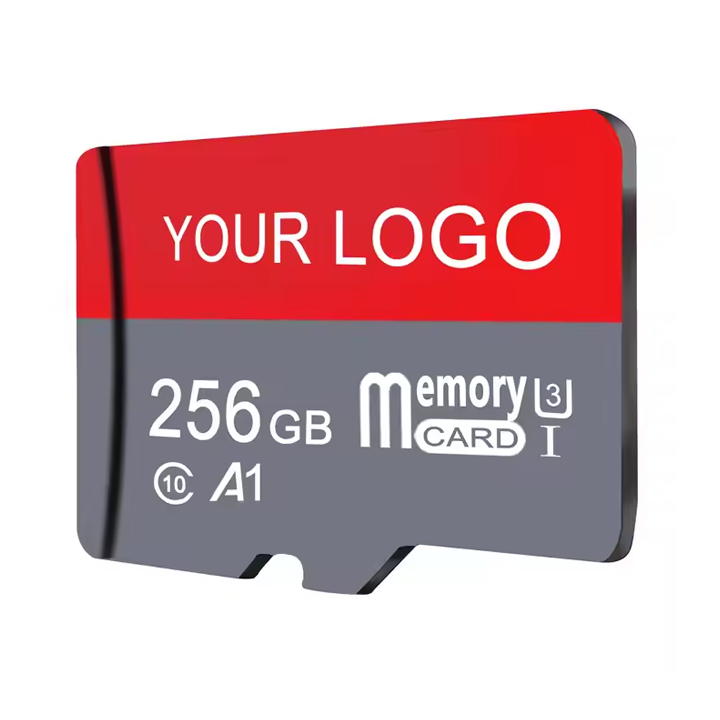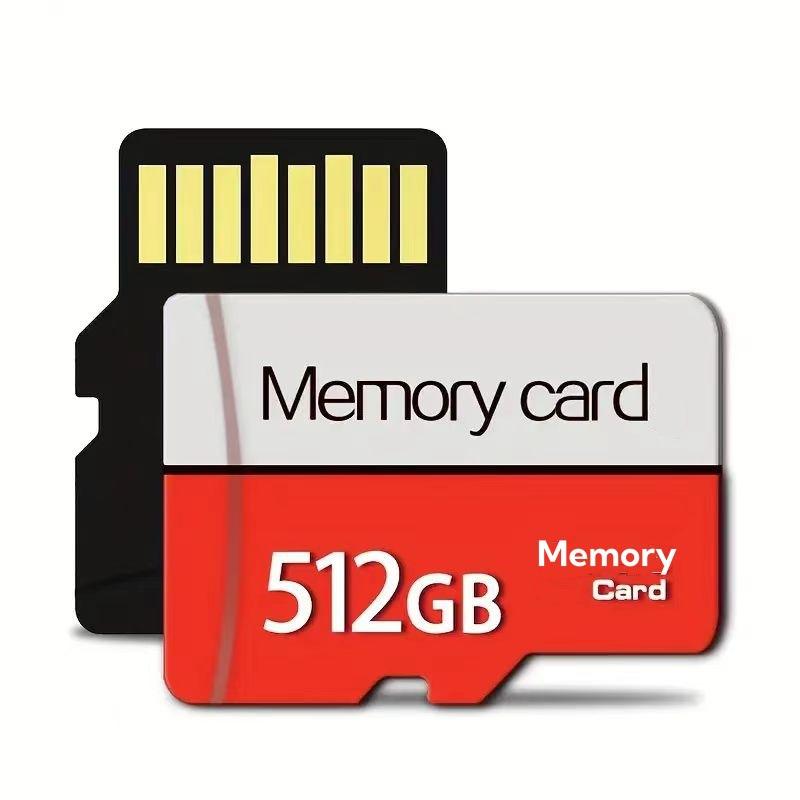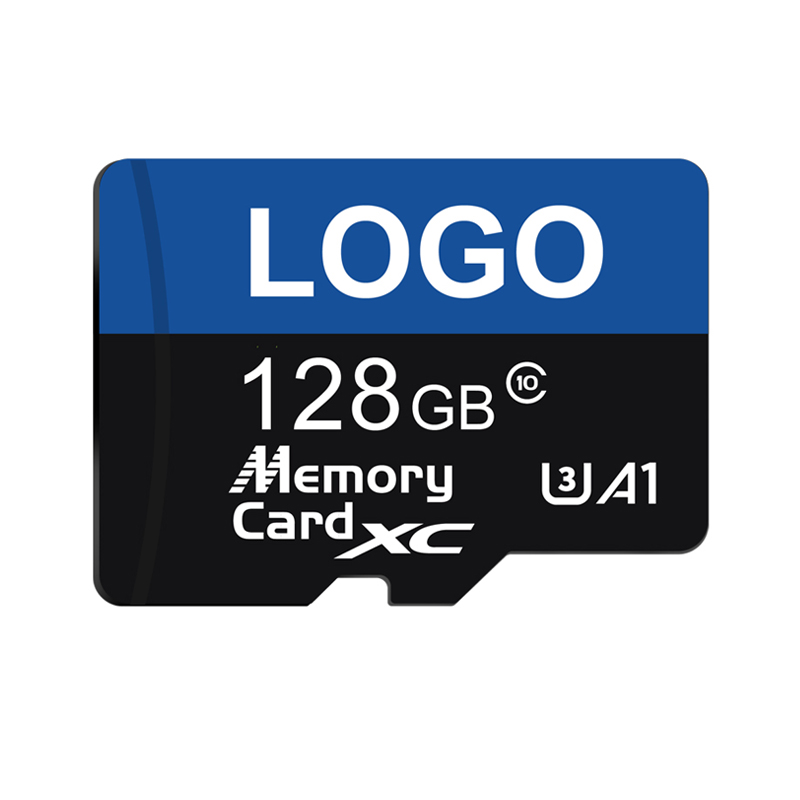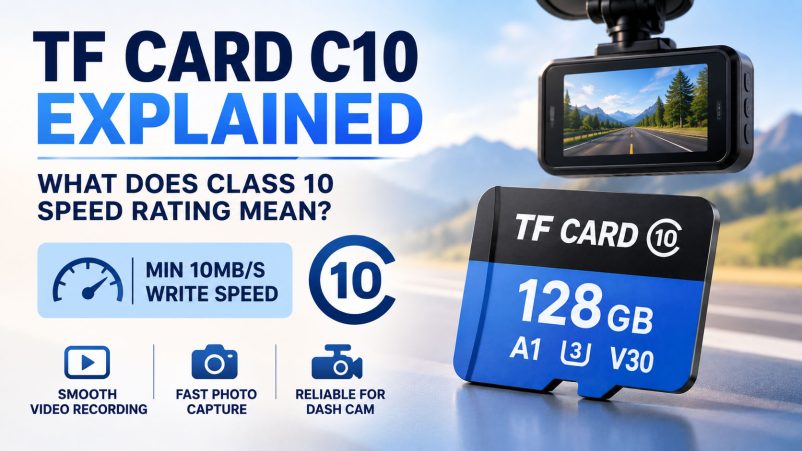
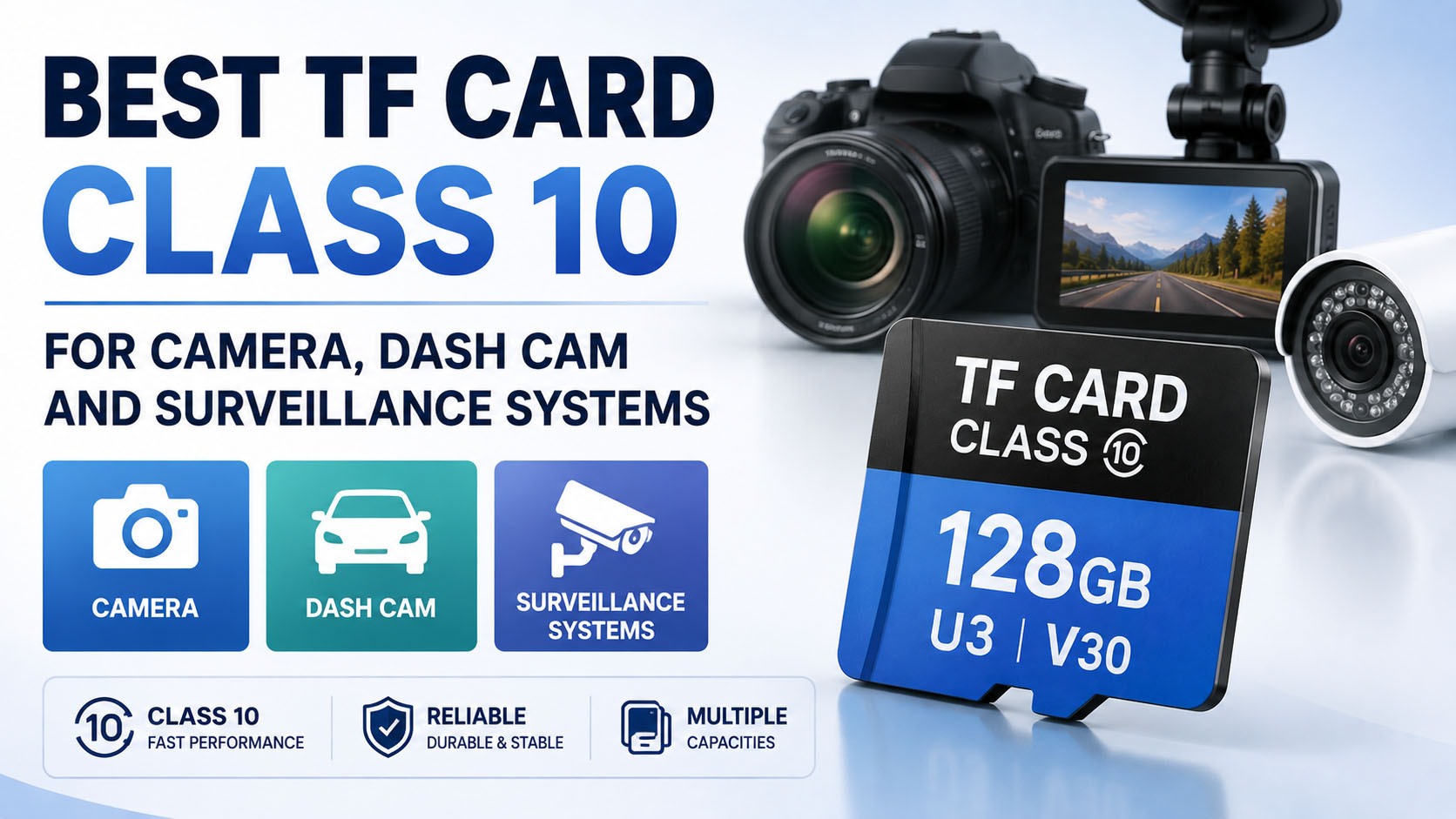
If you have ever searched for a TF card C10, Class 10 microSD card, or Class 10 memory card, you may have wondered what the number “10” actually means.
The short answer is:
Class 10 (C10) indicates a minimum sequential write performance of 10MB/s under the SD Speed Class standard’s defined conditions.
It is an important performance baseline for memory cards used in cameras, dash cams, surveillance systems, smartphones, action cameras, and other electronic devices. However, C10 does not mean that every Class 10 card has the same overall performance, endurance, or quality.
For buyers, the distinction between minimum sustained write performance, maximum advertised speed, NAND flash quality, controller design, endurance, and device compatibility is critical.
For wholesalers, distributors, electronics manufacturers, and private-label brands, the purchasing decision goes even further. A reliable TF card manufacturer should combine stable NAND sourcing, quality control, production consistency, competitive factory pricing, and OEM customization capability.
What Does TF Card C10 Mean?
C10 is the abbreviation commonly used for Class 10, one of the SD Association’s Speed Class ratings.
The SD Association defines four traditional SD Speed Classes:
| Speed Class | Minimum Sequential Write Performance |
|---|---|
| Class 2 | 2MB/s |
| Class 4 | 4MB/s |
| Class 6 | 6MB/s |
| Class 10 / C10 | 10MB/s |
The C10 symbol is designed to communicate a minimum sustained sequential write-performance level under the conditions defined by the SD standard.
This is important because video recording requires storage to maintain a sufficiently consistent write rate. A high peak speed alone does not guarantee that a card can sustain the required recording workload.
Is C10 the Same as 10MB/s?
C10 means a minimum sequential write-performance class of 10MB/s under defined standard conditions.
It does not mean:
- Maximum speed is 10MB/s
- Read speed is 10MB/s
- Every file transfer will run at exactly 10MB/s
- The card will always deliver 10MB/s in every device
- A C10 card is automatically high endurance
This distinction is especially important for international buyers comparing memory cards.
| Specification | What It Tells You |
|---|---|
| C10 | Minimum sequential write-performance class |
| Read Speed | Maximum or specified read performance, depending on product |
| Write Speed | Maximum or specified write performance, depending on product |
| U1 | Minimum UHS sequential write-performance class of 10MB/s |
| U3 | Minimum UHS sequential write-performance class of 30MB/s |
| V30 | Minimum Video Speed Class performance of 30MB/s |
| A1/A2 | Application-oriented random performance requirements |
| High Endurance | Suitability for intensive repeated writing, depending on product design |
The SD Association specifically distinguishes speed classes, which assure minimum performance under defined conditions, from vendor maximum-speed ratings.
C10 vs Maximum Read Speed: What’s the Difference?
This is one of the most common sources of confusion.
A memory card may advertise:
“Up to 100MB/s Read”
while also carrying:
C10
These numbers describe different aspects of performance.
| Rating | Meaning |
|---|---|
| C10 | Minimum sequential write-performance class |
| “Up to 100MB/s Read” | Maximum/peak read performance claimed by the manufacturer |
| U3 | Minimum UHS sequential write-performance class of 30MB/s |
| V30 | Minimum Video Speed Class performance of 30MB/s |
A card can therefore have a high advertised read speed and still use a C10 marking.
For applications such as video recording, sustained write performance is often more important than peak read speed.
Why Is Class 10 Important for Video Recording?
Video recording continuously generates data.
A simplified workflow looks like:
Camera → Video Encoding → Continuous Data Writing → Memory Card
If the memory card cannot maintain the required write performance, recording can become unstable.
The SD Association developed Speed Class standards specifically because variable flash-memory performance can make continuous video recording difficult to guarantee. Speed Class markings communicate minimum sequential access performance under defined conditions.
This is why C10 became a widely used baseline for HD and Full HD recording applications.
What Applications Is a C10 TF Card Suitable For?
C10 is commonly associated with applications such as:
- Full HD video
- Digital cameras
- Action cameras
- Dash cams
- CCTV
- Surveillance cameras
- Smartphones
- Tablets
- Portable gaming devices
- General file storage
The SD Association’s guidance associates Class 10/U1/V10 with HD to Full HD video recording and U3/V30 with Full HD to 4K video recording.
However, the actual requirements depend on the host device.
| Application | C10 Suitability | What Else to Check |
|---|---|---|
| Photos | Excellent | Capacity, reliability |
| Music | Excellent | Capacity |
| Documents | Excellent | Capacity |
| Full HD Video | Often suitable | Device requirements |
| 1080P Dash Cam | Often suitable | Endurance |
| 2K Dash Cam | Depends | U3/V30, endurance |
| 4K Camera | Often not enough by itself | U3/V30 or higher |
| 4K Dash Cam | Depends | U3/V30, endurance |
| CCTV | Depends | High endurance |
| Smartphone Storage | Often suitable | A1/A2, device compatibility |
Is Class 10 Good for a Dash Cam?
C10 can be suitable for some dash cams, but Class 10 alone does not make a memory card ideal for continuous recording.
Dash cams repeatedly write and overwrite video files.
Therefore, a better specification for many dash cam applications is:
C10 + High Endurance
For higher-resolution recording:
C10 + U3/V30 + High Endurance
The exact requirement should follow the dash cam manufacturer’s specification.
| Dash Cam Type | Recommended Starting Point |
|---|---|
| Basic 720P/1080P | C10 + reliable NAND |
| 1080P Loop Recording | C10 + High Endurance |
| 2K | C10/U3 + High Endurance |
| 4K | U3/V30 + High Endurance |
| Dual Camera | U3/V30 + High Endurance |
| Parking Mode | High Endurance + temperature tolerance |
| Fleet Vehicle | High Endurance + stable supply |
The important point is:
C10 describes speed class; high endurance addresses the repeated-write workload.
Is Class 10 Good for CCTV and Surveillance?
A C10 card can work in some surveillance systems, but buyers should not choose a card based solely on the C10 logo.
For continuous CCTV recording, the storage workload can be significantly more demanding than ordinary file storage.
| Requirement | Importance for CCTV |
|---|---|
| C10 | Basic write-performance baseline |
| U3/V30 | Important for higher-bitrate video |
| High Endurance | Very important for continuous recording |
| Capacity | Important for recording duration |
| Temperature Rating | Important for outdoor systems |
| NAND Quality | Important for reliability |
| Controller | Important for data management |
| Compatibility | Essential |
For 24/7 surveillance, high endurance and sustained write stability should be evaluated alongside C10.
C10 vs U1: Are They the Same?
C10 and U1 both indicate a 10MB/s minimum write-performance level under their respective standards, but they are not exactly the same marking.
| Feature | C10 | U1 |
|---|---|---|
| Full Name | Speed Class 10 | UHS Speed Class 1 |
| Minimum Class Performance | 10MB/s | 10MB/s |
| Interface Context | High Speed or compatible bus | UHS bus |
| Main Use | General/video recording | UHS devices |
| Higher Peak Bus Potential | Limited by host/card interface | Higher with UHS-I/II/III |
The SD Association notes that UHS Speed Class applies to UHS-equipped products, while C10 belongs to the traditional Speed Class system.
Therefore, C10 and U1 should not simply be treated as interchangeable labels in every host-device configuration.
C10 vs U3: Which Is Faster?
U3 has a higher minimum sequential write-performance requirement.
| Rating | Minimum Sequential Write Performance |
|---|---|
| C10 | 10MB/s |
| U1 | 10MB/s |
| U3 | 30MB/s |
| V30 | 30MB/s |
| V60 | 60MB/s |
| V90 | 90MB/s |
The SD Association defines U3 as a 30MB/s UHS Speed Class and V30 as a 30MB/s Video Speed Class.
For demanding 4K video applications, U3/V30 can therefore be a more appropriate starting point than C10 alone.
C10 vs V30: Which Should You Choose?
C10 and V30 are different speed-class systems.
| Feature | C10 | V30 |
|---|---|---|
| Minimum Class Performance | 10MB/s | 30MB/s |
| Standard | SD Speed Class | Video Speed Class |
| Primary Positioning | General/video recording | Higher-performance video |
| Typical Application | HD/Full HD | Full HD/4K |
| Best for 4K | Depends | Often more appropriate |
The SD Association identifies V30 as a 30MB/s Video Speed Class and associates U3/V30 with Full HD to 4K video applications.
For a 4K camera or dash cam, always follow the host device’s recommended card specification.
Does C10 Mean the TF Card Is High Quality?
No.
C10 is a standardized speed-performance classification. It does not fully describe:
- NAND flash quality
- Controller quality
- Firmware
- Endurance
- Temperature resistance
- Data retention
- Batch consistency
- Manufacturing quality
This is an important distinction for B2B buyers.
Two manufacturers can both offer C10 TF cards while having very different internal components and quality-control processes.
| Factor | C10 Tells You? |
|---|---|
| Minimum sequential write class | Yes |
| Maximum read speed | No |
| NAND quality | No |
| Controller | No |
| Firmware | No |
| Endurance | No |
| Temperature performance | No |
| OEM capability | No |
| Supply-chain stability | No |
What Is Inside a C10 TF Card?
From a storage-industry perspective, a TF/microSD card is a small but sophisticated storage system.
The key components include:
| Component | Main Function |
|---|---|
| NAND Flash | Stores data |
| Controller | Manages NAND and host communication |
| Firmware | Controls storage-management behavior |
| PCB / Package | Integrates the electronic components |
| Card Interface | Connects with the host device |
The combination of these components determines the card’s actual behavior.
This means that C10 is only one part of the product specification.
Why NAND Flash Quality Matters
NAND flash is the primary storage medium inside a memory card.
Its characteristics influence:
- Storage density
- Write performance
- Read performance
- Endurance
- Data reliability
- Cost
- Product lifecycle
For general consumer storage, the NAND selection may be optimized around cost and performance.
For high-endurance applications such as dash cams and surveillance systems, NAND selection must also consider the expected write/erase workload.
An experienced manufacturer should therefore select NAND according to the application rather than capacity alone.
Why the Controller Matters
The controller manages communication between the host device and NAND flash.
Typical controller functions include:
- Error correction
- Wear leveling
- Bad-block management
- Flash translation
- Data mapping
- Performance management
For a standard C10 card, the controller needs to meet the required performance.
For high-endurance applications, controller behavior becomes even more important because repeated writing places greater demands on flash management.
A professional supplier should evaluate:
NAND + Controller + Firmware + Workload
as an integrated system.
Does Firmware Affect C10 Performance?
Yes.
Firmware controls how the memory card manages its NAND flash and interacts with the host device.
It can influence:
- Write management
- Error handling
- Wear leveling
- Bad-block management
- Performance consistency
- Host compatibility
This is particularly important when a card is customized for a specific device or application.
For OEM projects, the ability to optimize the firmware and controller configuration can provide advantages over a generic off-the-shelf solution.
C10 TF Card Selection by Application
| Application | Recommended Starting Point | Key Considerations |
|---|---|---|
| Smartphone Storage | C10/U1 | Capacity + compatibility |
| Digital Camera | C10/U1 | Burst shooting + video |
| Full HD Camera | C10/U1/V10 | Sustained write |
| 4K Camera | U3/V30+ | Sustained write |
| Basic Dash Cam | C10 | Compatibility |
| Dash Cam Loop Recording | C10 + High Endurance | Endurance |
| 2K Dash Cam | U3 + High Endurance | Write + endurance |
| 4K Dash Cam | U3/V30 + High Endurance | Sustained write |
| Home CCTV | C10 + High Endurance | Continuous recording |
| 4K Surveillance | U3/V30 + High Endurance | Write + endurance |
| Industrial Equipment | Application-specific | Endurance + temperature |
These are general guidelines, not universal requirements. The host device specification should always take priority.
How Much Capacity Should You Choose?
C10 is a speed classification, not a capacity classification.
A C10 TF card can come in many capacities.
| Capacity | Typical Applications |
|---|---|
| 32GB | Basic recording, entry-level devices |
| 64GB | Full HD, general storage |
| 128GB | Cameras, dash cams, smartphones |
| 256GB | 2K/4K recording, surveillance |
| 512GB | Long recording periods, large media libraries |
| 1TB+ | Specialized devices that support higher capacity |
The SD Association currently defines SDHC as over 2GB to 32GB, SDXC as over 32GB to 2TB, and SDUC as over 2TB to 128TB.
Always verify the maximum capacity supported by the host device.
Why Capacity and Speed Should Be Evaluated Separately
A common purchasing mistake is assuming:
More GB = Faster Card
This is incorrect.
Capacity and speed are separate specifications.
For example:
| Product | Capacity | Speed Class | Possible Use |
|---|---|---|---|
| Card A | 64GB | C10 | Full HD |
| Card B | 128GB | C10 | Full HD / storage |
| Card C | 256GB | C10 | Storage / recording |
| Card D | 256GB | U3/V30 | 4K video |
| Card E | 256GB | U3/V30 + High Endurance | 4K dash cam / surveillance |
The right choice depends on the workload.
What Does C10 Mean for OEM Buyers?
For OEM customers, C10 can be used as one part of a product specification.
For example:
128GB Class 10 TF Card
can define:
- Capacity
- Speed class
- Form factor
But a professional OEM specification should also define:
- NAND type
- Controller
- Sustained write target
- Endurance requirements
- Operating temperature
- Packaging
- Quality-control standards
- Device compatibility
This creates a much more complete product definition.
Supply Chain Advantages in C10 TF Card Manufacturing
For B2B buyers, the quality of a memory card is closely connected to its supply chain.
A professional manufacturer may manage:
NAND sourcing → controller selection → firmware → assembly → capacity testing → speed testing → quality inspection → packaging → shipment
This integrated approach provides several advantages.
Stable NAND Sourcing
Consistent upstream sourcing can help reduce unexpected changes between production batches.
Competitive Factory Pricing
Large-volume procurement can improve cost efficiency for wholesale customers.
Better Batch Consistency
Controlled component combinations can help maintain consistent:
- Capacity
- Performance
- Controller configuration
- Firmware
- Product quality
Production Continuity
Stable supply-chain management helps support:
- Repeat orders
- Long-term contracts
- Seasonal demand
- Large OEM projects
For brands, supply continuity can be just as important as the initial product price.
Why Supply Chain Stability Matters to International Buyers
Imagine a distributor launches a private-label 128GB Class 10 TF card.
The first batch performs well.
Six months later, the supplier changes critical components because of supply problems.
The new batch may have different:
- Performance
- Endurance
- Controller behavior
- Compatibility
Even if the product label remains identical, the customer experience could change.
This is why professional buyers should ask about component consistency and long-term supply planning, rather than evaluating suppliers only by the sample price.
OEM Class 10 TF Card Capabilities
An experienced OEM TF card manufacturer can support more than standard product supply.
Typical OEM services include:
| OEM Service | Possible Customization |
|---|---|
| Logo | Custom brand/logo |
| Card Label | Custom artwork |
| Packaging | Box, blister, paper packaging |
| Capacity | 32GB / 64GB / 128GB / 256GB / etc. |
| Speed Class | C10 / U1 / U3 / V30, depending on design |
| Product Positioning | Camera / dash cam / CCTV / mobile |
| Barcode | Custom barcode |
| Labeling | Market-specific information |
| Manual | Customized user instructions |
| Testing | Customer-defined inspection requirements |
The exact customization options depend on the manufacturer’s production capabilities and project requirements.
Why OEM Capability Matters for C10 TF Card Brands
For a business building its own storage brand, private labeling provides more control over:
- Product positioning
- Packaging
- Pricing
- Distribution
- Brand identity
- Product portfolio
For example, an electronics brand could develop:
| Product | Target Application |
|---|---|
| 64GB C10 TF Card | Basic consumer storage |
| 128GB C10 TF Card | Camera / dash cam |
| 256GB U3/V30 TF Card | 4K recording |
| 128GB C10 High Endurance | Dash cam |
| 256GB U3/V30 High Endurance | Surveillance |
This creates a product portfolio based on application rather than simply capacity.
How to Choose a Reliable C10 TF Card Supplier
For wholesale procurement, evaluate suppliers using a structured checklist.
| Evaluation Area | What to Ask |
|---|---|
| NAND | What is the NAND source and configuration? |
| Controller | What controller solution is used? |
| Performance | What is the sustained write performance? |
| Capacity | How is actual capacity verified? |
| Testing | What production tests are performed? |
| Endurance | Is endurance testing available? |
| Temperature | What operating range is supported? |
| Compatibility | Has the card been tested in target devices? |
| OEM | Can logo and packaging be customized? |
| MOQ | What is the minimum order quantity? |
| Lead Time | How long does production take? |
| Supply | Can the same specification be maintained? |
| Warranty | What after-sales support is provided? |
This approach helps buyers distinguish a professional manufacturer from a supplier competing mainly on price.
How to Test a C10 TF Card Before Bulk Purchasing
Before ordering thousands of units, sample qualification is highly recommended.
| Test | Purpose |
|---|---|
| Capacity Test | Verify actual capacity |
| Sequential Write Test | Verify write performance |
| Sequential Read Test | Evaluate transfer performance |
| Sustained Write Test | Check long-duration stability |
| Loop Recording Test | Evaluate repeated recording |
| Device Compatibility Test | Confirm actual host compatibility |
| Temperature Test | Evaluate environmental stability |
| Batch Test | Check consistency between samples |
For dash cams and surveillance systems, real-device testing is particularly important.
A card that performs well on a computer benchmark may not necessarily behave identically in a continuous-recording device.
C10 TF Card Buying Checklist
Before purchasing, ask these questions:
| Question | Why It Matters |
|---|---|
| Does the device support microSD/TF? | Physical compatibility |
| What capacity does it support? | Prevents unsupported-card issues |
| Does it require C10? | Minimum write-class requirement |
| Does it require U3/V30? | Important for higher-bitrate video |
| Does it record continuously? | Determines endurance requirements |
| Does it use loop recording? | Repeated writing/erasing |
| Does it operate in high temperatures? | Environmental reliability |
| Is the card for OEM branding? | Determines customization needs |
| Is long-term supply required? | Important for repeat orders |
| Has the supplier tested the card? | Reduces procurement risk |
Common Misunderstandings About C10
“C10 Means the Card Runs at Exactly 10MB/s”
Not exactly. C10 is a minimum sequential write-performance classification under defined conditions, not a fixed real-world transfer speed.
“C10 Means 10MB/s Read Speed”
No. C10 refers to the speed-class performance requirement, primarily concerning write performance.
“C10 Is Always Enough for 4K”
No. Many demanding 4K applications require U3/V30 or higher, depending on bitrate and device requirements.
“C10 Means High Endurance”
No. Endurance is a separate characteristic.
“A 256GB C10 Card Is Faster Than a 128GB C10 Card”
Not necessarily. Capacity and speed class are separate specifications.
“A Higher Advertised Read Speed Always Means Better Video Recording”
No. For video recording, minimum sustained write performance is often more important than peak read speed.
FAQ: TF Card C10 Explained
What does C10 mean on a TF card?
C10 means Class 10, an SD Speed Class designation indicating a minimum sequential write-performance level of 10MB/s under defined standard conditions.
Is C10 the same as Class 10?
Yes. “C10” is commonly used as a shorthand for Class 10.
Is a Class 10 TF card fast?
Class 10 provides a 10MB/s minimum sequential write-performance baseline. Whether that is fast enough depends on the device and application.
Is Class 10 good for 1080P video?
Class 10 is commonly associated with HD to Full HD video recording and can be suitable for many 1080P applications. However, the device manufacturer’s specification should always be checked.
Is Class 10 good for 4K video?
It depends on the specific recording bitrate and device, but U3/V30 or higher is commonly a better starting point for demanding 4K recording.
Is C10 the same as U1?
They both represent a 10MB/s minimum class level, but they belong to different speed-class systems and apply in different interface contexts.
Is U3 faster than C10?
Yes, in terms of their minimum class write-performance requirements: U3 specifies 30MB/s, while C10 specifies 10MB/s.
Is V30 better than C10?
For demanding video recording, V30 provides a higher 30MB/s Video Speed Class requirement than C10’s 10MB/s Speed Class. The correct choice depends on the host device.
Can I use a C10 TF card in a dash cam?
Yes, if the dash cam supports the card and its recording requirements are within the card’s capabilities. For continuous recording, consider a high-endurance C10 card rather than relying on C10 alone.
Can I use a C10 TF card for CCTV?
Yes, provided the CCTV device supports the capacity and speed. For 24/7 recording, high endurance and sustained write performance are important additional factors.
Is C10 important for surveillance systems?
It can be a useful minimum write-performance specification, but surveillance buyers should also evaluate endurance, sustained write performance, temperature tolerance, capacity, and compatibility.
Does C10 indicate memory card quality?
No. C10 only describes a standardized speed-class performance level. It does not specify NAND quality, controller, firmware, endurance, or manufacturing consistency.
What capacity should I choose for a C10 TF card?
Common options include 32GB, 64GB, 128GB, 256GB, and 512GB. The right capacity depends on the host device and required recording/storage time.
Can I order OEM C10 TF cards?
Yes. OEM suppliers can provide customized branding, packaging, capacity options, and application-specific product configurations depending on their manufacturing capabilities.
What should I ask an OEM C10 TF card manufacturer?
Ask about NAND source, controller, firmware, sustained write performance, capacity verification, endurance, temperature range, quality testing, OEM customization, MOQ, lead time, and long-term supply stability.
C10 TF Card: Quick Decision Guide
| Your Application | Recommended Direction |
|---|---|
| Photos & Documents | C10 is generally sufficient |
| Music & Media Storage | C10 is generally sufficient |
| 1080P Camera | C10/U1 may be suitable |
| 1080P Dash Cam | C10 + High Endurance |
| 2K Dash Cam | U3/V30 + High Endurance |
| 4K Camera | U3/V30 or higher |
| 4K Dash Cam | U3/V30 + High Endurance |
| 24/7 CCTV | C10/U3 + High Endurance |
| Outdoor Surveillance | High Endurance + Temperature Qualification |
| OEM Storage Brand | Specification + Supply Chain + OEM Capability |
Final Verdict: What Does C10 Really Mean?
TF Card C10 means Class 10—a standardized SD Speed Class indicating a minimum sequential write-performance level of 10MB/s under defined conditions.
But C10 is only one piece of the memory-card specification.
For general storage and many Full HD applications, C10 can be a practical and cost-effective choice.
For more demanding applications, buyers should look beyond C10:
C10 → U3 → V30 → High Endurance → Application-Specific Qualification
The right specification depends on the workload.
For B2B buyers, the product specification is only half of the decision. The supplier’s capabilities also matter:
Quality NAND + Reliable Controller + Optimized Firmware + Stable Supply Chain + Strict Testing + OEM Capability
A professional TF card manufacturer can help buyers move from a basic C10 product to a complete application-specific storage solution, whether the target market is cameras, dash cams, CCTV, smartphones, industrial electronics, or private-label consumer storage.
C10 tells you the minimum speed-class performance. It does not tell you everything about the card. For professional procurement, always evaluate speed, endurance, quality, compatibility, supply stability, and OEM capability together.