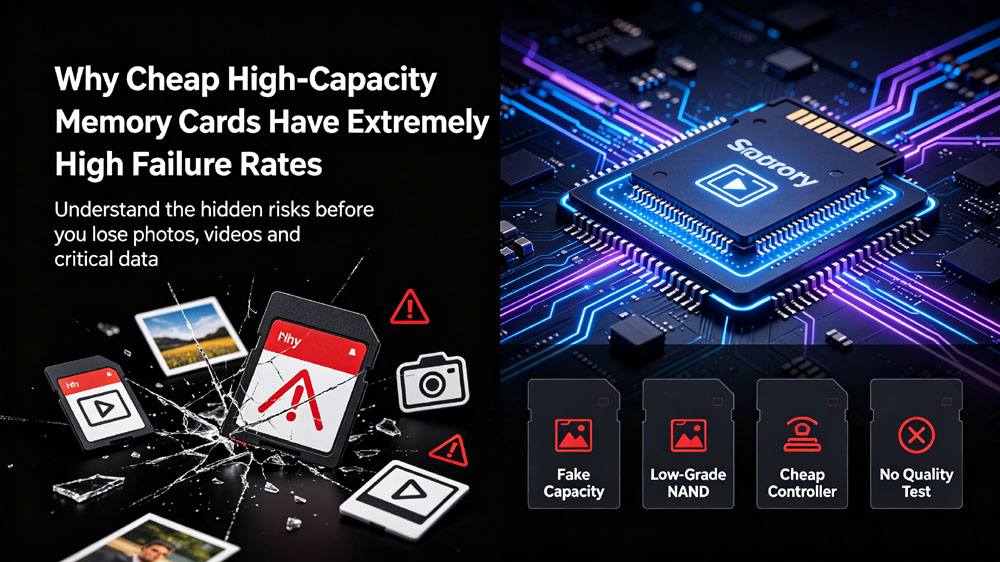
If you’ve shopped for micro SD, TF or SDXC cards online, you’ve definitely seen eye-catching listings: 512GB or even 1TB memory cards sold at 70% below brand-name prices. Many buyers grab these budget high-capacity cards for dashcams, drones, action cameras, smartphones and surveillance cameras — only to face sudden file corruption, unreadable storage, missing footage, or total card breakdown within days or weeks.
1. Fake Expanded Capacity (The Biggest Scam)
The top cause of cheap memory card failure is firmware modification — also called “expanded fake capacity”.
Unlicensed small factories rewrite cheap controller chip firmware to trick phones, cameras and computers into reading a much larger advertised size than the actual physical flash storage inside.
- Example: A card labeled 1TB only contains a genuine 32GB or 64GB NAND chip.
- What happens when you use it:
All files saved under the real capacity work normally at first. Once you cross the true storage limit, new data silently overwrites old photos, videos and documents without any warning error. Your wedding footage, travel shots or security loop recordings disappear permanently, and overwritten data cannot be recovered.
- Common failure signs: Sudden “storage full” alerts with plenty of space shown, broken video clips, blank image thumbnails, or the card becoming unmountable after heavy recording.
2. Recycled & Defective Low-Grade NAND Flash Chips
- Recycled flash pulled from broken old phones, tablets and discarded electronics
- Failed factory wafer offcuts with inherent bad memory cells
- Low-end generic TLC chips with tiny P/E erase cycle limits (faster wear-out)
3. Cheap Unstable Controllers & Missing Critical Firmware Functions
- No ECC error correction circuit: Cannot fix minor data write errors, which multiply and ruin files over time.
- Omitted wear-leveling algorithm: Genuine cards evenly distribute write cycles across all memory blocks; cheap cards repeatedly wear the same sectors, creating dead zones fast.
- No spare bad block mapping: Authentic cards reserve hidden spare storage to replace failing cells; low-cost cards skip this feature entirely, so one faulty cell crashes the whole card.
- Weak thermal management firmware: Under sustained 4K recording, counterfeit cards overheat quickly, trigger sudden write shutdowns, and permanently damage internal circuitry.
4. False Speed Class Labeling (U3, V30, A2 Fake Logos)
- Real V30 cards guarantee minimum 30MB/s continuous write speed for smooth 4K video recording.
- Fake “V30” cheap cards only hit 5–12MB/s steady write speed, far below camera recording requirements.
When recording high-bitrate 4K/8K footage, the card cannot keep up with data flow, triggering camera error codes, interrupted recording and damaged video files. Many drones and mirrorless cameras automatically reject these underperforming counterfeit cards mid-shoot.
5. Zero Factory Quality Testing & Loose Assembly
- Loose internal solder joints inside the card shell, causing intermittent connection failures when slightly shaken (critical for moving devices like drones).
- Thin, flimsy metal contact pads that oxidize quickly, leading to frequent “card not detected” errors.
- Unsealed plastic casings prone to dust and moisture damage during daily outdoor use.
6. Compatibility Conflicts With Modern Devices
- Not recognized by new Android phones, iPhones, 4K cameras or surveillance NVRs
- Formatting errors switching between multiple devices
- Inability to support exFAT file system required for storage over 32GB
Older dashcams and cheap action cameras may tolerate faulty cards temporarily, but high-end recording gear immediately throws storage error warnings.
Real Consequences Buyers Face From Failed Cheap Memory Cards
- Irreplaceable personal data loss: Travel photos, wedding videos, baby footage gone forever
- Lost business assets: Drone survey footage, security camera evidence, client video projects unrecoverable
- Extra hidden costs: Re-shoots, professional data recovery fees, repeated card replacements
- Device damage risk: Unstable controllers can corrupt camera internal storage or crash dashcam systems
How To Avoid High-Failure-Rate Fake High-Capacity Memory Cards (Buyer Checklist)
Step 1: Judge Price Against Official Market Benchmarks
Step 2: Verify Certifications & Packaging
- Genuine cards have clear laser-engraved serial numbers, hologram anti-counterfeit seals, and official brand model codes.
- Blurry printed logos, misspelled brand names, plain plastic sleeves without serial scratch-off codes = high-risk counterfeit.
Step 3: Test Real Capacity Immediately After Purchase
- Windows: H2testw (writes & verifies full capacity to catch expanded fakes)
- Mac/Linux: F3 disk test utility
- Android: SD Insight app to read original chip CID vendor ID
If the tool returns capacity far lower than labeled or mass error warnings, return the card instantly.
Step 4: Match Speed Class To Your Device
- Dashcam / 1080P recording: U1 V10 minimum
- 4K drone / mirrorless camera: Must pick U3 V30 A2 certified genuine cards
Avoid buying “high capacity only” without checking speed ratings first.
Step 5: Purchase From Authorized Official Sellers
Final Summary
The extremely high failure rate of low-cost large-capacity memory cards stems from fake expanded firmware, defective recycled flash chips, underdeveloped controller hardware, false speed labeling and zero quality control. While these cheap cards seem like a money-saving deal upfront, the risk of permanent data loss, wasted time and repeat replacement costs far outweigh the small price discount.
For any important recording, photography or surveillance usage, always select certified genuine SD/micro SD cards from reputable manufacturers and complete a full capacity test right after receiving your order.